I’m grateful to Dr Nathan Williams for sending me a link to this study he carried out as part of his doctoral research on the diets of Red Foxes in central southern England.
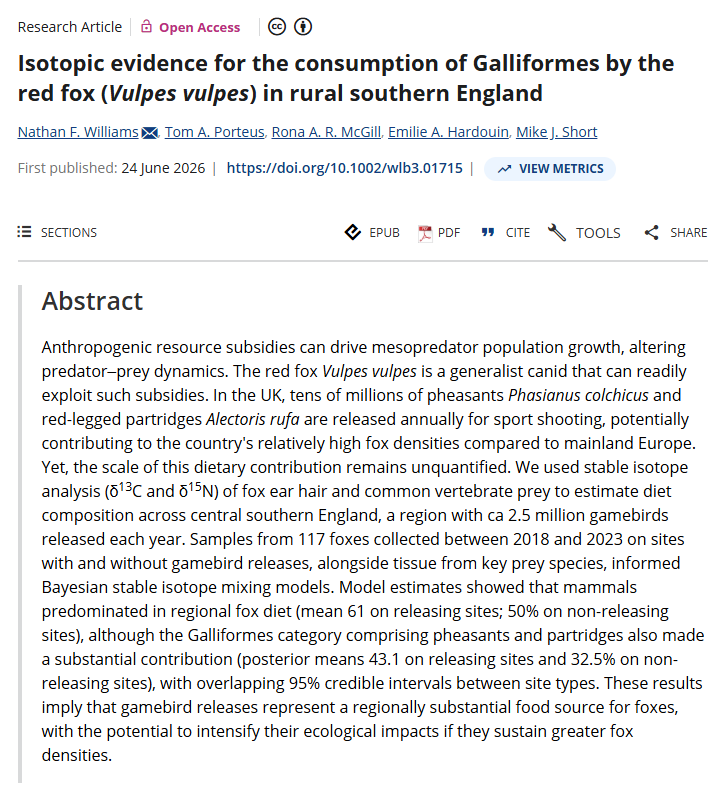
Once I got past the phrase “Anthropogenic resource subsidies” which are non-natural sources of food made available deliberately or unintentionally by people (eg, in the case of Red Foxes, food in gardens, landfill sites, millions of yummy gamebirds released for shooting) then we were away.
Mammals are the most important prey items for Red Foxes but they eat a lot of gamebirds too. The gamebirds might be slightly overestimated through confusion with poultry which might be caught by the Red Foxes or might turn up because Red Foxes have the delightful habit of eating dog poo and the dogs may have been fed dogfood with chickens as a component.
Gamebirds are in the diets of Red Foxes in areas of gamebird releases and not, but since gamebirds move around and so do Red Foxes it would always be difficult to pin down the diets in this way.
All is based on stable isotope analysis comparing the ratio of isotopes in Red Foxes (measured from ear hair clippings) with the ratios in potential prey in the areas (by a means too complicated for me to understand except in general terms).
An interesting approach which pretty much shows what one might have expected but is nonetheless valuable as confirmation.
[registration_form]
I met a Grouse moor keeper on the edge of Geltsdale and had a chat. He thought I would be upset in what he had in his box – 9 ,10 day old fox cubs which he had just killed along with the Vixen. I said to him ‘I bet you did not find 1 Red Grouse by the earth’ and he replied ‘No, all pheasants’. A new pheasant shoot had just been formed down the valley! Like all good predators, they will take what’s easy!
“Grouse moor keeper on the edge of Geltsdale”…now there’s a topic for you to write a book!