The author worked in my directorate at the RSPB for many years and so I know him and I know he knows this subject well. I didn’t know that he could write as well as he does here, though.
Simon admits to being a town planner in his first words in this book and he is rightly proud of his profession while this book demonstrates that planning can sometimes fail us and sometimes deliver the best possible outcome. Any decision-making system depends on the people involved with it and wildlife has benefitted from having Simon, and others, to look out for its needs and ensure it gets, sometimes, the protection it deserves.
The author’s introduction sets the scene very well for a host of case studies about what can only be called planning battles. The first in this book is the possibility of an airport being built in north Kent or in the Thames Estuary – a daft idea that has been resurrected many times only to be dismissed by the planning system every time (so far). I was involved in some of that work and Simon’s account is clear and accurate and covers the history of events and the details of them in a very accessible way. When this daft idea comes back again, which it probably will, then everyone should read Chapter 1 in this book to remind themselves of why it is never going to be a good idea.
Following chapters deal with HS2, road schemes, barrages, windfarms, housing proposals and some examples of good planning decisions allowing development and the survival or even the enhancement of nature alongside that development.
In the pages of this book the planning system seems much more intelligible than it does in others’ hands or often in real life, and that’s because the author is a professional who has seen a lot of the world of planning and understands it so well that he can portray it to the rest of us very clearly.
The planning system may seem dull, it may even be dull, but nonetheless it is important for our lives as citizens and for our lives as nature enthusiasts. This is a book that deserves a wide readership.
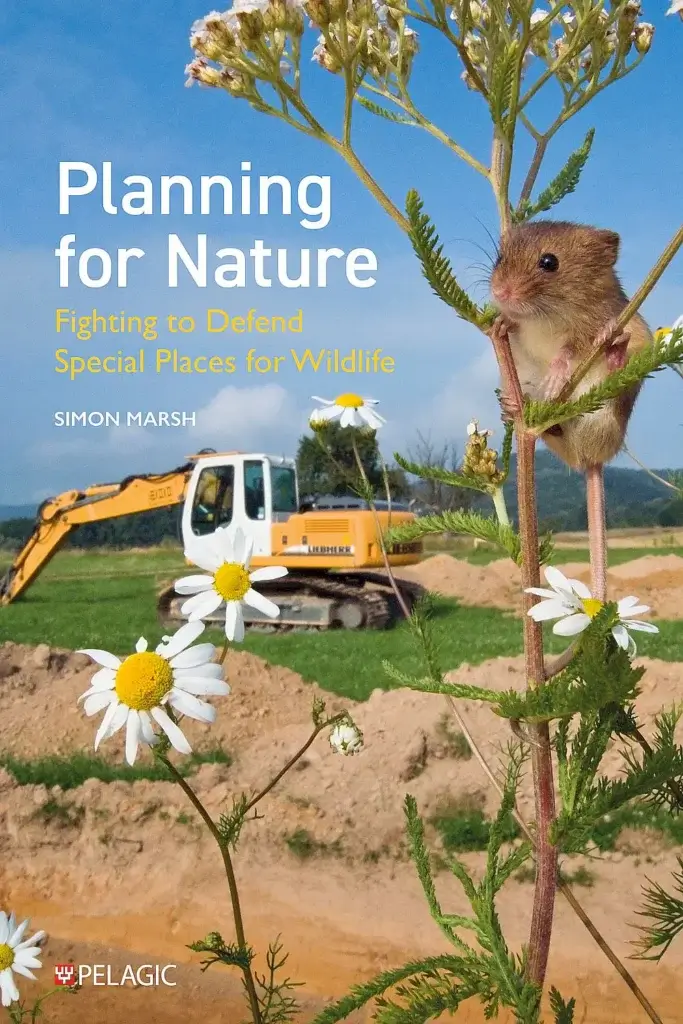
The cover? I’m not that keen on it although I’m not entirely sure why. Maybe it’s because the white petals of the foreground flower look as though they merge with the white on the digger and another forms a little roof on the far background tree. The subtitle in yellow may look fine on a screen but tends to disappear into the blue sky on the cover of the actual book. I’d give it 6/10.
Planning for Nature: fighting to defend special places for wildlife by Simon Marsh is published by Pelagic.
You could buy this book from Bookshop.org and I have set up a booklist to make that easy through this link https://uk.bookshop.org/shop/MarkAvery Disclosure: I am an affiliate of Bookshop.org and I will earn a commission if you click through and make a purchase
[registration_form]
You are too generous to the cover – it’s amateurish and 3/10 at the most! But the book seems interesting – thanks for reviewing.
Martin – thank you!
I actually like the cover. The imposing image of a Harvest Mouse against the stark background inferring vegetation clearance. Thus illustrating the conflict between development and nature, but perhaps where ecologists haven’t been involved in any pre-application work!
It begs the question, how did this scenario arise and why? And should it? Which presumably the book goes some way in addressing.
Richard – excellent. Thanks.
‘The planning system’ is often held up as an unreasonable barrier to economic development and prosperity but we should be very suspicious of anyone who seeks to give developers a free hand in what they build and where. Of course, development of one kind and another is needed and we should not want decisions on these developments to be simply bogged down in administrative process but reform of the planning system to make it more ‘efficient’ should never be allowed to become a trojan horse for ushering in a light-touch, anything-goes approach that enables development that we might regret for decades. Simon’s profession may be dull, and may sometimes fail to get things right but it is certainly essential and I look forward to reading his book.