I’ve never been to Italy despite the food and the culture, and that is partly because I was rather of the mind that it wasn’t a great place for wildlife. I think that may have been based on an overly bird-centric view of wildlife as Spain, Greece and the former Yugoslavia exert stronger pulls for the birdwatcher.
This book put me right on the rest of wildlife (ie most of it!) because Italy has more species of animal than any other European country and a host of endemic plants and animals. The book starts with a charming tale of the discovery of one of them in a stream by the author and his son (mostly his son actually!).
There is quite a lot of geology in this book and, although all that heaving and sliding and volcanism have shaped the landscapes of Italy, those parts of the book didn’t make the earth move for me.
The chapters have one-word titles such as ‘Ice’, ‘Island’, ‘Fire’ which hint at their contents but which at first irritated me because they don’t really signal what is coming. I shouldn’t have worried, the stroll in the mountains by a guy called Benedict, in ‘Refuge’, led to Monte Cassino, Pliny and much more. ‘Abundance’ is mouth-wateringly tasty. ‘Water’ introduced me to the clear waters of Posta Fibreno and the Tirino but also to pollution and dams. Each chapter is different and satisfying in a different way.
‘Island’ was fascinating and included some, I admit, necessary geology in the accounts of past and current wildlife on past (e.g. Gargano and Tuscania) and current Italian islands (including Sardinia, Elba and Montecristo). Gargano, now a peninsula not an island, once had a large flightless goose, an enormous barn owl and a very large hedgehog-related insectivore, whereas Tuscania, a former large island comprising parts of Corsica, Sardinia and Tuscany, was home to the primate Oreopithecus bambolii. The current Tuscan archipelago is the largest protected marine area in the Mediterranean and in 2021 was added to the IUCN Green List of protected areas because of the excellence of its management and conservation. I didn’t know any of that and I enjoyed reading about it all.
This book is the first by the author and it was a joy to read once I relaxed into it and went with the flow. It doesn’t make a case that Italy is great for birds, maybe they have all been shot, but who needs birds if one has Michelangelo, the Academy of the Lynxes, olives and endemic salamanders? If he writes a second book, I’ll read it. And this book will be in my top 10 books of the year come late November.
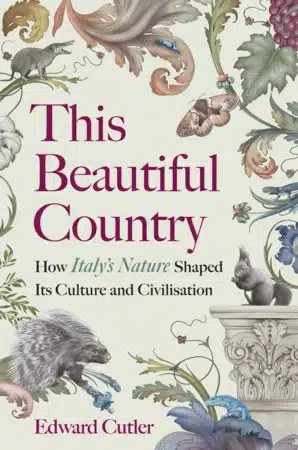
The cover? Yes, that is beautifully appropriate and quite enticing. I’d give it 9/10.
This Beautiful Country: how Italy’s nature shaped its culture and civilisation by Edward Cutler is published by Chelsea Green.
You could buy this book from Bookshop.org and I have set up a booklist to make that easy through this link https://uk.bookshop.org/shop/MarkAvery Disclosure: I am an affiliate of Bookshop.org and I will earn a commission if you click through and make a purchase
[registration_form]
It was the 6000 villages abandoned that got to me. Not moved by wealthy land owners like Scotland but by wanting jobs or emigrating! It has doubled its tree cover by natural regeneration now full of Bears and Wolves. Compare to modern Britain – the rich are buying up the countryside sending the poorer to the towns due to country house prices! Schools look like closing as many of the newcomers are semi retired or retired! Will your beloved Labour do anything at all for changing the balance?
John – thank you. That’s ‘my beloved Labour’ from which I resigned as a member more than 18 months ago? Please try to keep up! But I might consider rejoining.
Dear Mark, thank you for the very generous review – my first! Geology can indeed be a bit of a slog, as it was for me at first, but I hope it underpinned what came later. We do have some wonderful bird watching areas close to where I live in the Maremma (Orbetello lagoon and lake Burano hosting flamingoes and a wealth of migratory birds, plus now a colony of Bald Ibis that have learnt to migrate there following a microlite from Austria) so if you ever do decide to make a first trip to Italy I’d be delighted to welcome you and show you round. Thank you again!
Edward – hi! Thank you for writing such a good book. I’m sure you will get lots of good reviews (and some bad ones – it happens to all books) and I’m glad to have got in there first!