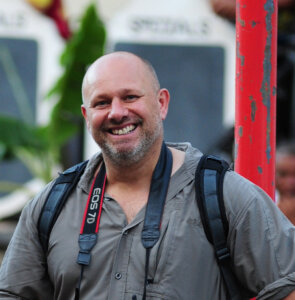
David Higgins works in conservation. He has lived and worked in the Falkland Islands, St Helena Island, India, The Skerries, the Yorkshire Dales, the North Pennines and now the Wiltshire Wildlife Trust. He loves islands especially seabird colonies, where he enjoys his main passion of wildlife photography.
I spent nearly four years in the Falkland Islands. The seasons and storms were matched in their ferocity by the incredible wonder of the wildlife. On Saunders Island I woke up when an albatross landed on my leg. On North Island I accidently surprised a Southern Sea Lion while carrying out peat surveys. It took a nip as it made its escape from my incursion. The bruise lasted two weeks, a fading reminder that behind every pedestal there may be teeth.
At the base of Settlement Rookery, on New Island, a rogue wave nearly took me to sea to join the penguins. On the beaches of Sea Lion Island, I stood close to beachmaster Southern Elephant Seals knocking ten bells of blubber from each other, waves of fat cascading down their bodies like earthquakes. Brown Skua and Johnny Rooks have swooped at me. I’ve been stopped in my tracks by gusts of wind, sand blasted on Yorke Bay, watched the Milky Way in minus fifteen degrees when the air turns clear as the thinnest ice.
The islands are surrounded by cold seas, currents drawn straight from the Antarctic, creating a miracle ecosystem rich with squid and fish. With near pristine seas come the seabirds and marine mammals. Commerson’s Dolphins, Peale’s Dolphins, Southern Elephant Seals, sea lions, fur seals, Sei Whales, Southern Right Whales, Humpback Whales, albatross, penguins, cormorants, sheathbills, Sooty Shearwater, prions in their millions and millions. Just like the Milky Way the sheer wealth and vast biomass of wildlife dwarves you. The Falklands I love are rich, an ecological haven in a messy world.

The people are some of the most capable I know. Practical, intelligent, good company, passionate. Over sixty nationalities inhabit the islands. In a population of less than four thousand that astounded me. The people, like the wildlife, are rich in diversity. But there are always threats to beauty and the hazards always come from the small group of ‘too much and never enough’ that see money in landscapes and don’t care what they destroy to get it.
Cue the open-pen salmon farming champions that have sized up the waters of the Falklands and digested the vast amount of money they can cheat from these pristine seas. These marine nets hold in thousands of salmon, in strings of welfare-diminished cages, but let the excrement and chemicals out into the marine environment. Given that the industry has smothered most available sites and are facing significant opposition to continued salmon farming or expansion, the Falkland Islands are one of the few remaining places they can locate. The majority of the islanders find this an abomination. They have made their feelings clear. The free press highlighted the issues. Before the election the prospective Members of the Legislative Assembly said no. Then the government said no. There was no ambivalence but Unity Marine, the salmon farming champions, still ‘see a powerful opportunity to shape a world-leading aquaculture industry…in the Falkland Islands, one that sets new global benchmarks for quality, sustainability, and innovation.’ Of course that’s nonsense as has been seen around the world.
The salmon farming industry has sucked money from every country they could get a hold in and left behind a disaster of pollution. They sink to as low a place as they can get away with. The cheapest possible place. They tell you what they want you to hear and hide the reality behind a cloak of industry secrets and commercial sensitivity. All the while the seabed is smothered in dirt, creating vast dead zones. Chemicals and antibiotics are dumped into the aquatic environment. Dissolved wastes follow the currents sending plumes of pollution into the sea.
Then there’s disease and parasites, and to stretch this to an analogy, the business sucks all the profits out of the local and national economy back to faceless multi-national shareholders. There is no altruism. They degrade the sea and take the money. It’s a modern Tragedy of The Commons pursued by greed and a wanton disregard for opposition or wildlife.
Louise Cherrie, a consultant and former member of the Tasmanian Environmental Protection Authority and Marine Farming Review Panel, recently visited the Falklands. She gave an overview of the experience in Tasmania. She highlighted that those in opposition to the industry will be labelled activists, eco-nuts and cranks. That the industry has a well-planned attack filled with misinformation and lies along with legal threats and employing the ‘right’ local people. This has already begun in the Falkland Islands. Unity Marine is part owned by a Falkland Islands company which has busied itself hiring ex-government staff including the ex-Chief Executive and the ex-Director of Fisheries. People that know and understand how the government works and have taken the dirty shilling.
It’s impossible to know if they’re smitten with the idea of salmon farming, want to diversify a limited economy or are just enjoying a good pay day. Not that any of those are mutually exclusive. But what they clearly don’t care about is the wider community who are against open-pen salmon farming. They also can’t care about the waters surrounding the islands, one of the few near-pristine ecosystems left in the world and among the very best of the UK and the UK Overseas Territories. They can’t have accounted for the potential knock-on impacts to wildlife, tourism or the fishing industry. Of course, there’s a chance they’ve been employed for their skills in other areas.
Louise Cherrie highlighted the mess and pollution that will occur if this industry is allowed to commence. The nutrient discharges from the proposed 50,000 tonne salmon industry would be the same as the nitrogen discharge from over 2,000,000 people. And this figure is the first proposal, once the door is ajar the industry will inevitably push for more. Up to 85% of the salmon waste would be dissolved and couldn’t be captured. The solid 15% will smother the seabed. Drifts of pollution will cloak coastlines, killing kelp stands and jeopardising the survival of fish and squid and their eggs and larvae. This would impact the Falkland Islands fisheries, and the ecosystem of seabirds and marine mammals that rely on these species for food.
Further south in Antarctic waters the pressure on krill fisheries would be increased as masses of them are stripped to be added to the salmon food stock. Then there are the high chemical and antibiotic use, risks to biosecurity, the disease, mass mortalities, escaped salmon feeding on native species, sea lion deaths, constant light pollution impacting seabirds, particularly those at the critical stages of fledging and migration. It doesn’t matter what the industry tells local communities; the reality is always a disaster.
And the play book continues. The Falkland Islands Government were taken to Judicial Review by the salmon lobby for saying ‘no’ in the wrong way. Given better legal representation the Government may have won but as it turned out they lost. The free press had its freedom taken away with the threat of legal action for making supposed allegations of bribery, insider dealing and secret agreements between Fortuna, the Falkland Islands partner to the overseas company, and officers working for the Falkland Islands Government. These allegations were never made, but a small press cannot afford legal action and so that avenue of free speech was silenced. Soon the most vocal people in opposition will be labelled and dismissed by the industry. The salmon farming lobby will push and push and divide and use all the weapons available to them; lies, abuse, threats, co-opting, bribery. The recent all paid for ‘fact-finding’ trip for the Chamber of Commerce, and other invitees, is an example. The idea that the people invited on the trip would have seen anything other than a stage-managed deceit is laughable and of course the subsequent trip report was positive about salmon farming. But it was always going to be.
A recent post on the ‘Salmon Free Falklands’ Facebook page titled, ‘They Never Stop Taking You to Court’ highlights salmon farming companies taking the Canadian Government to court for not renewing licences for fifteen salmon farms in British Columbia. They take you to court at the start and at the end and everything in-between and all the while they pollute your environment. But the threats aren’t all external. The present Falkland Islands Chief Executive has argued the Islands can legislate themselves out of a problem. That they can accept salmon farming and apply the oversight that will ensure it’s clean and safe. Despite that other, larger and better resourced, countries have been unable to do this, she is adamant that the challenge can be met. How do you debate or reason with that level of hubris?
Once it’s there it won’t leave easily. The industry will continue to grow till all available sites are utilised and the ecological debt will grow and grow and grow. The clarity of the seas that allow you to peer into the underworld of sea lions and dolphins will turn as opaque as the industry. The haven of prions, pinnipeds, penguins, cetaceans and albatross will become impoverished.
This is the ecocide far sighted governments are looking to make a criminal act, Scotland ahead of the crowd on this. And it’s all for the greed of a dirty industry and the people that fuel it. If this happens the Falkland Islands community will look back and wonder what they could have done to prevent this from happening. But what more could they do? They’re running a local scale campaign against a filthy and rich multinational industry that steamrollers opposition. Louise Cherrie suggests they’ll offer a small-scale trial next knowing that such a trial could never reveal the true horror of large-scale open-pen salmon farming and so would offer further ammunition to their lies.
Open-pen salmon farming would be an unwelcome venture in pollution that would trap the Falklands into a decades long con and a failing marine environment. I can see a future where they look back to the days the sea was clear and pristine with anger-tinged nostalgia. The same nostalgia I feel for the reed buntings and skylarks that used to exist in the fields behind my childhood estate and the astonishing urban commons that became a housing estate. But it’s worse in the Falklands, those fields near me were never even close to pristine.
[registration_form]
Thank you for sharing this. I am Tasmanian and therefore know of the malign influence of salmon companies.
Thanks Ian, the Tasmanian experience is helping the Falklands community stand up and try to stop the industry getting a foothold
Well said David, & thank you for speaking up about this travesty.
A couple of points to add to your excellent piece..
The fifty thousand tons production figure is merely a starter..
There are already noises & the will, to want to push that to 200,000 tons as quickly as practically possible, & if it can be done… 250,000 tons.
What is becoming more obvious & reprehensible is the speed at which the narrative is changing, from the company proposing this concept, & the so-called ‘knowledgeable industry experts’ that they have dragged into the mess to promote their sewage industry..
Yes, it IS potentially possible & practical by now, for them to have developed efficiencies that minimise food waste as its fed out, but the food still becomes effluent.
But it is the scourcing of that food to make the feed, that we need to be mindful of too & the unregulated pressure on the Antactic krill stocks is already evident this season as the suction dredger vessels have already exceeded any earlier-set limits for a years catch, by some 40,000 tons..
And the additional plant-based element of the feed could only practically & economicall come from South America which straight away puts even more land into de-forestation & agriculture production..
But these foolish soya growers only use ‘plough-in-a-drum’ & direct till land management, which renders vast acreages unuseable after only a few plantings, because nothing will grow back there..
So then, they must cast-around for more land to either sequester from other farmers or even more native forest..
Its imperative that sight is not lost of the side-industry evils that such a business would bring to the Falklands door & it could do nothing other than cause serious global disrepute.
A strong coordinated public voice is going to be essential in the near future to get this critical danger recognised & acted against.
Thanks Nick, I keep looking to see if there’s progress but it looks like things will be on hold till after the elections – feels like can-kicking to me but hard to assess not being there any more. Thanks also for the extra information – especially the overseas knock-on impacts that wouldn’t be visible locally. Knowing you all the, ‘strong coordinated public voice,’ will continue to be heard. Good luck and let me know if theres anything else I can do to help.
Hi Nick, hope all’s well there. Thanks for the extra information and for highlighting the ‘out of sight’ overseas knock-on impacts that many people wouldn’t even realise. The idea the salmon industry would settle for a 50000t industry in the Falklands when they would be able to harvest far more is ridiculous, they simply have no care for the impacts and will push and push as you point out. I keep looking for progress but it seems there won’t be any till after the next election – a typical bureaucratic can-kicking response. Good luck with the campaign and let me know if there’s anything I can do to help.
Mark, you speak with authority, knowing the Falklands far better than me. What was clear to me in my short time there was the risk is too great given the certainty of harm. I have great faith in the strong, courageous and proud Falkland Islanders to stand against the proposal. However, the industry is a law unto themselves, proven by global lived experiences. I note a report from a fact-finding envoy to the Faroes holds it up as best practice. This is a falsehood for open-pen production conveyed by a captured government and community dominated by industry employment. In reality 47% of farm sites are ‘polluted’ or ‘highly polluted’ according to Seafood Watch. Even New Zealand where there is minimal opposition, the reality is the environment can cope due to the relatively small scale at around 9,500t. The 50,000t proposal for the Falklands is abhorrent. Thankyou Mark for your article and continuing to shine a light on the issue. We in Tasmania who live with this unwelcome neighbour stand with you!
Thanks Louise. Mark gave me the platform for the article, which he does for a lot of environmental causes which is greatly appreciated. Your visit to the Falklands, the presentation and articles in the paper, gave me a huge resource to tap in to for this piece – that was really appreciated and I know the Falkland Islands community greatly appreciated your help too. As Nick mentions above the 50000t is just a foot in the door and even though the door isn’t yet ajar they’re already lubricating the hinges to push for more. It would be a disgrace if the FI Government capitulates to the salmon farming lobby. I just hope the campaign against them remains strong – knowing the people involved I feel confident it will. Dave.
Hello. I have just read this blog – yet another depressing story of corporate greed plundering and decimating our natural environment. The most worrying aspect, is the extent to which they are able to use their financial resources and the law to railroad their business model. I have no expert knowledge or opinion to offer, but I started giving a small monthly donation to ClientEarth a few years ago. They seem to me to do very good work, with some success, and so I wonder if they can help this cause?
Hi Tracy, Ill have a look at ClientEarth – thanks for the suggestion and for taking the time to comment.
Cheers,
Dave.