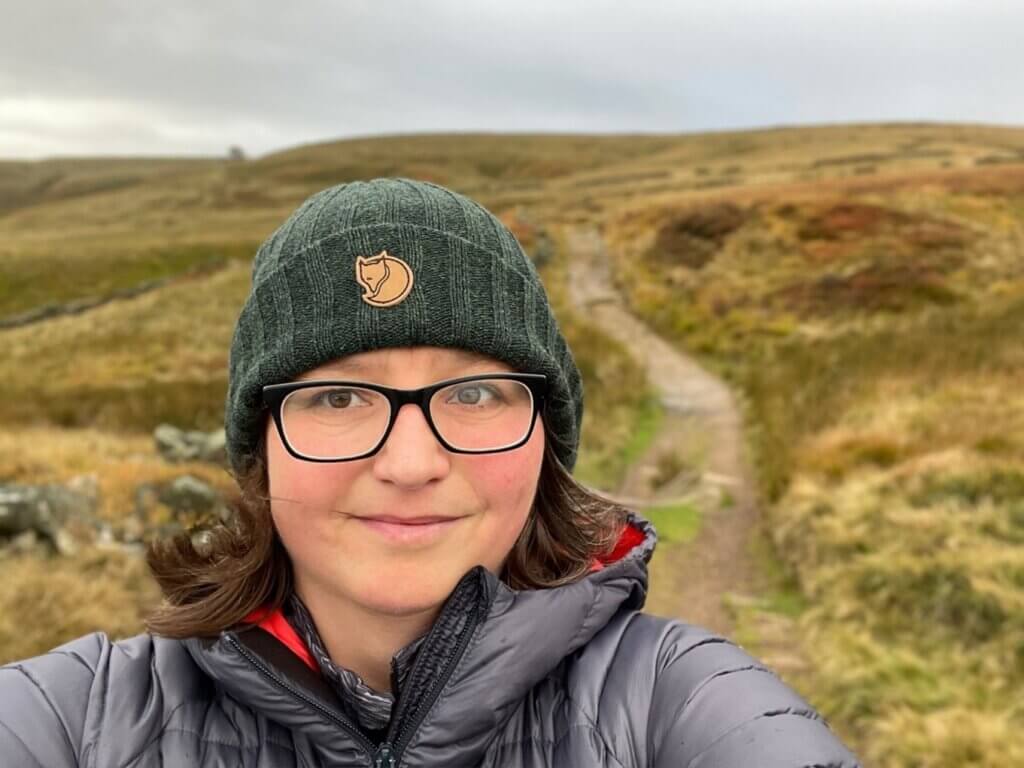
Kate is a photographer and has lived in Haworth for twenty years. Walking on the moors she has come to learn that no two days are ever the same. Her blog about Haworth & Stanbury moors is at www.katietuppence.com. This is her fourth blog in this series about Walshaw Turbines – see here for the whole series.
Turbine 14 Round Hill SD 95291 34566 ///crucially.issues.with

26 July 2025 My aim this morning was to head to the proposed site of wind turbine T14 and write about what I saw on the way. I follow my usual rules: I only describe what I see or hear on the way to T14, and all the photos were taken on the walk.
I set off from Bully Trees above Stanbury following the Pennine Way, past Top Withens before dropping down to the Walshaw reservoirs. Within a few minutes into my walk I spotted a pair of kestrels, the first of many that I would see. Kestrels were overhead for most of the morning. They are a common bird above Walshaw Moor.

The bracken had sprung up over the past week or so and although many people don’t like it, it gives a great landing site for many small birds.
There were lots of reed buntings, willow warblers, meadow pipits and stonechats flitting here and there, pausing every now and then for a photograph. It was lovely to see so many juveniles too: 2025 has been an amazing breeding season on Walshaw Moor.

As I was following the Pennine Way along the SE edge of the middle reservoir I spotted a short-eared owl out hunting. These are now quite a common sight on Walshaw Moor, though they are nationally threatened and amber-listed.

The reservoir was much quieter than I was anticipating. There was a small group of lapwings circulating but no where near as many as I observed at the start of the season and many will have already started their journeys back to their wintering grounds.

There was a handful of oystercatchers down at the reservoir too and I could hear the odd curlew but didn’t see any.

I always feel a bit melancholy when the ground nesters head off after the season. I love them being here. From March to July the moorland’s a hive of activity full of chicks and new beginnings.
The sand martins are still here, but no photographs because they’re far too quick for me. I stood and watched them for a while, darting through the air, this way and that. And then I headed off up the Greave Clough to the proposed site of T14.
After the Pennine Way, this feels like a remote place despite the good track that the 12-metre-wide CEP spine track will follow if it is built, four times the width of the present track.

I try to formulate a time lapse in my mind of how it would have come to be. A glacier would have definitely passed this way, forming the U-shaped valley I’m in that the sometimes raging stream has deepened to a V. There are erratics scattered about and the Mere Stones up above me have glacial striations.
When I reach the site of T14 I decide to make myself a coffee and think about our ancestors being here, before the industrial revolution, before the first settlements even. Sat with my stove on I think about them sitting round a wood fire. I wonder what they would think of the mess we have made.
T14 is a strange site. It seems to be on the side of the hill. If it was on the flat top of the ridge just a minute above it would be right on top of T40. None of the other sites I have been to have looked like this.

I hear a kerfuffle above me. A kestrel is attempting to mob a buzzard. It’s a bold manoeuvre. Then over in the distance I notice another bird of prey approaching, probably like me curious to know what is going on. I think it’s a kite, which are becoming more common on Walshaw Moor.
So above me as I’m sat having my brew is a kestrel, a buzzard and a kite. I fired off a few shots, not the best, but a document in time if nothing else.


After I’ve finished my brew and had a buttie I head off back home across the tops. I stop off at the field near the plantation over Stanbury way, hoping for a last sighting of the Curlew family I’ve been observing all season. I sit for a good half hour or so waiting before deciding to head off: ‘I’m too late’ I think to myself.
But then I hear him. I look up and there he is stood on the wall. He stays for 10 seconds or so as I stand and watch him, then he is gone. I smile to myself. ‘Until next year my feathered friend.’

+++++++++++++++++++++++++++++++++++++++++++++
This is the 42nd in a series of guest blogs originally based on the 65 wind turbines which Richard Bannister planned to have erected on Walshaw Moor. Turbines 5, 6, 8, 8CEP, 9, 11, 13, 14, 16, 17, 20CEP, 21, 21CEP, 25, 25CEP, 27, 29CEP, 31, 32, 33, 33CEP, 34, 35, 36, 37, 38, 40, 42, 42CEP, 43, 44, 47, 53, 54, 56, 57, 58, 60, 62, 64 and 65 have already been described.
The developers have canned their original 65 wind turbines, quite possibly in response to the public humiliation of having their so-called ‘plan’ publicly shown to be damaging, irrational and probably unlawful. They have come back with a plan for 42 wind turbines and the amazing Nick MacKinnon and friends have regrouped and set off on a new tack too. The series continues.
To see all the blogs – click here.
[registration_form]
That’s a beautiful piece of writing. That photo of the curlew is absolutely beautiful.
Hi Kate. Thanks for your interesting blog. I counted 96 Lapwings in your “small flock” photo. Thats not a bad count if it reflects local breeding birds. How do you think Curlews did generally on these moors this year? Did the dry weather have any impact on breeding success?
Hello Kate. Thankyou for a lovely interesting piece. We must fight the wind farm.
Totally agree with John Drury’s comment. Pleased to note a Red Kite up there.