I’ve been meaning to review this book for weeks as I’ve had it on my desk for what seems an age. I don’t know why I didn’t get round to it earlier but I’m glad I finally did because I enjoyed it very much.
We are taken in a dozen chronological chapters from the end of the Ice Age to the new forests of today. There were things that interested me in every chapter. The author has a calm, erudite and convincing way about his writing. I hope he knows what he’s talking about because I believe everything he says.
I hope he is right about the rapidity of the climate change as the ice melted and the land became suitable for vegetation because I now have it in my head that things went from ice to nice in as little as 50 years and it will be very difficult for me to forget that.
We learn of what the Romans did for our forests – quite a lot of clearing – and how they used the timber, and that is how the story of forest cover rolls out chapter by chapter. Each has examples from locations scattered across Britain and so I learned of the role of archeological investigations in the area of south Northants in elucidating the post-Roman resurgence of forest cover. I also found that areas I know reasonably well have ancient trees of which I have been blissfully ignorant. I may look some of them up in future.
The penultimate chapter fills in gaps in my knowledge about the setting up of the Forestry Commission as a result of timber shortages caused by warfare from 1914 and the reasons for setting up a state forestry service to meet the crisis. I use this example in my book Reflections as just part of the rationale for greater public land ownership to meet the crisis of wildlife decline. This chapter, of fairly recent history, is as gripping as the earlier ones of ancient history. I had not appreciated the scale of impact that felling in the 1914-18 war had on forest cover although I should have done.
The last chapter on new forests is quite interesting and brings the story more or less up to date but it slightly fizzles out and there is no bringing together of lessons learned. I got to the end of the text in the last chapter and turned the page expecting more. It’s not a big deal and can be taken as a compliment because I thought the author had a little more to give.
Silly me for not getting going on this book earlier – it’s very good. It’s a tale of what timber has meant to us over thousands of years as our needs have shaped our demands for wood for all sorts of uses. Forests have been sources of timber for buildings, transport, warships, pit props, firewood but also the places where wild animals, outlaws and woad-painted Britons have lived. How do we see forests today? As blots on, or as jewels in, the landscape depending on their form and origin? As carbon and wildlife stores? For recreation or industry (or both)?
We still use timber in a wide range of ways and it has to come from somewhere. This very book (as with many others) is printed on Forest Stewardship Council certified paper which ‘supports responsible forestry’. It will sit in this room with several hundred other books which are on bookshelves made of wood, or on furniture made of wood or are on the floor with only a thin layer of moth-eaten (maybe beetle-eaten?) carpet separating them from wooden floorboards. On the wall are a variety of paintings (some of which have trees depicted) and many of which are in wooden frames. The door is a wooden one and this room (unlike several others here) is covered in wallpaper. I’m surrounded by bits of forest. Have a look around – you probably are too.
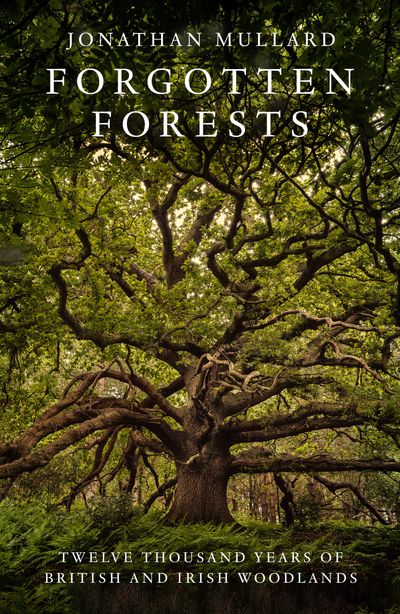
The cover? That’s the Bayfield Oak in Norfolk and it makes this book appear to be about forests and ancient trees which is quite helpful. I’d give the cover 7/10.
Forgotten Forests: twelve thousand years of British and Irish woodlands by Jonathan Mullard is published by William Collins.