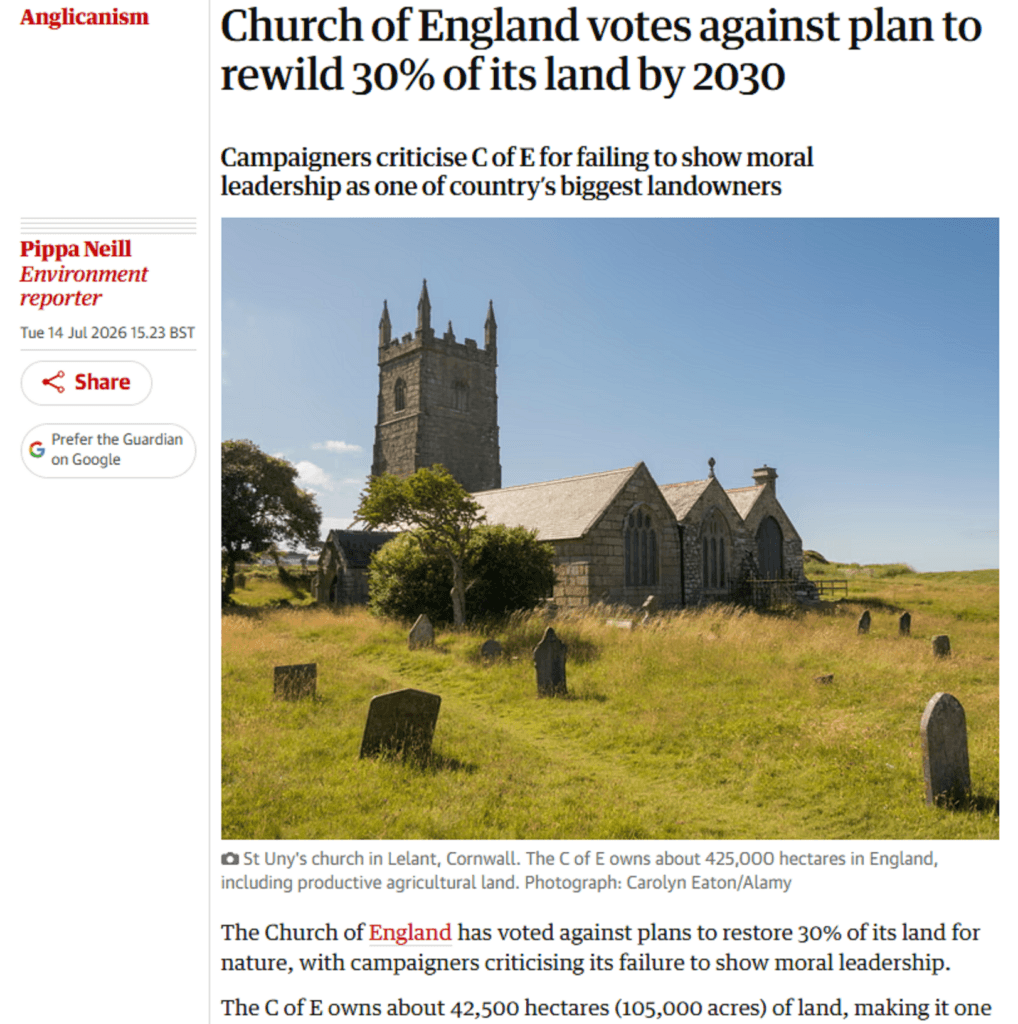
Yesterday I posted a very short blog with links to the Guardian story about a decision on nature conservation made by the Church of England (CofE) and the two papers which formed the background to the decision. I’ll call the first paper the Proposal and the second paper the Response.
The Guardian article
But let’s start with the Guardian article. Did you read it? If you read it, did you think that the article was about rewilding? You could be forgiven for thinking that from the headline but as we all know, headlines are written by sub-editors not by the journalists who write the original stories. The sub-editor has the task of making a headline fit the page and making a headline that will entice the reader to settle and read at least the first few sentences. ‘Rewild’ is an attractive word to sub-editors because it is shorter than any other description of what is going on used in the article and, perhaps the sub will know, a word loaded with baggage that will attract some readers because they are fans of rewilding and attract others because they loathe the idea. Either is fine by the sub-editor.
The article uses ‘rewild’ twice (please check I haven’t missed any). The first , paragraph 3, describes the Proposal as calling for 30% of CofE land to be rewilded (I’ll come back to that) and the second, paragraph 5, notes that the Response has no rewilding targets.
The article talks a lot about 30by30 and nature protection. The international 30by30 target is for 30% of a country to be designated for nature protection by 2030 – it is not a rewilding target. It is mostly a target about protecting the remaining areas rich in nature (and making them even richer). If anyone thinks that rewilding and nature protection are always exactly the same thing then they may have been misled by previous articles by journalists and comments from campaigners because they aren’t the same. However good rewilding is, and I am a supporter, it isn’t the same as nature protection; it is a particular type of activity that occupies one small part of nature protection.
Lest anyone thinks that the 30by30 target is a rewilding target, even a glance at an online encyclopedia will tell you otherwise – click here – it is a mixture of protecting existing sites of high nature value and improving and restoring others (which may include some of what is generally called rewilding) but, again, isn’t the same as rewilding.
And nor does the 30by30 target apply, in any way, to individual landowners. Don’t worry, you do not have to have rewilded 30% of your garden and removed 30% of your house in the next few years. The 30by30 applies to governments and what percentage of land (and sea) they have designated for nature conservation. Most governments are failing to get anywhere near this figure, as is the way with international environmental targets these days.
The Proposal
Paragraph 3 of the Guardian article states that the Proposal calls for 30% of Church land to be rewilded. Does it? Did you read the paper kindly provided by me yesterday? If you did you will find (check to see I haven’t missed any) that it uses ‘rewild’ or ‘rewilding’ once. The once is “Knepp Estate, a 3,500 acre rewilding project in Sussex…” and Knepp is a rewilding project, the owners of Knepp call it a rewilding project and it is a high-profile and pretty successful rewilding project. But that is the only use of the word.
So, if the Proposal doesn’t openly call for the CofE to go for 30% rewilding on its land, what does it call for? Did you read it? It calls for these two things:
a) Recognise the pivotal role that large landowners such as the Church must play in meeting this target and responding to the escalating nature and climate crises;
b) Request the Church Commissioners build on their current environmental efforts and act at the scale required to meaningfully respond to the climate and ecological crises, by committing to protecting nature on 30% of its land – in line with the UN’s definition – by 2030, or the nearest plausible date to it within the Commissioners’ contractual arrangements with its tenants. Specifically:
i. That areas to be protected focus on its lower productivity farmland (classified as very poor, poor and moderate agricultural land), restoring all Sites of Special Scientific Interest to favourable condition, and restoring its fenland peat.
ii. That the Church Commissioners work to practically and financially support tenant farmers to make full use of the new income streams available to them to take the lead in nature restoration.
So the proposal behaves as though the 30by30 target does apply to individual landowners, or at least that individual landowners should consider the possibility that they could behave as though it applies to them in some way. It’s unclear whether the proposal is simply flying a kite or what, but it asks for a commitment to protect nature on 30% of its land, not to rewild 30% of its land.
There are really three asks. First, that all SSSIs are restored to favourable condition. This is definitely something that the CofE should commit to doing. I’m surprised if it wouldn’t commit. Let’s read the Response in a while to see whether it does.
Second, is an ask for restoring its fenland peat. This is very interesting and could be very challenging. If fenland peat is peat in The Fens then it is likely to be farmland, quite possibly Grade 1 agricultural land producing arable crops. I wonder what proportion of the CofE’s land is such peatland – it’s difficult to tell.
Third is to support tenants in using new income streams to restore nature. Why would a benign and responsible landowner not support its tenants in doing this? There may not be very many of them who want to, but would the CofE tell them they can’t restore nature?
The Proposal, to my mind, recognises the issues, the practical problems, offers solutions to those issues and problems and urges the CofE to take the lead. It’s so reasonable, it might almost have been written by the RSPB.
The Proposal, but read it to check, recognises that the Church Commissioners have less than total freedom in that; 2030 isn’t far way, recognised in the phrase “by 2030, or the nearest plausible date to it within the Commissioners’
contractual arrangements with its tenants“; most CofE land is tenanted rather than farmed directly by the CofE and tenants have rights, recognised in the same italicised phrase quoted above and in paragraph 15; that the emphasis should be on the low-grade agricultural land, peatland and forestry in the rural estate, recognised in paragraph 10 and 9 (where the breakdown of land class is very valuable and pertinent); and that, as a charity, the CofE has a legal obligation to use its investments wisely to generate an income, recognised in paragraphs 11-14 which include a link to a legal opinion (which I haven’t read myself).
My reading of the Proposal is that it is reasonable and well-argued but that it isn’t a clear radical call for rewilding 30% of CofE land and no-one reading it could see it in that way.
The Response
The response comes across as rather defensive to me. It gives the impression (I got the impression) that it isn’t keen on the proposal because it will cost the CofE money but that won’t look like a very public-spirited reason to most of us.
The real response to the proposal might have been along these lines:
Whilst agreeing with the ambitions behind the Proposal it erroneously applies the 30by30 approach to an individual landowner’s management of their land whereas 30by30 actually refers to government designation of sites. The Church’s landholding will contribute to several of the many biodiversity targets agreed under the Kunming-Montreal Global Biodiversity Framework, particularly Targets 7, 10 and 16 and should be understood in that light. Considering the preponderance of farmland in the rural estate, much of it of high agricultural value, an approach which produces food with a light impact on biodiversity and reduced greenhouse gas emissions is a better approach than one which sacrifices food production to wildlife and carbon storage. The recently published England Land Use Framework recognises that the optimal land use for the public good will vary with location and capacity to produce different benefits to the land owner and to society as a whole. The Church Commissioners agree with that analysis.
These points are mostly present in the Response but scattered around it in paragraphs 3, 5, 8, 12, 13, 19, 20 and 21 at least.
The Response does bang on about finance whilst ignoring the points made in the Proposal and the legal view. Mammon, or fiduciary obligations, is brought into the argument repeatedly in paragraphs 2, 4, 6, 7, 9, 15, and 17.
Where does that leave me?
I don’t want the CofE to rewild 30% of its landholding for a number of reasons. First, it won’t be very good at it. Second, it is a landholding dominated by high-grade agricultural land and sustainable food production must be the default option.
However, my interest has been sharpened by this event. I wonder:
- how much farmed peat in The Fens does the CofE have, where is it, how close to restored wetland sites is it, and what is the potential for restoring nature and reducing greenhouse gas emissions?
- what is the breakdown of SSSI condition across the CofE’s designated sites and how quickly will they reach favourable condition? Is it quickly enough?
- where are the 22,000 acres of forestry plantations and what is their potential for nature?
- where is the low quality agricultural land and what is its potential?
- what would a map of CofE land look like?
These things are complicated. Did the Guardian do a good job in explaining the issues? Not particularly, because it is written with the assumption that somehow the 30by30 target ought to be something that individual landowners seek to match when it is about protecting the best places not rewilding the worst.
Was the Proposal a good proposal? Not really because it was based on a misconception or a sleight of hand that 30by30 should be implemented by large landowners whereas it is a target for government action. The Proposal shook things up, but didn’t put enough pressure on the weakest points of the CofE’s current position.
Was the Response a good response? It simply made me suspicious, rightly or wrongly, that the Church Commissioners are much more interested in money than God’s creation and that they are using fiduciary responsibility as a bigger excuse for modest action than it should be.
But you may feel differently. However, my view is based on spending a fair time reading and re-reading all three, relatively short, documents and reminding myself about the international targets.
I just wonder how many people actually check the facts behind newspaper articles and what people with a point of view or vested interest say. Do you read political party manifestos? Do you glance at the annual reports of your favourite and least favourite charities? Are you suspicious or trusting?
[registration_form]
Excellent analysis! I read some of the comments on Facebook under a post of the Guardian article and it was clear that most had not read the article much less the CoE papers. This did not appear to deter commenters from holding very strong views on whether or not the CoE was acting in a christian way.
Given that the CoE is such a large landholder in England it is good to at least see the issue of how this land should be managed in the way that best balances production of food with the protection of nature and the environment, being discussed. Hopefully, having aired the subject they will keep it high on the agenda and not just move on to other things and forget about it
I wonder if the C of E employs an ecological expert for advice?
Thank you so much for doing this analysis Mark. I read the Guardian’s article and was a bit suspicious because of the reference to re-wilding. I was planning to do a bit of research and am pleased that you have saved me the effort.
Despite not being a church person, I have been supporting a local Eco Church project. I was not surprised to find that the church community reflects wider society – a small proportion who are passionate about nature and prepared to take positive action and a much larger proportion who profess to care, but are not prepared to do anything. I was surprised to find that despite church-wide initiatives and structures, the resources to do anything positive are very limited. It seems that any proposed change, for the benefit if nature, that requires the expenditure of church funds will always be rejected. I have been told numerous times that the money needs to be spent on the church buildings, but seen little evidence that that happens.