 Conor Mark Jameson worked in conservation all of his career and now lives and writes in west Norfolk. He is also the author of Silent Spring Revisited (reviewed here), Looking for the Goshawk (reviewed here), Shrewdunnit (a collection of his feature articles, (reviewed here) and Finding W. H. Hudson – The Writer Who Came to Britain to Save the Birds (reviewed here).
Birds in England at 100
A hundred years ago in his book Birds in England Max Nicholson called on naturalists to raise their game. Conor Mark Jameson reflects on its context, and its impact.
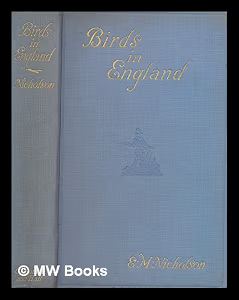
Max Nicholson (1904-2003) was just 22 years old when he published his seminal work Birds in England: an account of the state of our bird-life and a criticism of bird protection. The book was brave and outspoken – a remarkable body of work for one so young – and not yet university-educated. He went to Oxford on a scholarship soon after, to read History.
Nicholson had been deeply impacted by what he witnessed in Germany at the end of World War I, when stationed there. Almost all civilian firearms were banned, and birdlife ‘bounced back’ in apparently remarkable ways, in both numbers and behaviour.
With Birds in England he lit a fire under bird enthusiasts. ‘There are a hundred bird-lovers now for every one who lived even fifty years ago,’ Nicholson writes. ‘Only during the last generation have bird-lovers become numerous enough to be reckoned a force. By the lowest ebb of Victorianism, birds had practically ceased to mean anything to England.’
He was picking up the baton from his hero, W. H. Hudson, who gets a whole chapter in the book. In 1925, while Birds in England was being written, Hudson’s memorial and sanctuary were being unveiled in Hyde Park by Stanley Baldwin. The Conservative prime minister told the large crowd about the increasing need for bird sanctuaries. An appetite for change was in the air. The era of excess and the private collectors – that Hudson had done so much to challenge – was being re-assessed. ‘This day we are helping to draw people’s attention to bird life,’ the PM cried. ‘I rejoice to be allowed to unveil this memorial!’
In his book, Nicholson’s range of targets is wide – and he does not exempt himself from criticism. ‘I collected myself until four years ago,’ he confesses: he had given up collecting at age 18.
Intriguingly, he had originally intended to include a chapter defending collectors against what he thought was excessive blame for the demise of rare species. But he changed his mind on this – and one event in particular led to volte face. ‘The more thoroughly I investigated the subject,’ he writes, ‘the more I was forced to see that … the guilt of the collector has been, and is still, immense’. He describes collecting as a ‘Victorian leprosy’. The turning point was the recent London auction of an egg collection amassed by the late Sir Vauncey Harpur-Crewe. Nicholson looked on in horror at this ‘appalling and criminal waste…’ His description of proceedings is sickeningly vivid.
‘Dumped down anyhow in a series of dirty old cigar and cardboard boot-boxes were enough eggs and enough dusty mounted skins to populate a county with birds. But rarity after rarity was treated by the bidders as rubbish simply because no data had been preserved to authenticate it, and even in the minority of cases where the data were attached, they were far from unimpeachable… Some of the alleged identifications were a standing joke all over the room… meagre details so obviously unreliable … stuffed specimens so badly set up that they were quite worthless…’
The young author captures the essence of a dying age, the gratuitous excesses of the collector era. He was appalled not only by the rarity of many of the specimens held up before an audience largely indifferent to the ethics of it all, but the eye-watering volumes of birds and eggs.
Among the wares displayed, the auctioneer exhorted his audience to bid for the eggs of chough (33), red-backed shrike (75), stone-curlew (24 clutches), Montagu’s harrier (14), hen harrier (10), honey buzzard (11 eggs, including a clutch taken in 1871 in the New Forest, likely among the last British nests), white-tailed eagle (3 eggs, with a note that a female was shot on the nest – the species by this time extinct in the British Isles), and golden eagle (1 egg, that sold for 2 pounds).
Not one of these specimens had ‘done any service to science whatever’, Nicholson rages. This collection was just ‘one example among scores,’ adding to the ‘evil odour which has fallen on the whole business of collecting’.
In an early example of his pioneering survey work, of which he exhorted others to do more, that same year, 1925, he carried out a census of the birds of Hyde Park and Kensington Gardens. Counting 2,600 house sparrows (among the total of 5,000 birds he logged) this study has in more recent years been used as the benchmark for the house sparrow population in the city, and its much-lamented demise. His survey was a little less time-consuming in 2000, when he found only eight.
He was not afraid to vent his frustration with the RSPB, flush with Hudson’s game-changing lifesavings, much needed in straitened times (1926 was the year of the General Strike – things were precarious). ‘If birds are to flourish in England, it has been necessary sometimes to criticise people who are doing, or striving to do, good work for bird protection,’ he explains. ‘My love of birds is greater than my love of bird-lovers.’ He was a critical friend.
For him, the RSPB of the time ‘says too much and does too little’. Rightly or wrongly, he thought it should be doing more to craft better protection laws. As Nicholson worked on his Birds in England manuscript, efforts were ongoing to strengthen these laws. Later in 1925 came the latest in a line of Wild Bird Protection Bill. He wasn’t impressed, calling it ‘surely the most unfortunate piece of legislation since the last one.’ He was not sad when, like its predecessors, it failed. A new and better draft law could be made.
‘It must purge its membership of collectors’ and was hindered by the presence of game-preservers among its supporters. Besides the private collectors there were of course other pressures on birds. He mentions that our islands still had 17,000 gamekeepers. ‘We have extirpated our competent wild ratcatchers and given their work to incompetent human ones’. Nicholson became RSPB President, much later and I was lucky enough to have been present when a modest memorial to him was installed at the RSPB’s Lodge nature reserve, after his passing in 2003.
The good news we could tell Nicholson is that most of the species whose demise he lamented have come back. Even the London sparrow is showing an apparent recent upturn. And recent egg collections don’t sell in London auction houses anymore. It takes time but cultural norms do change. The collectors may largely have died out but clearly there is much still to be done to carry on his pioneering work – and that of quite a few others.
A longer version of this article was published in the November 2026 issue of Bird Watching magazine.
[registration_form]