This book has a laudable aim, to wit to nudge us to travel less in cars, but it’s quite a big ambition in a country with poor public transport, and for a leisure activity where some of the best places are out of town and somewhat remote. But here you will find a variety of outings you can make from a carefully selected 20 towns and cities across England, Scotland and Wales and see quite a range of wildlife. In fact the wildlife laid out in these pages is impressive and I’d like to see it all. Where the book worked best for me was in persuading me that making a day trip into London, from Northamptonshire, might well be worth it to visit Hutchinson’s Bank or Paradise Fields with my Senior Railcard and bus pass. If I do, then the detailed accounts of how to travel, where to go and what to see look as though they will be very useful.
But when I visit relatives in Hull and am gagging to visit Spurn then the alternative to jumping in my car, or in my daughter’s electric car, are to wait until Saturday (as that is the only day it runs, March – November) and get the slow bus to Spurn. And maybe there won’t be many takers for seeing Black Grouse at World’s End where you leave Wrexham just after 6am to travel a few miles by bus and then face a four-mile uphill stomp to see the grouse far less well than those sitting in their cars. And all that is based on you being in Wrexham the night before.
If you start your day in London, Leeds, Bristol, Birmingham or Edinburgh then I can see that this book is very useful as a guide to using public transport to visit urban wildlife sites, and I suspect there are other locations, not included here, where that would be true too.
Compare the ease with which you can watch sporting events and watch wildlife by public transport. Most sporting events take place at designated and often regular times at a limited number of large venues and attract big crowds. Taking the train and then walking (or getting a bus) to the match is commonplace. It’s rather different from how we consume wildlife in our leisure time and given that wildlife is often found at quiet less-visited areas then it’s not surprising that public transport doesn’t always come up with easy solutions.
Those sports fans aren’t necessarily the least bit bothered about their carbon emissions, but society makes their travel quite low-carbon by making sustainable policy decisions. With more such decisions, involving low-carbon energy production then our lives will be lower carbon, but it isn’t accepted in UK politics that that should be what we do, and it isn’t accepted in society that that is how one should vote.
The carbon benefits of personal decisions that many have made involving not flying (or hardly flying), being vegetarian (or almost vegetarian), travelling less, and switching to renewable energy suppliers will dwarf the harm they do by driving to Spurn a few times a year rather than getting the bus. Indeed, many who have made a long list of personal choices that slash their carbon emissions may feel that they deserve to use their cars less but on such activities.
The book is well written and has a wealth of useful detail about toilets (or lack of them), bus times and routes and which road you should walk along, as well as the wildlife you hope to see. And it is clearly and well written too. But often, the clarity and detail just rub it in that this is a relatively hard road to follow.
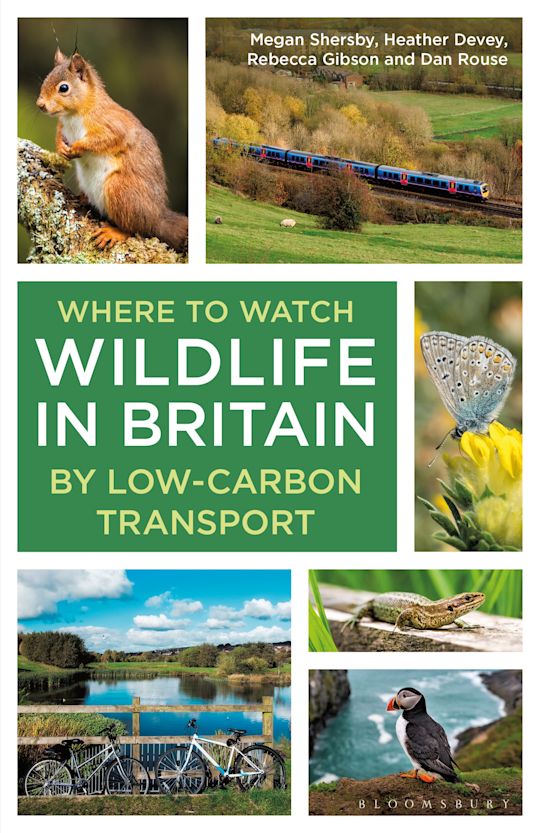
The cover? A train, some bikes and some wildlife – it’s fine but doesn’t quicken the pulse at all. I’d give it 6/10.
Where to Watch Wildlife in Britain by Low-carbon Transport by Megan Shersby, Heather Devey, Rebecca Gibson and Dan Rouse is published by Bloomsbury.
You could buy this book from Bookshop.org and I have set up a booklist to make that easy through this link https://uk.bookshop.org/shop/MarkAvery Disclosure: I am an affiliate of Bookshop.org and I will earn a commission if you click through and make a purchase
[registration_form]
I’ve been thinking about a response for a while. Although I get what you’re saying, the issue is the UK’s terrible car dominated transport system and forced car dependency (which is what you’ve described). As a car-free birder who currently cannot afford a car even if I wanted or ‘needed’ one, I’m well aware of the issues and transport related barriers to accessing nature. I’m also looking forward to getting this book for more inspiration of where to try visiting! Strange as it might sound, I’m glad I challenged myself to not drive (even though I can drive and used to share car with family) because it’s opened my eyes and mind to issues I was previously less aware of and forced me to adapt. Plus, not needing a car for everything is wonderful. Sadly too many don’t have that option.
It’s worth remembering a few things when discussing transport. First, access to a car is linked to income. Here are some lovely visualisations and analysis by Jo Wood :https://observablehq.com/@jwolondon/car-access-and-deprivation
…and the bluesky thread and video linked to it: https://bsky.app/profile/ianwalker.bsky.social/post/3mjjjokb5m22p
As well as income, access to a car is also linked to age (because young people cannot drive & x% older people don’t drive) plus health (some conditions prevent you from driving).
This leads onto the second/third points which is that driving is expensive but also subsidised. In the UK, fuel duty has been frozen (and reduced) since 2011 at a huge cost. If the billions wasted every year just on that had instead been invested in public transport and active travel infrastructure so that people could travel easily without a car… just think what could’ve been achieved! We could have a high quality transport system but the government chose not to. Then there is parking and the weird way people moan about having to pay or “free” (not actually free) parking. Why have we normalised cars being dumped on roads and pavements? I could go on – the true cost of driving/cars to individuals and society is high (e.g. https://www.sciencedirect.com/science/article/pii/S0921800921003943 & https://uk.bookshop.org/p/books/roadkill-unveiling-the-true-cost-of-our-toxic-relationship-with-cars-henrietta-l-moore/7833460?ean=9781394295999&next=t). Why is public transport “for profit” when it should be an essential public service? Why don’t we have a high quality network of active travel routes (for walking, wheeling, cycling) which would bring independence to those who cannot drive, including children? Of course I’m aware that public transport isn’t cheap but again, this relates to the funding or lack of and is still very different from owning a car. This year my main most of transport has been walking including for errands.
Linking back to the first point though, freezing fuel duty helps those who drive more the most. Enabling people to travel without a car would be far more beneficial. Even if all cars were electric, it’s thought a 40-60% reduction in driving would still be required (e.g. https://www.slideshare.net/slideshow/decarbon8-carbon-pathways-workshop-kevin-anderson-aligning-uk-car-co2-with-paris/220917600)
Forth, not all sports fans would find travelling to a match without a car easy for various reasons. Maybe they live somewhere with no or limited transport options, plus x% still drive to the station etc so haven’t really done the trip without a car.
Finally, the most remote ‘wild’ areas (and settlements) in the UK aren’t accessible by car. You do have to park some distance away and walk even to some RSPB sites which lack car parks and are a long way from the nearest road. Also, Kerrera, for example, only recently got a single track road connecting more of the island & community.
Reducing car use has many more benefits as I’m sure you’re aware (pollution, direct & indirect deaths etc etc – motonormativity) but access to nature & nature reserves is an issue that needs tackling and hopefully this would benefit rural communities too if done right.