Tim writes: what’s the difference between a Weasel and a Stoat? I remember the old joke from my childhood about one being weasily recognised as the other is stoatally different but they are not easy to separate unless you get a good view. Weasels are small, from head to tail ranging from 21-27cm including a…
Category: THE PHOTOGRAPHS: by Tim Melling, Oscar Dewhurst, Paul Leyland, Guy Shorrock, Brian Leecey
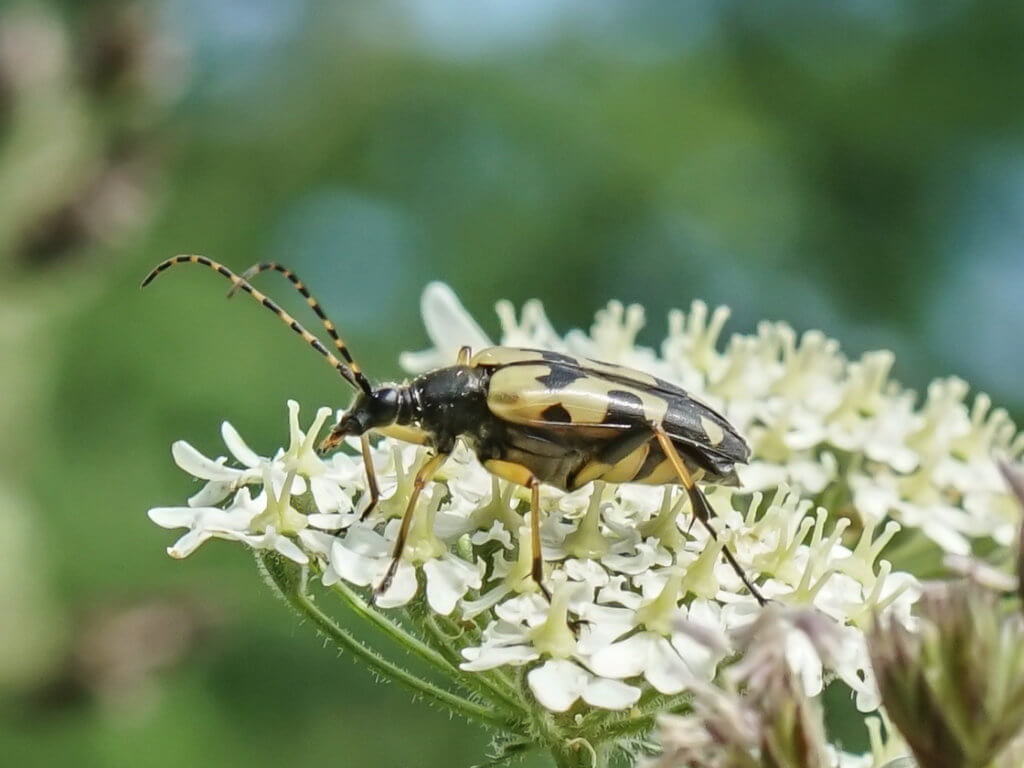
Paul Leyland – Rutpela maculata
Paul writes: I start to see these photogenic beetles around the middle of June and they stay around until the end of August. Rutpela maculata is probably the commonest of the Longhorn (Cerambicidae) beetle family, it is certainly the one I see most often. They are easy to see in the right habitat, their bright…
Tim Melling – Dotterel
Tim writes: this was one I took of an obliging male Dotterel on Lancashire’s Pendle Hill in late April. I was particularly pleased with this shot as you can even see the semi-palmations between its toes which are obscured when it is in vegetation. An old Norfolk folk name for Dotterel is “Stone Runner” and…
Sizzling Sandgrouse by Paul Sterry
Paul writes: If you think the UK has been hot of late then think again: on a recent photographic trip to northeast Spain temperatures peaked at 44°C. The aim of trip was to photograph sandgrouse, two species of which – Pin-tailed and Black-bellied – are present in the region. The height of summer, when water…
Paul Leyland – Volucella bombylans
Paul writes: there are several hoverflies which mimic bumblebees, Volucella bombylans is the most common and widespread. It is also probably the cleverest, as it comes in several colour forms to enable it to mimic a number of different species. This one, with its yellow and white markings, goes with the white-tailed bumblebees, whilst another…
Tim Melling – Black-browed Albatross
Tim writes: It was more than thirty years ago when I first saw a Black-browed Albatross; a lost individual that resided in a Gannet breeding colony at Hermaness on Unst on the Shetland Isles. This one was photographed off the Falkland Islands in the South Atlantic where they breed in good numbers. Many albatrosses have…
Paul Leyland – Grizzled Skipper
Paul Leyland: This is a new butterfly for me in the UK. I’ve seen plenty in mainland Europe but it was nice to find one closer to home. I saw it on 20 June at Lullington Heath on the South Downs in East Sussex. This is a lovely National Nature Reserve which consists of two…
Tim Melling – Hourglass Dolphins
Tim writes: here are two Hourglass Dolphins belting through the water alongside our ship. You cannot quite see the wavy, white hourglass flank marking that gives rise to the name on these individuals. They are only found in Antarctic and sub-Antarctic waters, usually in deep water. We saw several groups coming to bow-ride our ship…
Paul Leyland – Golfclub Duckfly
Paul writes: there is a recent practice for giving previously obscure hoverflies English names, in addition to their Latin ones. Often the names are fairly mundane and don’t really add to the insect’s appeal, however I think this one is great and is likely to make you more interested to look out for one. Anasimyia transfuga is…
Tim Melling – Rockhoppers on the march
Tim writes: these are all Southern Rockhopper Penguins (Eudyptes chrysocome) returning from a foraging trip to their noisy nesting colony in the Falklands. Arthur Cobb, after whom Cobb’s Wren is named, once described the noise of a Rockhopper colony “as if thousands of wheelbarrows, all badly in need of greasing, are being pushed at full…