
Nick MacKinnon is a freelance teacher of Maths, English and Medieval History, and lives above Haworth, in the last inhabited house before Top Withens = Wuthering Heights. In 1992 he founded the successful Campaign to Save Radio 4 Long Wave while in plaster following a rock-climbing accident on Skye. His poem ‘The metric system’ won the 2013 Forward Prize. His topical verse and satire appears in the Spectator, and his puzzles and problems in the Sunday Times and American Mathematical Monthly. Email: nipmackinnon@gmail.com
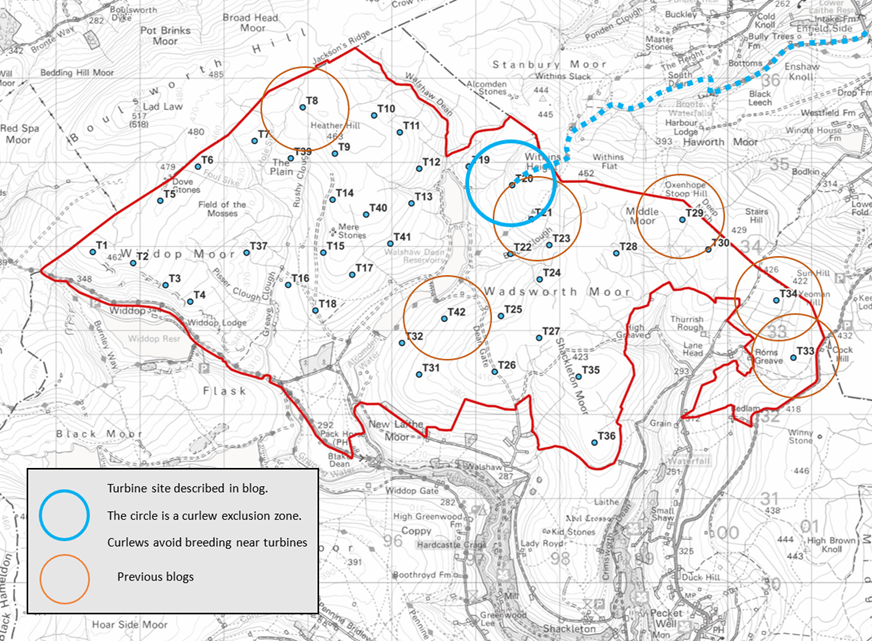
Turbine 20 Withins Height SD 97442 34726 ///zaps.noisy.overcomes
27 July 2025 In this blog we shall let aerodynamics cut CEP to shreds. The wind is always primary in reputable wind farm design. It wasn’t in CEP.
Kate Bush (67) and Emily Brontë (207) share a birthday on 30 July, and Clare Shaw of the Stronger Together Boggarts group has organised a Massed Wuther on Penistone in Haworth, in sight of Wuthering Heights. These happen all over the world, but this is the first under Wuthering Heights itself, and somebody came from Pittsburgh to be with us. The dancers hope to draw attention to the plan of three very rich men to destroy one of the most famous bits of high ground on Earth, in return for money. The dance is hard, and we and our friends have been rehearsing for weeks. Kick, sway, crouch, shiver, push a window, push a window, left hand down the neck …
Walshaw Turbine Research Group (WTRG, who write these blogs) have a formula, “For decades the international nature designations protected Brontë Country from the destructive greed of men like Richard Bannister, Mohammed Dr Ghazi Osman and Christopher Wilson. Now international Brontë Country must pull its weight to protect nature.”.
The day starts early with a dog walk up to T20 past Top Withins. The developers may believe T20 is hidden behind Withins Height from the internationally famous receptor at Wuthering Heights but half the pylon, the hub and all three blades are visible, and so many people come here from Japan that the signpost says ARASHI GA OKA.
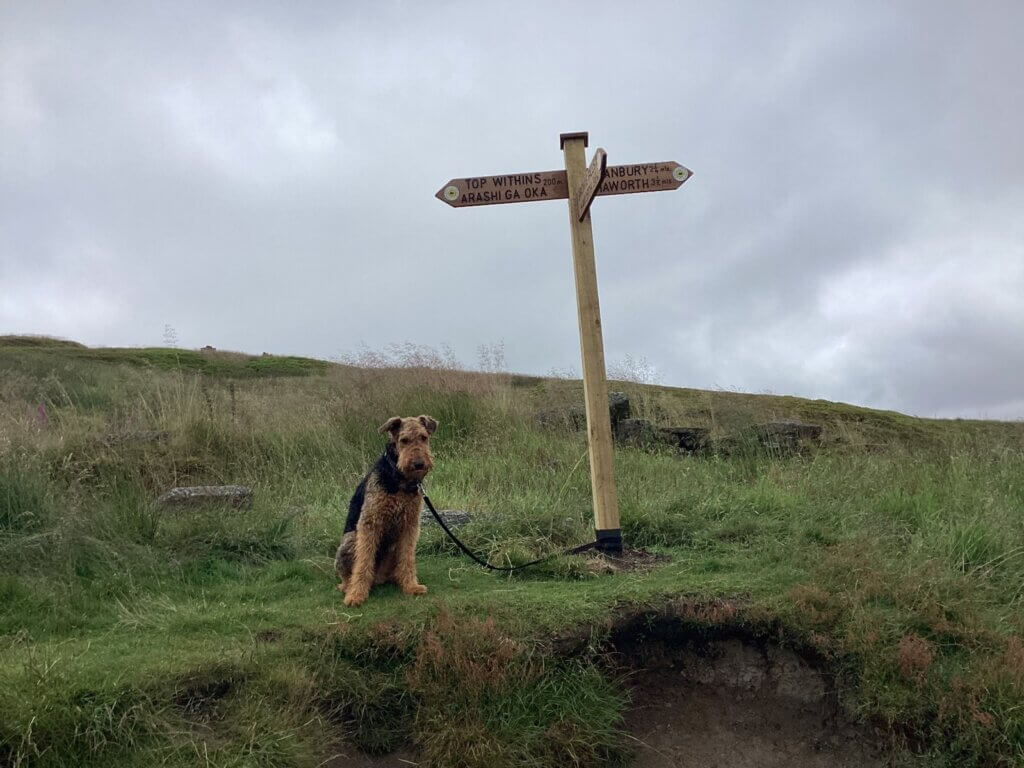
Back home, the dog refuses to get into his red dress, and to be honest he has been struggling with a couple of the dance moves too, so he is left behind with Soothing Classical for Pets. We arrive early to put up banners, but the huge carpark is already full. I turn to Lydia in wonder and relief. “It’s a success!” After an hour of rehearsal, we dance a perfect performance with no prompts. A BBC 4 drone takes footage for a documentary on choreographer Linday Kemp, a graduate of Bradford Art College and mentor to Bowie and Bush, which will be broadcast in November. There are lots of press and the Getty photographer takes what will be the standard photo accompanying newspaper reports on Calderdale Energy Park hereafter.
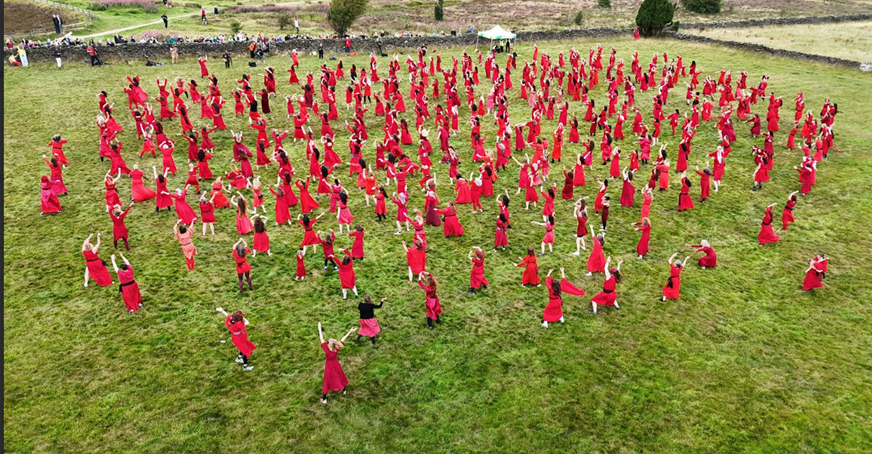
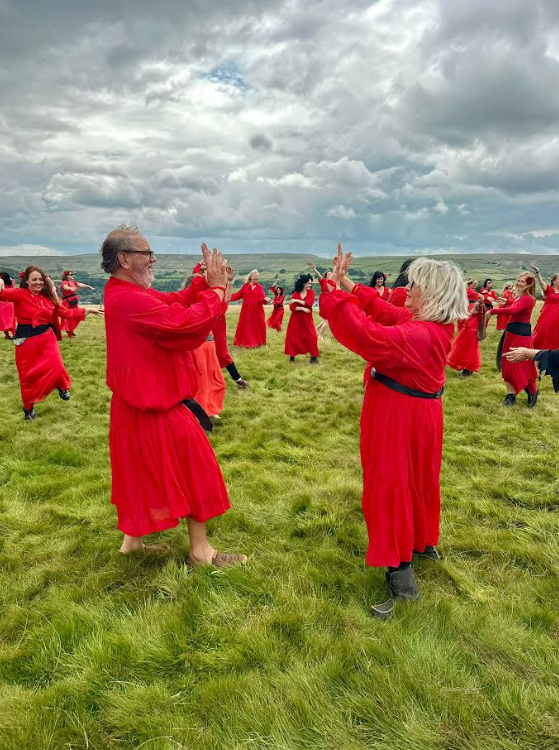
This event has been long planned by poet Clare Shaw, and it was sensational; the happiest day of the campaign so far. Poets and artists met in January 2024 to work out how to stop CWF Ltd. I envisaged this series of turbine-by-turbine blogs, Lydia started the Worth Valley campaign, and Clare began to plan the Wuther and the Book of Bogs. Lydia’s meeting in Haworth was addressed by Mark Avery and Robbie Moore M.P. got a lot of things moving. Our legal team were interested members of the audience. Don’t mess with poets. As Project Director Christian Egal says, “The opposition are unusually capable.”
A legal letter from Christian Egal always brightens my day. The latest (23 July 2025) comes from further up the food chain in his legal team and is thrillingly weird. It is the hallmark of the insecurity of CWF Ltd that when making corrections to earlier mistakes they always offer some chippy comment hoping to show that they know what they’re doing. “The position of T38 has not been changed.” These are the priceless extras that we love most. The latest has a goldmine of answers to questions that I have never asked, riddled with astonishing ignorance of the client’s proposals. We shall go through them another time or we’ll never get to aerodynamics.
The WTRG case is that the six-week “non-statutory consultation” was unlawful. Under the Gunning Principles a consultation must allow the public to give the proposal “intelligent consideration”. The CEP proposal is so far from being a credible wind farm that Christian Egal himself had not given it “intelligent consideration”.
The CWF Ltd lawyers are struggling with the simplicity of this argument. The side of it they won’t touch is the actual CEP proposal because they can smell it is rotten. They correctly judge that WTRG have vast magazines of ammunition if they try to claim that CWF Ltd are not an incompetent developer who have not proposed a useless wind farm and then consulted the public on it.
With one hand tied, the CWF Ltd lawyers can only work with the “process” end of the argument, and argue that what happened between 29 April and 10 June 2025 in Hebden Bridge, Oxenhope and Trawden, on a nationally podcasted Webinar, on large banners, in leaflets, on a website and in a glossy brochure, in phone calls to Tom on the hotline and emails to Kevin at Cavendish, was not a public consultation. The reader will understand that though the correspondence is between “MacKinnon” and “Egal” we are puppets in the hands of our legal teams. We think Christian’s are Pinsent Masons, because he’s worth it. Mine … were given supper yesterday to celebrate the latest letter, which says this:
“Your assertion that the NSC held during the period of 29 April – 10 June 2025 was “unlawful” is strongly rejected. The NSC is not required to meet the statutory tests applicable to the formal consultation process under the Planning Act 2008, nor is there any legal obligation for the NSC for Calderdale Energy Park to be governed by the Gunning Principles. We are, however, familiar with the Gunning Principles and our view is that the NSC was proportionate and appropriate for this formative stage of the proposed development.”
The most revealing words in this section are “strongly rejected”. What one would expect next is a strong rejection, rooted in the facts of the case. What we get instead is a classic “triple excuse”, three diversions that are only ever used to cover an unspeakable fact.
The classic triple excuse is technical, high-minded, and banal. You invite your girlfriend for a weekend in Margate. The triple excuse is:
Technical: “But darling, Jupiter is retrograding into Aries on Friday.”
High-minded: “And I’m volunteering at the donkey sanctuary on Sunday morning.”
Banal: “And I must change the goldfish water.”
The unspeakable fact is: “I can’t come to Margate this weekend because I’m getting married to your father.”
The unspeakable fact for Pinsent Mason is that to defend CWF Ltd against the “intelligent consideration” test in Gunning Two would mean finding arguments that the CEP as published on 29 April 2025 was a credible wind farm, and they cannot go there. In their letter they indicated two defences unrelated to Gunning Two: “proportionate” and “appropriate”. Both terms are irrelevant, but the material published for the public consultation was disproportionate and inappropriate. It was a load of cobblers, and the CWF lawyers know that just as well as we do. What they are struggling with is why their client voluntarily held an unlawful public consultation on a load of cobblers.
The conclusive demonstration of the failure of the CEP design process is the aerodynamics.
There are sophisticated mathematical models of airflow through a wind farm, and they are completely ignored by the UK onshore industry because the computations are too hard on real terrain, and our island is too cramped to implement the findings anyway. This position is accepted by the planners even though it leads to wasted resources in overcrowded British wind farms.
This means that everyone can understand how real wind farms are laid out for aerodynamics, and everyone can see that Calderdale Energy Park is not a properly designed wind farm, so the consultation was inevitably unlawful. The CEP layout was rushed out soon after the arrival of Christian Egal to maintain some sense of momentum for the Saudi-based investors after the collapse in ignominy of CWF in October 2024. Skeleton crew start-ups must keep the investors sweet somehow.
Wind farm designers start with the rotor diameter (RD) of the turbines, which is about twice the blade length. It is the rotor diameter that appears in the product names, like the Vestas V162-7.2 MW with a 162 m RD. Were the site less wuthering, the Vestas V172-7.2 MW might have been chosen; the larger rotor allows better harvesting of light winds. The rotor diameter determines the turbine spacing and is primary in any layout.
A turbine extracts energy from the wind, so behind the blades is a wake of slower moving, turbulent air. Practical wind farm aerodynamics is about getting the next downwind turbine far enough away so that the wake has somewhat filled with fresh fast air. In the maps below, the spacing rectangles are 3 RD wide and 5 RD long because that is the minimum spacing used in all reputable onshore wind farm designs in the UK. For efficiency, the upwind distance should be much greater, but the UK is not large enough for efficiently spaced onshore wind, so the industry is allowed 5 RD without any regulatory push back. The circle represents the area swept by the blades and the spreading lines are the diminishing wake. All the maps assume a SW prevailing wind.
The first map shows about one tenth of the relentlessly laid out Whitelee WF (529 MW), very much the golden child of onshore wind in the UK. Whitelee is everything that CEP isn’t.
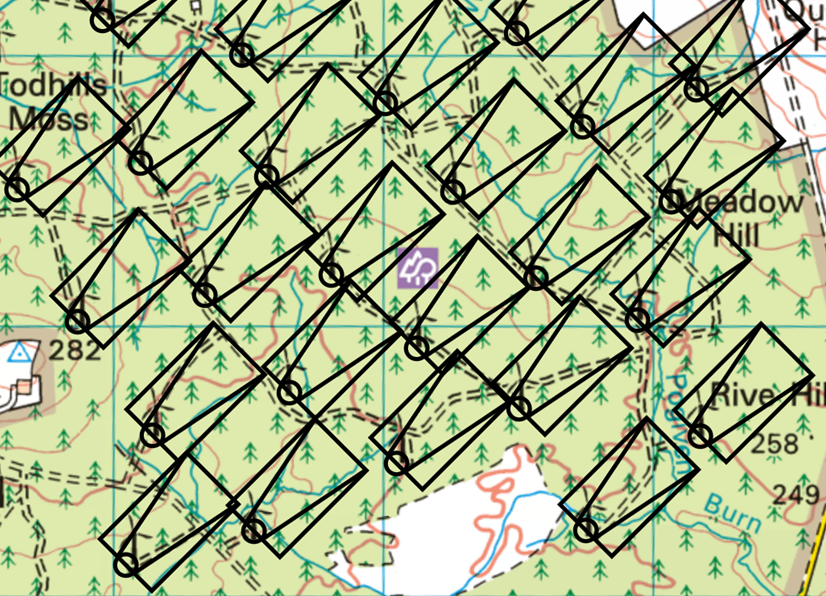
Christian Egal himself presided over a UK standard 3 RD by 5 RD spacing when he was CEO of EDF Renewables UK, but as we shall see, he lost his head on parachuting onto Walshaw Moor in February 2025. To be fair, he had only been here three weeks when his workplace was suddenly overrun with curlews. They are in terminal decline in his former stamping grounds in Wales, for some reason. At the annual 6% decline, curlews will cease to be a breeding species in Wales by 2033. We have lived just under Walshaw Moor since 2020 and the number of curlews has at least doubled in that time, with 2025 being extraordinary. Lapwings and golden plovers have also boomed. When there are so many, the waders can exert communal control of the airspace against avian predators and all ground-nesting birds benefit, including grouse. This week we have started to see more corvids and gulls because the Walshaw waders have left for the coast.
Next is Scout Moor, which has the familiar Pennine terrain and was properly spaced by cramped UK standards from the outset.

Academic theory insists that the wakes are much longer than 5 RD. The leading researcher is Charles Meneveau, Louis M. Sardella Professor in Mechanical Engineering at Johns Hopkins, and he has shown that 15 RD is optimal for efficient extraction of energy. The onshore developers in the UK cannot afford 15 RD. Our onshore wind farms will always be overcrowded and suffer wake losses, which comes out in the poor capacity factor of UK onshore wind. In most of the world the typical downwind spacing is 7-10 RD and some use Meneveau’s 15 RD. The first US wind farm I checked was Amazon Texas and here it is.
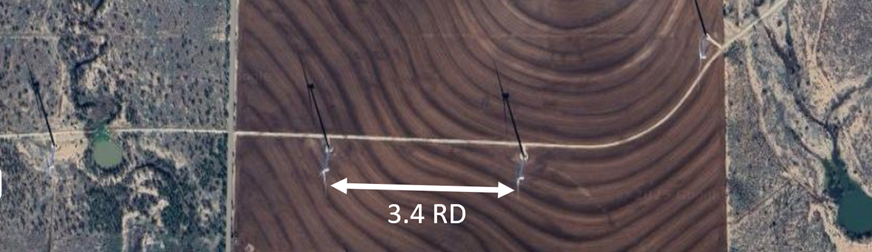
I would like to show you the next row, but it is so far away that if both rows were on the photo, you couldn’t see the turbines. The footprint of Amazon Texas is 3 RD by 15 RD. The point is that 5 RD is a bare minimum.
The next map shows some of the huge Viking WF on Shetland. After the layout was done correctly, the turbines were uprated without any resiting and the wind farm became badly overcrowded.
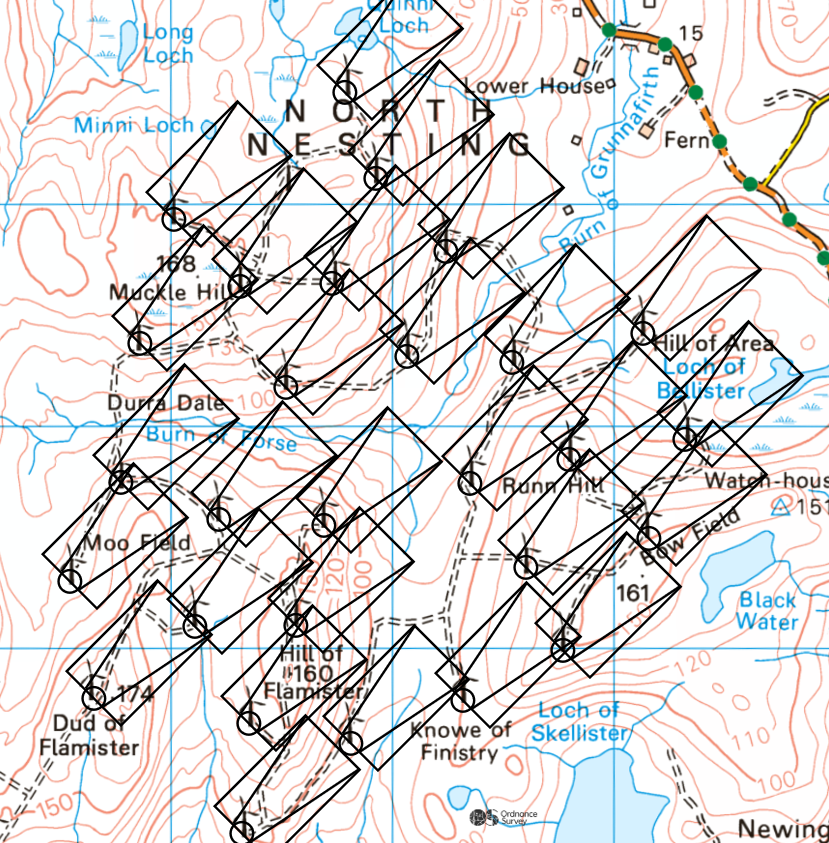
This over-crowding is indicative, for this huge wind farm on the edge of nowhere seems designed to harvest the constraint payments when the grid cannot distribute the current. Constraint payments are a function of maximum power, and this always gives an incentive to overcrowd which the planners are too shy to control. The Prime Minister himself has said he will come down hard on these shenanigans. When he gets round to inviting the wind farmers and regulators to 10 Downing Street (“Are you free next month? After Easter? Never? Never is a good for me too!”) he will discover that the bill-paying public’s only reliable source on constraint payments is a charity founded by Noel Edmonds.
Whitelee, Scout Moor and Viking Shetland are built on very different terrain with different turbines, but they all conformed, when designed, to a 3 RD by 5 RD footprint. No supercomputers solved the partial differential equations of air flow. The designers simply applied the 3 RD by 5 RD rule of thumb, and they did this first. The downwind spacing of 5 RD is very much a minimum and it is inevitable that UK onshore wind farms will suffer large wake losses because we don’t have the room onshore to space them properly.
The next map shows Calderdale Energy Park with the same 3 RD by 5 RD footprints on the 162 m rotor diameter of the 7.2 MW turbines. We see at once that CEP is grossly overcrowded by the standards of reputable UK developers like EDF or SSE.
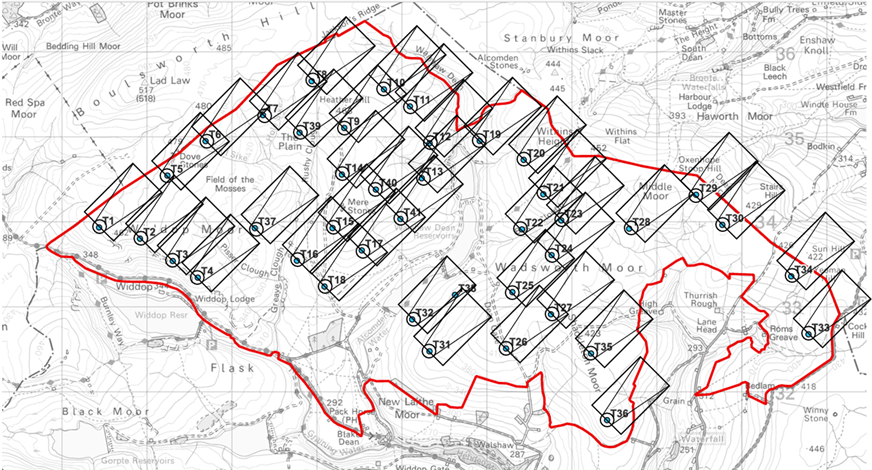
Readers will be wondering how overcrowded the original CWF 65-turbine proposal must have been. Surely the wakes must have been piled up like corpses in a plague pit … But here we come to the most instructive map of all. Suddenly, we know all about CWF Ltd.
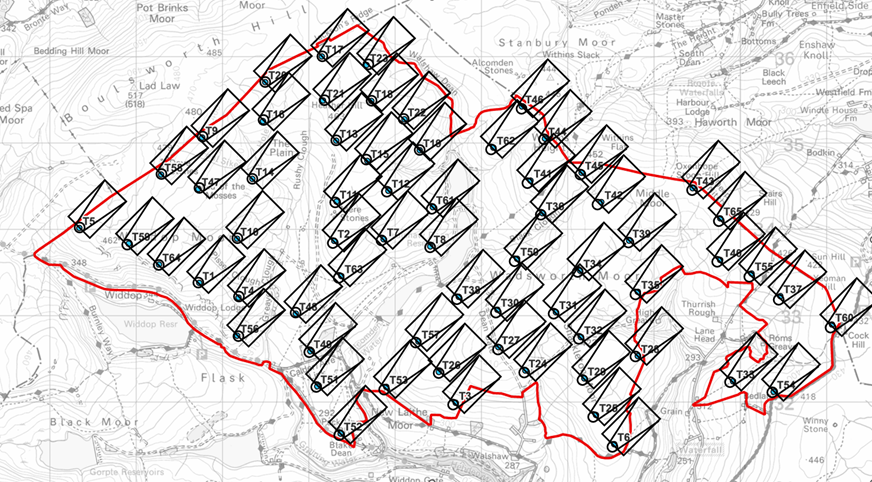
The collapsed CWF with 65 turbines was properly laid out for aerodynamics by the reputable company Natural Power to the usual 3 RD by 5 RD spacing. That CWF had correct aerodynamics is the most convincing evidence that something went terribly wrong at the CEP design meeting on 21 February 2025. There was a lot wrong with CWF, and it was going to be mitigated down to a nubbin on other grounds, but it started with an aerodynamically correct layout by the usual cramped UK onshore standards. The collapsed CWF proposal, described by CEPs rock star consultant Donald Mackay as “worse than useless” was correctly spaced. If CWF was “worse than useless” then CEP must be “utterly incompetent”.
Calderdale Energy Park is not a real wind farm. The layout presented on 29 April 2025 and corrected by WTRG on 1 March 2025 and again on 2 March 2025 has been thrown together to mollify the investors after the ignominious collapse of CWF. Real wind farms in the UK are planned on a 5 RD downwind spacing from the start. The Environmental Impact Statement for Garn Fach WF (Powys, 85 MW, approved October 2024) states:
4.2.2 Design parameters for the scheme were established at the commencement of the project (i.e. 5 x 3 rotor diameter spacing of wind turbines, tip height 149.9 metres to avoid fixed visible light).
Garn Fach is of particular interest because it was developed by EDF when Christian Egal was CEO of EDF UK renewables. Does Garn Fach exhibit overcrowding? Juste un peu, Christian! Juste un peu. Did Christian Egal decide design parameters at the commencement of his CEP project as his team did at Garn Fach? He did not. What he did instead is much weirder than that, and we shall soon reconstruct the CEP Design Awayday on Friday 21 February 2025.

For Carrick windfarm (Galloway, Sitka plantation, 86 MW) the environmental impact statement says:
44: There is no industry standard for spacing, only manufacturer recommendations, and operational experience. Referring to onsite wind measurement data, it was confirmed by the Applicant that there are high percentages of wind direction from NW, through SW and SE of the site. As a result, a spacing of five times rotor diameter in all wind directions was applied for the Proposed Development.
The reason for the wider spacing at Carrick is that turbulent wakes trapped in a cramped array will damage the turbines, shorten their lives and generate large annual maintenance bills. Nobody on either side of the CEP discussion is denying that the wind is very strong on Walshaw Moor. It can have a frightening solidity from west, southwest and south. Since very powerful winds come from a full quarter of the compass, CEP should be spaced at 5 RD in all directions, and even that may not be enough to protect the investment of the pension fund that would be the eventual owner.
While waiting at the Dog & Gun for my father-in-law and his friends to arrive for dominos, I stared at a pint of Landlord and finally understood the dimension law of a wind farm. In the range we are considering, the power of a turbine is roughly proportional to the rotor area. The areas of the rotor circle and the 3 RD by 5 RD footprint are both proportional to RD2. So, the power of the turbine is proportional to the area of its footprint. If you increase the power of the turbines, you increase the area of each footprint by the same factor, so you can fit fewer turbines and get similar total power. Farmers sow the available area. They can reap with scythes or a combine harvester, but the area is the area.
Had the areas been the same, the aerodynamic limit to the power of CEP with 7.2 MW turbines would have been similar to CWF’s with 4.8 MW turbines at 300 MW. The boundary of CWF and CEP is the same, but the useable areas are not. Because of the retreat in the south from the National Trust, slightly in the north from Emily Brontë, and everywhere from the very deepest peat, CEP has a smaller useable area to harvest than CWF. Since CWF was properly laid out for aerodynamics by Natural Power, the only way Christian Egal could match the 300 MW power of CWF was to squash the turbines much too close together and site some, like T21 and T22, in hopeless places that CWF avoided. The gross overcrowding was either deliberate and deceptive, or the result of negligence and incompetence. Either way, the proposal does not allow “intelligent consideration” by the public because it is not a real wind farm.
I have written before about ringing up Natural Power on 30 April 2025 to ask them why the CEP maps were all wrong. Emma the receptionist was terrific and eventually found James Lightbody who had worked on the CWF layout and came to the phone. He sounded dismissive about CEP. “I had something to do with some wind farm proposal near Halifax ages ago, but I don’t now”. Natural Power cannot be rejoicing that their name is on the maps of Christian Egal’s useless Calderdale Energy Park, blighted from the day of launch by his incompetence over T38 and the phantom T42 and overcrowded like a Black Sabbath mosh pit.
We might think CWF Ltd is at the helm of a £500 million project and Natural Power are the servants of unlimited international finance, but it is the other way round. Natural Power are a highly successful company with 139 employees and an annual turnover of £20 million. CWF Ltd is a zero-employee start-up, like Zume, the robot pizza delivery company. The things that were right about CWF were all the work of Natural Power. It was the management of CWF Ltd that was incompetent.
CWF Ltd had no reputation in 2021. In September 2023 it published nonsense about Padiham and voltage on its website and did not correct the hilarious errors until we pointed them out in October 2024. The proposal then collapsed, and the website was jet washed, though we have all the screenshots. When Christian Egal became Project Director of Calderdale Energy Park in February 2025, he was joining a company that had never been reputable and is now, until further notice, disreputable, because it published an utterly incompetent wind farm and put it forward for national mockery at an unlawful public consultation.
Using the CWF and CEP layouts, the statements of the consultants and some information supplied by our mole ‘Deep Stoat’ we can reconstruct the design meeting of CEP. Since we now have so much specialist knowledge of the plan, we can style the account in tribute to the inventor of the technical thriller, Frederick Forsyth (1938-2025).
The Day of the Eagle
It is cold at 09:50 on a February day in Manchester, and it seems even colder when a wind farm is about to be designed. At that hour on 21 February 2025, Executive Chairman Wilson met his project director for the first time. Living up to his ruthless nom de guerre ‘440 Kelvin Volts’, Wilson had secured the services of a French freelance.
“We’ll need a secure code-name for you, M. Egal. What do you suggest?”
“What about ‘the Eagle’? Will that do?”
Wilson stood open-mouthed in wonder at the brilliance of the ploy.
“A double-bluff? Genius!” Not since the KGB had given Michael Foot the code name “Boot” had so daring a subterfuge been attempted.
The launch date was ambitious: 29 April 2025. The rush was determined by the political cycle. Venture capital had turned Walshaw Moor into a casino, a Labour government were unwitting croupiers, and Wilson needed the roulette ball to land in 42 before the general election.
The consultants had gathered by 10:00. Wilson introduced his new Project Director to a star-struck team. “Ladies and Gentlemen. This is Christian Egal, code-name the Eagle. He has landed.”
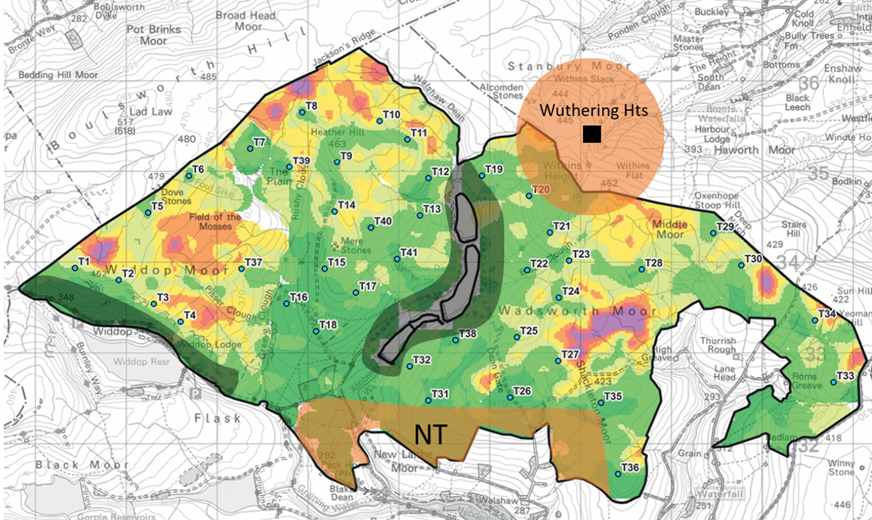
A projector displayed a map and a totaliser thermometer reading 0 MW with a target of 300 MW at the top. Because peat was going to be the primary design criterion, the base map had to be the peat depth survey. The CEP turbines would, if possible, only be placed on the green depths, with a preference for darker green. This was virtue signalling on peat. The main destructive force is not the digging but the drying around the tracks and they will run over the deepest peat. The turbine power had been decided as 7.2 MW and among models under consideration was the Vestas V162-7.2 MW with a rotor diameter of 162 metres, the workhorse of the industry. Areas where the ground was steeper than 25% were already greyed out.
After some pleasantries to put his team at their ease, M. Egal reminded the meeting that, “While there are limited statutory heritage designations on the site, Calderdale Energy Park is located within the Brontë Country, which is an area of historical and cultural importance. The site is near Hardcastle Crags, a renowned natural landscape comprising a wooded Pennine valley. Given the site’s heritage value, we are committed to respecting the local historical and cultural features throughout the planning and development process.”
The National Trust property at Hardcastle Crags was particularly sensitive because it had been given to the people by the beloved Lord Savile, who had sold Walshaw Moor to Richard Bannister in 2002. The greed of Richard Bannister and the generosity of Lord Savile is a toxic PR contrast, according to the mole Deep Stoat. New boy Donald Mackay observed that the substation and battery would still have to go on the National Trust buffer because both had to be “low down and central.” Egal looked sharply at Mackay. Competence could be useful in a project that had suffered such abject failure before he arrived, and Mackay had a reputation for plain speaking that set him apart from the obedient run of wind farm consultants, who like freelancers in any business rarely say “No.”
The meeting considered the unexpected force of the Brontë sisters on the site and a circular buffer was put around Top Withins, a site of worldwide pilgrimage as the inspiration for Wuthering Heights, and gateway to the Brontë Moor, just a few steps above.
The consultants began to place the 7.2 MW turbines on the map. Having left Natural Power and set up as a freelance, Alison Sidgwick was proud to be at the meeting and was glad to report later that, “Peat and hydrology were the lead design criteria, but no aspect had a trump card.” Sidgwick continued, “The turbine numbers stay the same once you have placed them so that the consultants know where they are. We refer to the turbines by their numbers.” With the turbines all having new numbers, the meeting started at T1 in the SW corner and worked along the charismatic Scout Ridge.
Just after lunch (grated carrot salad, lamb with Jerusalem artichokes, cheese, dessert, cafe crème) there was trouble on Wadsworth Plateau. The CWF layout had two turbines on the very deep, wonderfully intact peatland mesotype. Donald Mackay reminded the meeting that the spine track would still be on the watershed here and would have to float. It was decided to push T23 and T24 off the plateau peat to the edge, linking them to the watershed spine with spurs. Mackay observed that T23 and T21 were now so close their blades could clash, so T21 got shoved west until it was almost on the Pennine Way. This put it on top of T22 which was then sent down a 26% slope into the depths of Black Clough, where no CWF turbine had ever been. The Eagle looked at the Lewisman approvingly. “Thank you, Donald”. The consultants glared enviously at Mackay. Who was this wunderkind? Mackay might have observed that the cluster was still too close together, but he has a sense of what is “above my pay grade” as he later put it at Trawden.
By the time T35 and T36 were placed on Shackleton Moor, they had almost run out of room, with the totaliser stalled at 259 MW. This was strange. Surely with bigger turbines there should already be more power than the 312 MW of CWF?
It was now that T37, T38 and T39 were fatefully sited on Field of the Mosses. No thought could be given to the flood risk they would cause, because the meeting did not have a proper map of the hydrology. Though £33,000 had been spent on site visits, nobody had discovered the Greave Clough sluice and tunnel.
Now the consultants could smell the finish. Although his team were gasping for tea (Yorkshire by Taylor’s of Harrogate) Christian Egal does not encourage the English disease. A note from the moor owner had requested that T41 be located more than 185 metres from John Getty’s house, the only residence inside the boundary. This put it on a steep edge. T42 then had to be planted on the other side of the Getty residence and the totaliser ticked up to the face-saving 302 MW, less than CWF but enough to appease the investors. It was 16:10 on 21 February 2025. Christian Egal stepped back from the screen. “C’est ça”. A ripple of applause ran round the conference room.
Despite a rattle of china in the background, and the susurration of chocolate fingers (Cavendish) petites beurres (M. Egal) and rough oatcakes (Donald Mackay) being fanned onto Old Chelsea serving plates, somebody (was it Sue “Nae Comment” Birnie?) observed nervously that T38 was on the blank area of the peat survey. Christian Egal, for whom the incomplete peat survey was a failure of the ancien régime, made the kind of brisk decision for which he is revered in the industry. T38 was deleted. Voila!
The ever-solicitous Kevin Whitmore (“Good morning, Monsieur Egal! Here’s a sparrow for your cat.”) asked, “Shall I be mother?”. The tension now broken, this idiom was richly enjoyed by the Project Director, who had built several wind farms in Wales and speaks excellent English. He had his own supply of Liptons, a tea-substitute common in continental Europe, and the bag floated wanly in the milk while he added hot water from a battered EDF Thermos. Donald Mackay was still staring at the map. Surely the layout was grossly overcrowded? Why did the software not display the footprints? Christopher Wilson ceremonially turned off the projector like Princess Anne unlaunching a battleship and everybody relaxed, swapping tales of bulldozed peat, four metres, six metres, eight metres deep, in the Caithness Flow Country during the golden time. On the open laptop the cursor on the layout spreadsheet was still pulsing in Row 38. Nobody thought to scroll to the bottom of the list.
With T38 deleted, T39 was in row 38 and T42 had bumped unseen up to row 41. At the end of a long day, it was an easy mistake to read the row numbers as turbine numbers. The layout spreadsheet had autosaved as “210225-41t” It was now just short of 300 MW, but that could be fudged.
(When MacKinnon asked the CWF hotline what the power of the turbines was, he was eventually told “Divide 302 by 41 to get 7.4 MW”, but 7.4 MW is not the power of any onshore turbine. Try searching “7.4 MW onshore turbine” and then 7.2 MW. There were meant to be 42 turbines, each 7.2 MW and exactly 50% more powerful than the 4.8 MW CWF turbines, with 65 times 4.8 MW giving the 312 MW still listed in the NESO TEC register as the power of CWF.)
At 08:30 on Monday morning, 24 February, the spreadsheet was sent under end-to-end encryption to JWO who faithfully plotted the positions of turbines T1 to T42, with no T38, on all seven maps: International & National Ecological Designations; Habitat Survey; Peat Depths; Hydrology; Public Access, Green Belt & Recreation; Cultural Heritage. As he traced the Pennine Way over the OS dashes, JWO found it hard to get the green and yellow dashed line past T21, and the famous National Trail wandered onto the bog.
The maps of Layout 210225-41t were completed by JWO on Friday 14 March 2025 and checked by LF. Neither were known to Natural Power and may belong to the nomadic tribe of mercenary cartographers who haunt a gazetteer of backstreets from Antwerp to Zaragoza.
It was a bright, cold day in April when Christian Egal noticed that the project maps had a T42 and no T38. “Sacré bleu!” New maps were urgently commissioned from JWO, signed off on 17 April 2025 by LF and Christian Egal mopped his brow. He had discovered a career-threatening error with just twelve days to go!
On Launch Day, 29 April 2025, CWF Ltd published the earlier suite of maps with T42 on them. On Monday 1 May, MacKinnon hit the CWF careline as it opened at 09:00 and began explaining the problem to Tom Andrews of Cavendish, who was staffing the phone while working from home, and still had half a Weetabix to go. We last saw him singing like a bird to John Page at Oxenhope. It took MacKinnon six minutes to explain the problem to Andrews, whose drawl may have exasperated his schoolmasters but will pay dividends in the bonhomous world of public relations. Tom had not been given a crib sheet of useful facts by Christian Egal, and nobody ever asked Tom a question that was simple enough for him to answer; but he’s a willing lad with a great future in PR ahead of him, and eventually he realised that having a Turbine 42 on a 41-turbine wind farm was about as welcome as finding Gregg Wallace in your pantry. MacKinnon, who in high feather lapses into a Kray Twins persona developed in his tough E18 boyhood, told Andrews to “Get Egal and Wilson on the blower naaaow”.
Poor Tom. Nobody wants to be the bearer of bad news.
We can only imagine the panic at CWF Ltd between 9:10 and 10:30. “Mon Dieu! Nous avons publié les mauvaises cartes!” Cavendish Consulting launched a crisis Zoom. We might think Christopher ‘440 Kelvin Volts’ Wilson had choice words for his Project Director, but Deep Stoat observes sagely that “Wilson needs Egal forty-two times more than Egal needs Wilson”.
“My dear chap! This is the kind of ballsup anyone might have made. Six months ago, I had the whole shebang plugged in at Padiham, but it turned out to be bally Rochdale!”
This quaint public-school idiolect, not often heard in the Welsh wind farms, rather eluded M. Egal, but the emollient tone reassured him.
The cover up was agreed and published on the website. “The following maps have been updated to relabel T42 as T38. The location of T38 has not been changed”. Nobody can say who crafted this implausible statement. Success has many fathers, but failure is an orphan. The Day of the Eagle was over.
The dimension law for a wind farm shows that increasing the rotor diameter of the turbines does not necessarily increase the total power of a wind farm. 65-turbine CWF was correctly laid out by Natural Power experts and was tight as a drum, and CEP had lost area to NT and Brontë buffers and non-green peat, so the consultants should have suspected that their 42-turbine 302 MW layout must be grossly overcrowded, even without seeing the layout footprints.
CWF Ltd then held a public consultation on this incompetent layout, which they published in a glossy brochure (with a correction sticker correcting additional incompetence), on a website, in a recorded Webinar, and on large banners displayed at three locations. The CWF Ltd lawyers have been unable to present a case that this public consultation on an incompetent layout was lawful under the Gunning Principles, despite being repeatedly asked to do so. They cannot attempt a defence without engaging with the comical incompetence of the layout itself.
Are the investors being strung along by the management, or was this incompetently designed Calderdale Energy Park only meant to fool the British public? Why did Dr Osman, who has a stellar reputation, resign as the “person with significant control” with notification on 19 May 2025, less than three weeks after the disastrous launch? Companies House are pursuing that question for us.
Unless they start again and consult the public on a genuine wind farm proposal, CWF Ltd is a disreputable company who have carried out an unlawful public consultation. Windpower Monthly, the industry bible, was understandably reluctant to publish the full suite of evidence given in a recent interview, but not afraid to publish the conclusion:
“We await a lawful public consultation on a properly designed wind farm.”
CWF Ltd and Natural Power have been approached for comment. The legal exchange between WTRG and CWF Ltd is ongoing. The analysis in this blog has been lodged with the Planning Inspectorate and formed part of an interview with Windpower Monthly, the leading trade magazine, who have documented the industry for 40 years. The full interview with Windpower Monthly, from which journalist Orlando Jenkinson courageously selected and published quotations, will be available on the website of Stronger Together.
+++++++++++++++++++++++++++++++++++++++++++++
This is the 41st in a series of guest blogs originally based on the 65 wind turbines which Richard Bannister planned to have erected on Walshaw Moor. Turbines 5, 6, 8, 8CEP, 9, 11, 13, 14, 16, 17, 21, 21CEP, 25, 25CEP, 27, 29CEP, 31, 32, 33, 33CEP, 34, 35, 36, 37, 38, 40, 42, 42CEP, 43, 44, 47, 53, 54, 56, 57, 58, 60, 62, 64 and 65 have already been described.
The developers have canned their original 65 wind turbines, quite possibly in response to the public humiliation of having their so-called ‘plan’ publicly shown to be damaging, irrational and probably unlawful. They have come back with a plan for 42 wind turbines and the amazing Nick MacKinnon and friends have regrouped and set off on a new tack too. The series continues.
To see all the blogs – click here.
[registration_form]
When I read “Eagle” my mind jumped (pun intented) to Eddie the Eagle. From there it tracked onto “Are you ready, Eddy” (Emerson, Lake and Palmer). Can the lyrics be reworked to fit? Dunno. I’m not the poet.
Superb,as always,I’ve followed Nick McKinnon’s blogs all the way through, the depth and thoroughness of his research takes my breath away, thank goodness we have people like him with the skills, knowledge and energy to oppose this diabolical project.
Hey the local travelogue producer Northern Introvert I mentioned earlier did a video about the peat in the North York Moors
The Hidden Super Power of wetland.
P.S. the index of turbine posts still hasn’t been updated sadly