Nick MacKinnon is a freelance teacher of Maths, English and Medieval History, and lives above Haworth, in the last inhabited house before Top Withens = Wuthering Heights. In 1992 he founded the successful Campaign to Save Radio 4 Long Wave while in plaster following a rock-climbing accident on Skye. His poem ‘The metric system’ won the 2013 Forward Prize. His topical verse and satire appears in the Spectator, and his puzzles and problems in the Sunday Times and American Mathematical Monthly. Email: nipmackinnon@gmail.com
Guest blog – Walshaw Turbine 16 by Nick MacKinnon
Turbine 16 Greave Clough SD 94764 33542 ///coil.lays.lower
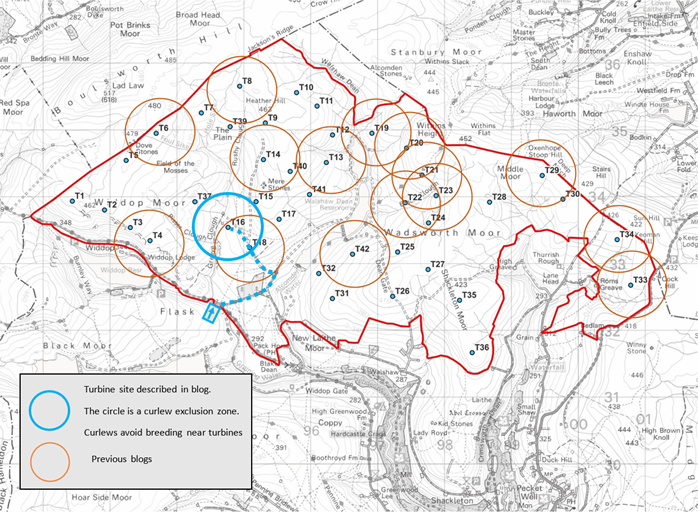
This blog was sent for comment to Paul Duncan (Natural England) Richard Bannister (Walshaw Moor Estate) Christian Egal (CWF Ltd) Marc Davies (Logika) and James Lightbody (Natural Power) on 29 December 2025.
20 December 2025 “’Tis the year’s midnight, and it is the day’s,/ Lucy’s, who scarce seven hours herself unmasks;/ The sun is spent, and now his flasks/ Send forth light squibs, no constant rays;/ The world’s whole sap is sunk.” A Nocturnal upon St Lucy’s Day John Donne.
The dog and I make a quick trip to T16 in Greave Clough on solstice-eve, for tomorrow there will be thick fog. T16 is a gently sloping site, not typical of Calderdale Energy Park.
The extraordinary impact of the very steep CEP layout on hydrology can be seen at once in the new diagrams below of the slope at the turbine sites compared with reputable peer group wind farms in the Pennines. The CEP layout is grossly overcrowded and far too steep and yet it is proposed for one of the most dangerous catchments in the UK, already implicated in three catastrophic floods since 2000.
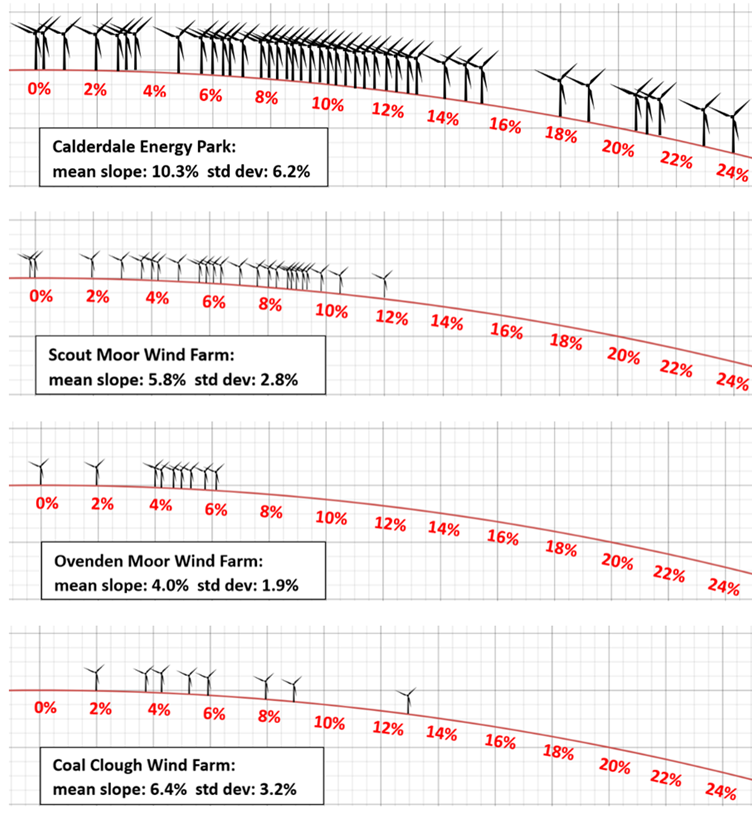
The turbine heights are shown to scale. The average site slope in CEP is about double that of the real Pennine wind farms, and half the CEP layout is on slopes that are beyond, or far beyond, the reputable maximum. The steep sites will accelerate drainage and require far more excavation to get a flat foundation, crane hardstanding and laydowns, so they are dangerous and destructive. Most of the turbines on flatter ground overlook the heart of Brontë Country, and when they are removed, the mean slope will increase further. With double the mean and standard deviation slope of Scout Moor, Calderdale Energy Park is all over the place.
The unprecedented steepness of half the CEP sites is caused by Christian Egal’s attempt to get 300 MW on what might be (with normal gradients and spacing) a 100 MW site, except that Walshaw Moor is an internationally designated SPA for red-listed birds, an SAC for irreplaceable habitats, and is known to millions as the inspiration for five world-famous women (CB, EB, AB, SP, KB). Wuthering Heights is the 14th greatest UK number one of all time, sandwiched between wind farm bangers Good Vibrations and Great Balls of Fire. Kate Bush was the first woman to write and perform a UK number one and is as much a trailblazer as the Brontë sisters and Sylvia Plath. No wind farm in the UK has ever been proposed with even one of those three international factors present to any extent anywhere on the site, but for CEP all three factors operate at full strength over the whole site.
Even using these destructive and dangerous turbine placements to get the turbines further apart, CEP is still grossly over-crowded by standard spacing norms that M. Egal himself insisted on when he was CEO of EDF Renewables. Here is what EDF wrote in the Environmental Statement for Garn Fach Wind Farm in February 2022, defining the standards expected from his EDF design teams before Christian Egal parachuted into the chaos of CWF Ltd in February 2025.
4.3.3. Wind Turbine Spacing – the wind turbines need to be spaced far enough apart to ensure that whatever the wind direction, the energy losses associated with the wind turbines are minimised.
4.5.11 The Applicant has applied a minimum separation distance between each of the wind turbines, in general 5 times the rotor diameter when perpendicular to the predominant wind direction, and 3 times the rotor diameter for other wind directions. This creates an elliptical shape around the wind turbines orientated in the direction of the predominant wind direction. This is to protect turbines from the wake effects caused by other wind turbines in the scheme so that they do not hinder performance.
4.5.5 Based on Ordnance Survey (OS) terrain data, the gradient of the land was also considered in the siting of the wind turbines, to minimise the need for cut and fill for wind turbine foundations.
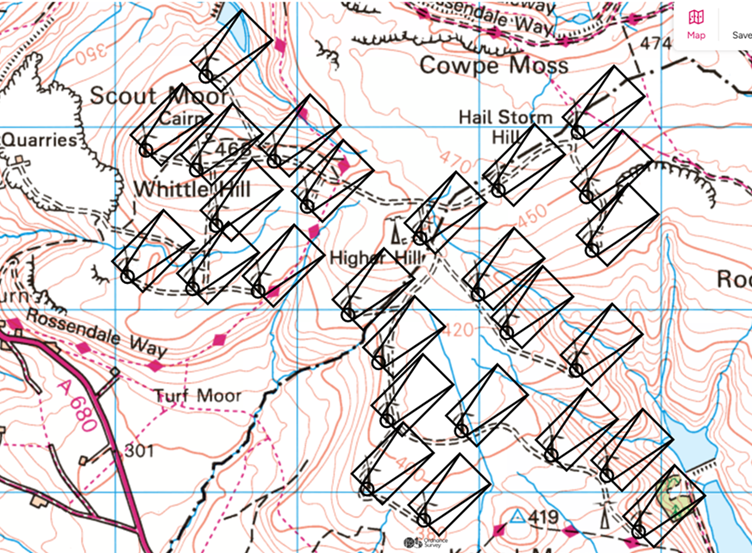
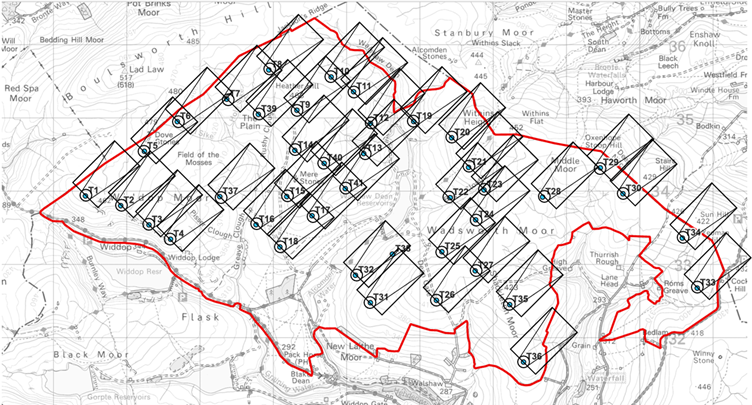
The overcrowding is shown by the next two maps, one of the reputable Scout Moor WF and one of Calderdale Energy Park. The reason for the overcrowding and the destructive sites is that a correctly designed CEP at 100 MW cannot carry the cost of its connection to the grid if it has to use Rochdale or the unbuilt “Leeds North Connection Node B 400kV Substation” that are now its two entries in the NESO TEC register.
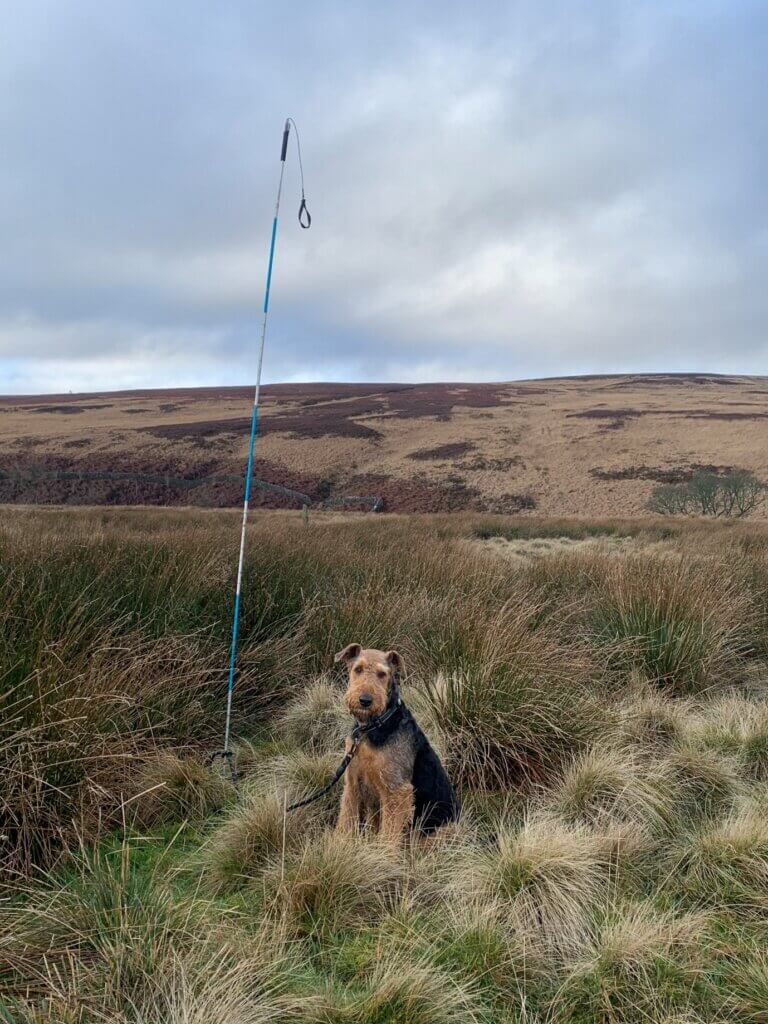
At the winter solstice the Earth is a spaceship navigated from Stonehenge. The South Pole leans hard into the bend like the Millennium Falcon and radiation from the reactor falls like stair rods on the Tropic of Capricorn, as the sun “to the Goat is run/ To fetch new lust and give it you.” The peat depth at T16 is 30 cm, now regarded in England as deep. The Parliamentary Under-Secretary of State for Nature Mary Creagh explained the point once more on 10 December 2025:
The Government recognise the importance of our peatlands and the need to protect them for future generations. Peatland restoration mitigates climate change, increases biodiversity, and reduces the risk of flooding. Our recent ban of burning heather and grass on peat deeper than 30 cm is protecting an area the size of Devon. To demonstrate our commitment, we will invest £85 million in peat outcomes between 2026 and 2030.
There are existing protections in planning policy for irreplaceable habitats, which includes peatland habitats like blanket bogs and lowland fens. Impacts on these habitats from development is only permitted in exceptional circumstances (Hansard).
On the facing slope, the Walshaw Moor Estate has been treating the invasive Molinia, which forms ankle-breaking tussocks if you find yourself among it; it looked a mess in August after flailing, but the regrowth is moss green.
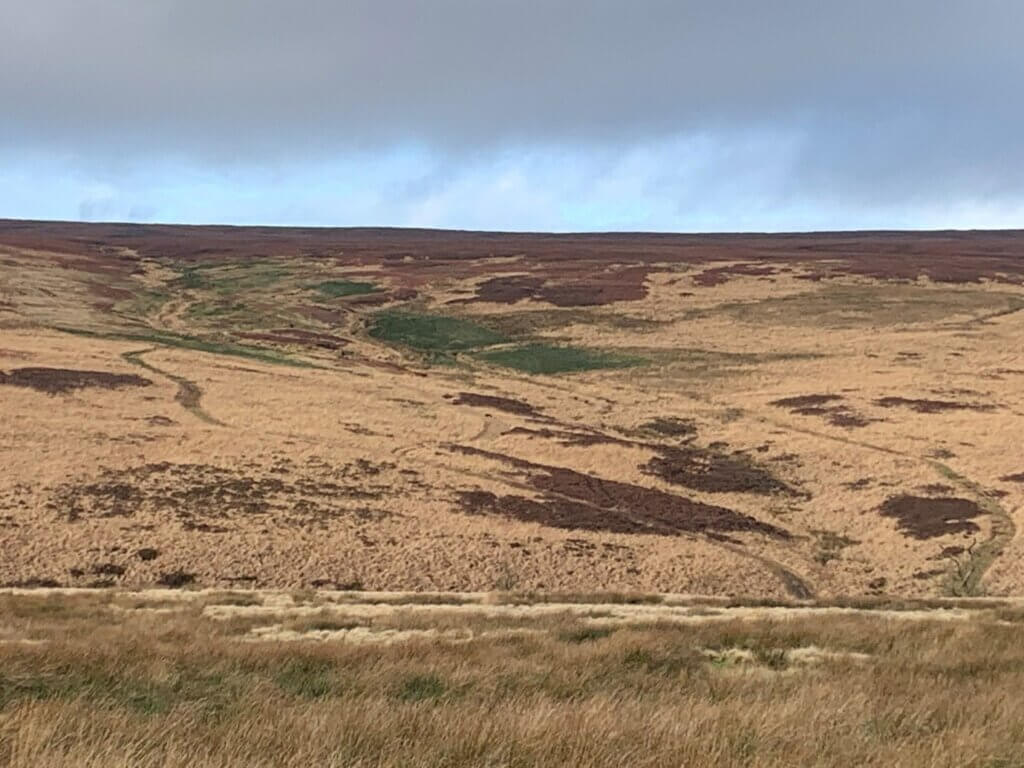
The next photo shows the same scene a year ago, with the last of the snow.
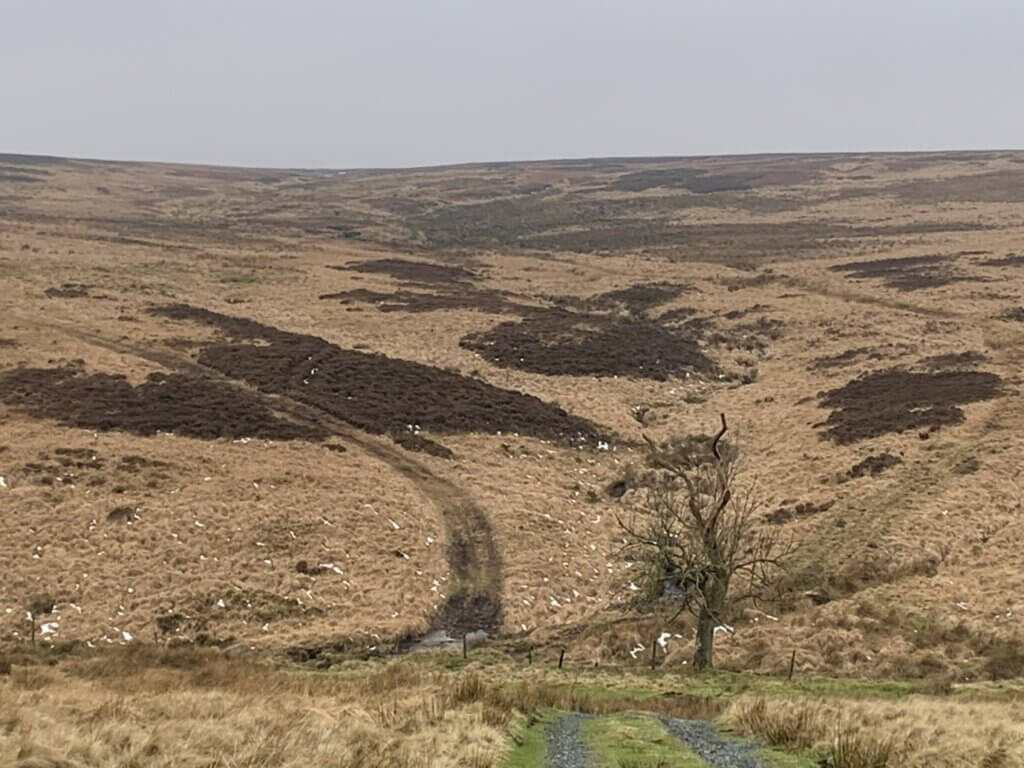
A gradual improvement of the vegetation is specified by the 2018-2042 Catchment Restoration Agreement between Natural England and the Walshaw Moor Estate, the subject of a successful day in court for Mark Avery, documented in his own long series of blogs. The area in the photograph is on the Molinia (purple moor grass) control map in the agreement, which shows that by 2016 the area had been correctly sprayed with glyphosate but not then reseeded with heather, cotton grass and sphagnum. Follow up treatment (removal of dead Molinia and reseeding) was specified, and this may now have been done. Molinia control is vital in the decades of climate warming ahead because it is a potent fire risk when dry. Serious rewetting is the best way to weaken Molinia dominance; burning it off is the worst way, for it has deep roots and benefits preferentially from the ash. Grazing by hairy cows is a possibility, but cattle prefer anything to purple moor grass, so they must be fenced in, and they will eat what is under the Molinia. The tussocks slow surface flow, so Molinia has a part to play in flood control: it is much better than the bare granite, concrete and French drains of a huge wind farm.
The turbine sites west of Greave Clough require tracks to be driven straight up the slope, and these will be cut-and-fill because the slope is too steep (13%-7%) to float the track. These access tracks will dry the peat and encourage molinia growth. There is nothing cheaper and simpler that the UK can do to reduce atmospheric carbon than to rewet our blanket bogs to reduce the wildfires that will release thousands of years of sequestered carbon. If government climate change policy is a major factor in planning, and all scoping reports for wind farms say it is, then those wind farms must go on mineralised soils, not deep peat.
I have been in correspondence with Natural England on their agreement with the Estate.
Dear Tom Entwistle,
Thank you for your earlier very good letters.
We have six questions about the Walshaw Moor Estate Catchment Restoration agreement between Natural England and Walshaw Moor Estate, which runs from 2018-2042. Our questions relate to the proposal to build Calderdale Energy Park.
The agreement begins with a vision:
“To agree the management of the Walshaw Moor Estate as a beacon of best practice, through the restoration of the moor towards favourable condition to achieve a healthy and resilient ecosystem that supports sustainable land use, internationally, nationally and locally important biodiversity assets, natural flood management and improved water quality; and provides a range of cultural services.”
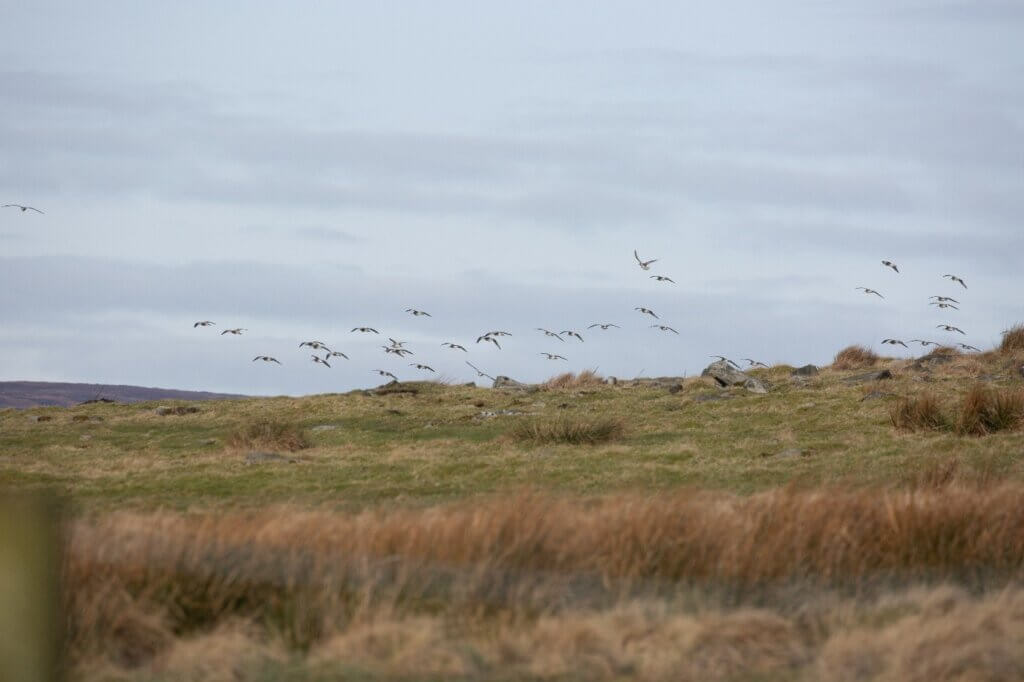
As I have reported to you before, the agreement has had startling success in building much larger assemblages of curlews, lapwings and golden plovers, with 2025 being spectacular. One mechanism is apparent: there are now enough curlews and lapwings on Walshaw Moor to achieve a measure of avian predator exclusion during the breeding season: the gulls and corvids give up because they can no longer pick off isolated nests. The gulls and corvids come back in August. This effect must lead to more successful breeding by all ground nesting birds, including grouse, which are less able to fend off avian predators.
Walshaw Moor SPA must not be destroyed until the causes of the spectacular return of the charismatic red-listed birds is understood, so that if the curlews are to be made extinct on Walshaw Moor despite their spectacular breeding success, at least the lessons can be applied elsewhere (Wales and the Yorkshire Dales National Park, for example) where curlews are now almost unknown.
At boot level, the rewetting of the moor is evidently leading to more moss, even on the drier heath sections. This improvement is less spectacular than the breeding success of the red-listed birds, but your vision is happening.
The vision will be destroyed by Calderdale Energy Park.
Please may I have the answer to these six questions.
a] Will CWF Ltd be permitted to use limestone (which is a sphagnum poison) to surface the wind farm access tracks? The Estate is scrupulous in using blue granite, an inert stone, as the agreement requires? (8.1.6 Aggregate used on tracks will be inert materials.)
b] Will CWF Ltd be prohibited from making turning circles and passing places in deep peat as the agreement requires? (8.1.7 No turning circles or passing places will be constructed on deep peat (>40 cm, now > 30 cm).
c] What are the breeding assemblage numbers for curlews, lapwings and golden plovers in the years 2018-2025 monitored under the agreement? (3.2 Breeding birds Bird assemblages will be monitored across the Estate by the keepers, once yearly when undertaking July Grouse Counts.)
d] Why are the numbers collected in July when the curlews, lapwings and golden plovers have often flown?
e] Do Natural England propose to rely on the assemblage data when it is being collected by the Estate whose owner will benefit greatly from Calderdale Energy Park?
f] What would be the relationship of CWF Ltd to the Catchment Restoration Plan?
The answer to this set of questions came from Deputy Director Paul Duncan.
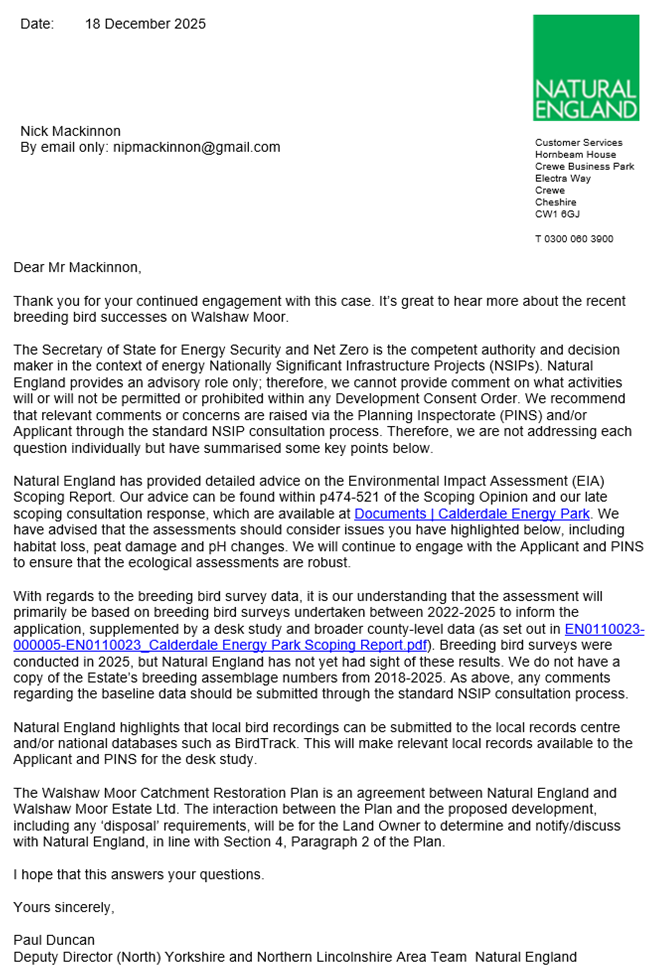
I was expecting there to be a problem with the annual bird counts. The capital value of a brace of grouse used when valuing the moor is about £3500. Shot, hung, drawn, plucked and oven-ready they are £38 a brace from the excellent Swaledale Meats. The economics of a grouse moor is arcane. The gamekeepers must calculate the shootable surplus which would not survive the winter. The count is done with precision in mid-July, using trained dogs to flush the grouse, but by this time some red-listed birds may have left. The gamekeepers are interested in, indeed enthusiastic about, all the birds on the moor, and will have a keen sense of population trends even if no formal count was made. They are justifiably proud of the flourishing assemblages of curlews, lapwings and golden plovers on Walshaw Moor, which elsewhere are in terminal decline. In Wales, the curlew will be extinct as a breeding bird by 2033, though they will return hopelessly to their breeding grounds for another thirty years to lay eggs for foxes and raise chicks for crows. The Walshaw gamekeepers are doing this work unacknowledged by their partners at Natural England, and congratulations are overdue, but if Natural England are not getting the annual reports, then they cannot know how well the Estate is doing relative to the agreement.
Curlews, lapwings and golden plovers are England’s rhinos, hippos and elephants, and Walshaw Moor at dusk in June 2025 was pulsating like the Okavango Delta, especially with so many kestrels, kites and buzzards overhead. Although I sometimes see hen harriers, and short eared owls are common, I’m too restless and inexpert to have seen the merlins. If there are to be rewilding experiments on moorland, it may be better to start with Welsh wasteland than Walshaw wonderland.
It may be too late for the Welsh curlew, but Gylfinir Cymru have a ten-year plan (2021-31) with seven priorities, and at number 4 is:
Review land management sensitivity maps in Wales and adopt the principle that future sites for forest expansion and renewable energy should avoid areas that hold more than five pairs of curlews.
I wrote back to Natural England to try to establish a marker for the SPA baseline.
Dear Paul Duncan,
Thank you for a clear response and for pointing out the late NE response on hydrology which I had not read until now. The vague bird data you mention in your reply is not a substitute for the annual monitoring that should have been completed by the Walshaw Moor Estate under the NE-WME agreement.
“3.2 Breeding birds: Bird assemblages will be monitored across the Estate by the keepers, once yearly when undertaking July Grouse Counts.”
Please will you ask the Estate for the reports of their annual monitoring and either publish them (and send them to me) or say that they do not exist. A note can then be made to the Planning Inspectorate. You should be given at least the grouse counts, even if no counts were made of any other species, despite the requirement of 3.2.
My extensive documented observations, based on sixty visits, since March 2020, are that the agreement is being carried out scrupulously by the Estate, and that it really is “a beacon” as the Agreement Vision hoped. The Estate should be rightly proud of what is being achieved, and the assemblage numbers, if they exist, should be strong for the Estate, and for Natural England.
There is much in Paul Duncan’s letter to digest and more in the NE late response on hydrology to the Scoping Report. As with the Environment Agency response, we see that Logika and CWF Ltd are far out of their depth in their own Scoping Report.
Overall, the assessment of hydrological impacts needs to sufficiently account for the functional extent of the peatland system across the site. Natural England considers that the current scoping report does not demonstrate that a sufficient level of detail will be provided in the ES to ensure the ecohydrology of the wider ecosystem function will be assessed. Based on the information provided at this stage, the hydrological impacts are considered likely (in our view) to impact ecological structure and function in a wide area, potentially reducing future site resilience and limiting the ability of future restoration to improve site condition. We advise that an ecosystem function approach will help determine these impacts.
A particular outcome of the assessments should be to sufficiently account for the functional eco-hydrological extent of the peatland system across the whole site, rather than solely focusing on immediate and/or buffered areas that relate to the proposed development itself. Peatland habitat is highly sensitive to change, and some impacts may take time to propagate across the site, so the assessments will need to ensure any longer-term effects are considered throughout the ecosystem. All hydrological assessments should be suitable in order to make this assessment appropriately.
On the evidence of their CEP Scoping Report and given their own acknowledged lack of onshore experience, Logika do not have the capacity to manage the EIA process in such a complex case as Walshaw Moor. It is instructive to compare the Logika Scoping Reports for CEP (1 September 2025) and Dengie Marshes (30 May 2025).
The Dengie Marshes report has a named lead, and all the consultants are named. It has no obvious errors, excellent maps, was written by human beings without identifiable A.I. slop and was submitted to Maldon District Council as Revision 02.
The CEP report is anonymous and the consultants are all unnamed. It has dozens of glaring errors, useless maps, AI slop about the river Kelvin and glacial till, and was submitted to the Secretary of State as Revision 00.
My planning consultant friend, who has written scores of Scoping Reports in West Yorkshire, said, “The professional standard in a scoping report is zero errors, and submitting Revision 00 is bizarre. I’ve never heard of such a thing. Revision 00 never leaves my desk. Revision 01 doesn’t leave the office. We might get Revision 02 back from the client with a few points and submit Revision 03. You would be wide open to justified criticism if you happened to make a slip in Revision 00 and the client submitted it. A wrong road number is a major error. For any maps to be wrong is beyond my understanding. A West Yorkshire council would simply reject a report with that many errors, but the point never arises because no consultant who wanted to stay in business would sign off a scoping report with even one such error in it.”
If we compare the document control statements of the two Logika reports for Dengie Marshes and CEP, we see clearly why the latter was bound to be shoddy work. No authors admit to writing, editing or checking it. Nobody admits to control over the document.
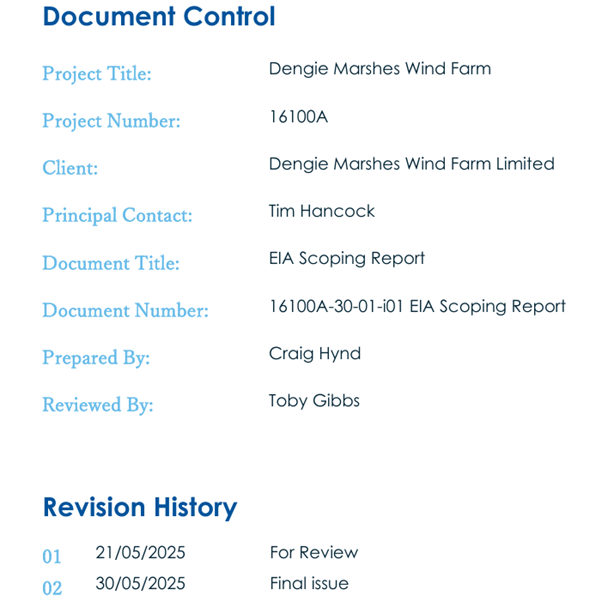

It is not certain that Logika actually signed off the CEP Scoping Report. It has none of the features of completed work found in their accurate Dengie Marshes document. It seems likely that Christian Egal was given Revision 00 for comment and submitted it unread. No other explanation for the incompetence of the CEP Scoping Report has the same explanatory power. There was no document control. The Dengie Marshes report is the work of eight named consultants, with three in a supervisory role. The CEP report is entirely anonymous and Leeds Director Marc Davies, when asked, cannot point to a wind farm Scoping Report with even 5% as many errors as Logika’s for CEP. “Success has many fathers. Failure is an orphan.”
Logika are miles out of their depth on Walshaw Moor. They have excuses: the layout they were handed following Christian Egal’s design meeting of 21 February 2025 was demonstrably useless on flood risk, gradient, public access, culture & heritage and aerodynamics; and they must have been hired at short notice, because Natural Power, a rival consultancy with immense on-shore expertise, still has its logo on the non-statutory consultation maps, and they are much better maps than any Logika has offered. I have asked Natural Power, and they were not at the February design meeting, did not design the layout that appears over their logo in the Consultation Brochure and did not recognise the initials in the document control panels for the maps.
Logika incompetence was greatest on hydrology, and all the statutory consultees who took the trouble to analyse the work in detail said so in various ways, with Natural England, the Environment Agency, Wadsworth Pais Counci , Oxenhope, and Haworth with Stanbury village councils the most trenchant. The asymmetry is striking. CWF Ltd had two years and £5 million pounds to get the thing right, but a few people working pro bono with the three parish councils shredded Logika’s work in just 28 days.
The Planning Inspectorate, acting for the Secretary of State, said this in their Overarching Comment at 2.0.1:
It should be noted that if the proposed development materially changes prior to submission of the DCO application, the applicant may wish to consider requesting a new scoping opinion.
Since his whole layout must “materially change” Christian Egal had better take this hint, expressed in the dead pan neutrality of the planning mandarin: “The applicant may wish to consider…”
Calderdale Wind Farm Ltd have still not published the required Statement of Community Consultation (SoCC) that was scheduled for November 2025 in the Programme Document that they are required to maintain, and which has itself not been updated since 1 September 2025. Statutory consultation is meant to take place in January-March 2026 but cannot begin until the consultees have had 28 days to digest the SoCC, a complex document that may try to resolve the myriad self-inflicted errors and obscurities of the Logika Scoping Report, themselves partly caused by Christian Egal’s hopeless layout, but with extra nonsense that is all Logika’s own. The statutory consultees will expect the right maps and road names, and a clear account of the extent of what is human expertise and what is AI slop in the Scoping Report. They need to know roughly where the aggregates are coming from (poisonous limestone north or inert granite south?) if they are to make sense of the road numbers and traffic movements.
The SoCC should agree terms for the consultations. A bare minimum before valid statutory consultations can begin is that a wholly revised layout is advanced that is professionally designed for aerodynamics and gradients, satisfies the Environment Agency on flood risk, and begins to engage with Natural England’s expectations on the ecohydrology of the whole moor.
The light is fading as we walk back to Clough Foot. Two girls on mountain bikes are hunched over the handlebars and hurtling down the steep tarmac to the bridge over Alcomden Water that divides CEP: the gradient is 9%.
“Let me call/ This hour her vigil, and her eve, since this/ Both the year’s, and the day’s deep midnight is.”
++++++++++++++++++++++++++++++++++++++++++++++++
This is the 51st in a series of guest blogs originally based on the 65 wind turbines which Richard Bannister planned to have erected on Walshaw Moor. Turbines 4CEP, 5, 6, 6CEP, 8, 8CEP, 9, 11, 13CEP, 13, 14CEP, 14, 16, 17, 18CEP, 19CEP,20CEP, 21, 21CEP, 22CEP, 23CEP, 25, 25CEP, 27, 29CEP, 31, 32, 33, 33CEP, 34, 34CEP, 35, 36, 37, 38, 40, 42, 42CEP, 43, 44, 47, 53, 54, 56, 57, 58, 60, 62, 64 and 65 have already been described.
The developers have canned their original 65 wind turbines, quite possibly in response to the public humiliation of having their so-called ‘plan’ publicly shown to be damaging, irrational and probably unlawful. They have come back with a plan for 42 wind turbines and the amazing Nick MacKinnon and friends have regrouped and set off on a new tack too. The series continues.
To see all the blogs – click here.
[registration_form]
That is an impressive and depressing blog Nick. It is really great that Walshaw Estate are carrying out extensive re-wetting and that the breeding wader numbers are increasing rapidly. It is appalling that Natural England seem to have little interest in this and cannot even produce lists of these. I suggest a direct complaint to their Chair Tony Juniper and Marian Spain as Chief Executive.
Additionally having July grouse counts as an acceptable way of measuring breeding waders is totally ridiculous. One survey in May would give a useful indication, ideally 3 counts would suffice.
Keep up your great work. Windmills are great but belong in the lowlands, ideally on intensive farmlands and industrial estates.
Thank you Barry. The next one brings NE in from the cold!