
Nick MacKinnon is a freelance teacher of Maths, English and Medieval History, and lives above Haworth, in the last inhabited house before Top Withens = Wuthering Heights. In 1992 he founded the successful Campaign to Save Radio 4 Long Wave while in plaster following a rock-climbing accident on Skye. His poem ‘The metric system’ won the 2013 Forward Prize. His topical verse and satire appears in the Spectator, and his puzzles and problems in the Sunday Times and American Mathematical Monthly. Email: nipmackinnon@gmail.com
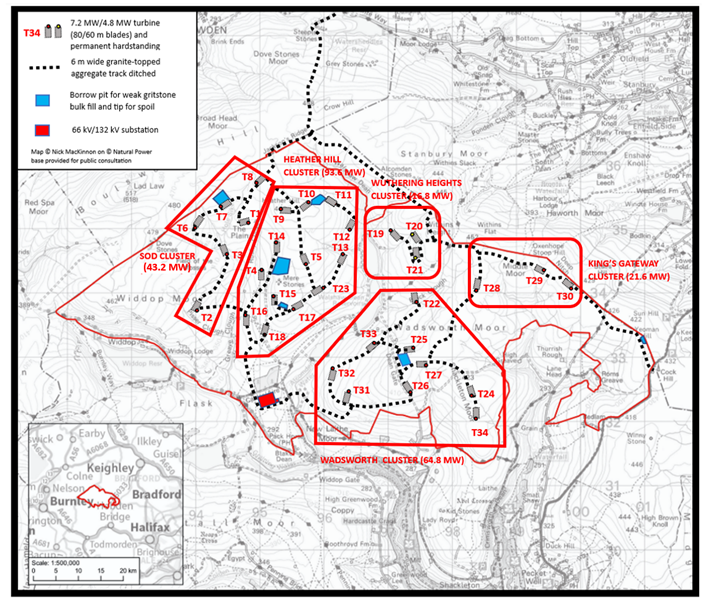
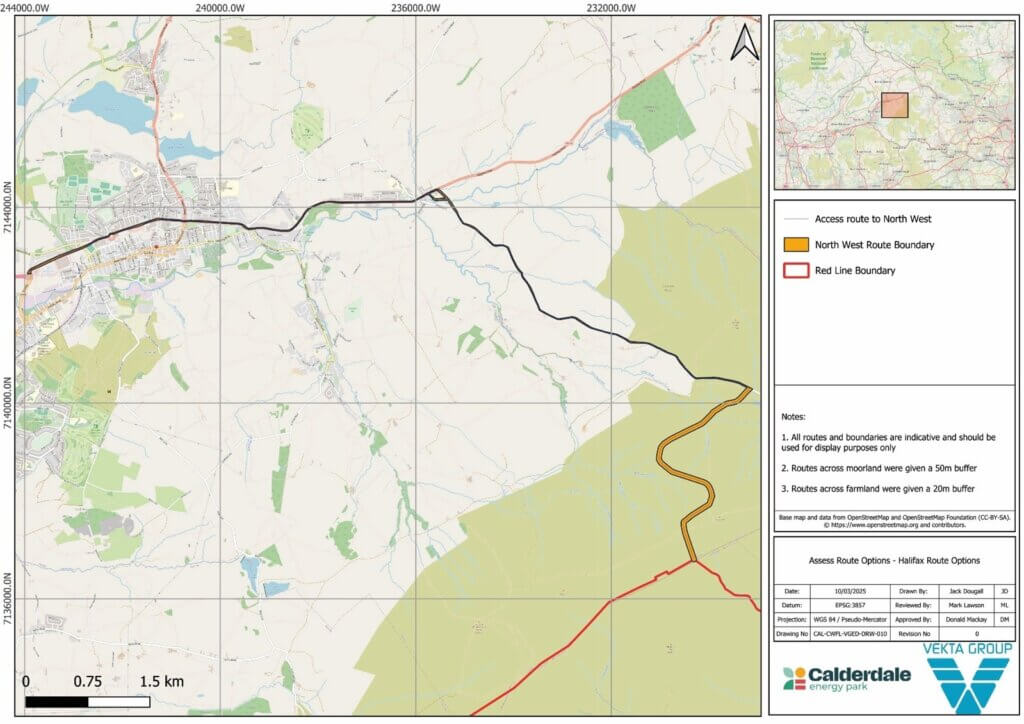
We start, and finish, far from our usual beat. A Preliminary Environmental Information Report (PEIR) is coming on 8 April, and we should finally have some six-figure turbine locations and proper maps: CWF Ltd must start placing their bets. It is not possible to do 1:25000 analysis of the turbine locations using the Google map provided (from which I made the one above) and while we wait for the PEIR, we shall extract what we can from the only public slide of the access corridor.
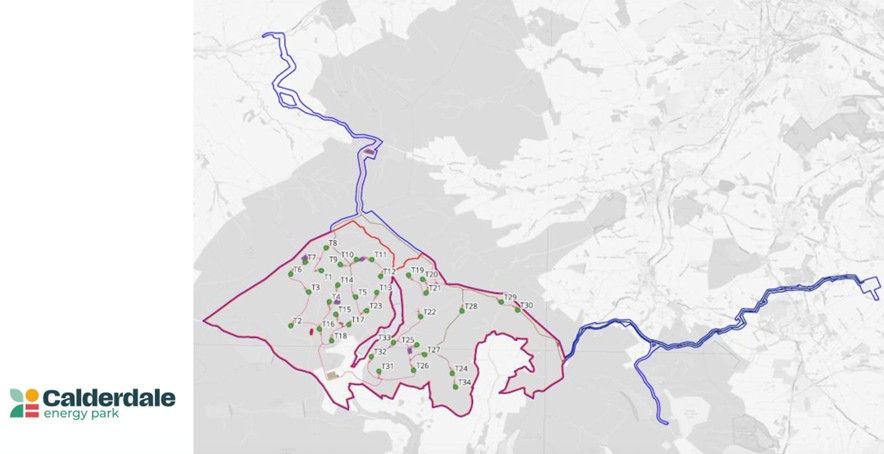
The important thing about the map above is that the export cable starts at a substation southwest of the reservoirs and has a hard 8.4 km journey under thermally smothering peat before it reaches the edge at the Cock Hill elephant. The next 10 km to Bradford West may be less expensive and is still underground. The relative cost of this connection dominates the finances of CEP.
It is typical of CWF Ltd to open the consultation and publish complex documents simultaneously and then shut the consultation before anyone can ground truth their nonsense. We now have ample proof of their failure to conduct adequate consultation in the Non-statutory Consultation and the Scoping Report. The behaviour of CWF Ltd in this matter will not escape the censure of the Planning Inspectorate, particularly as both involved incompetent documents. It has been the work of this blog to be on the front foot with what is coming next by extracting the maximum possible from the poor information released in advance. After two years’ work, we know where the bodies are buried. First, we need to put the access corridor through Laneshaw Bridge on a proper map base.
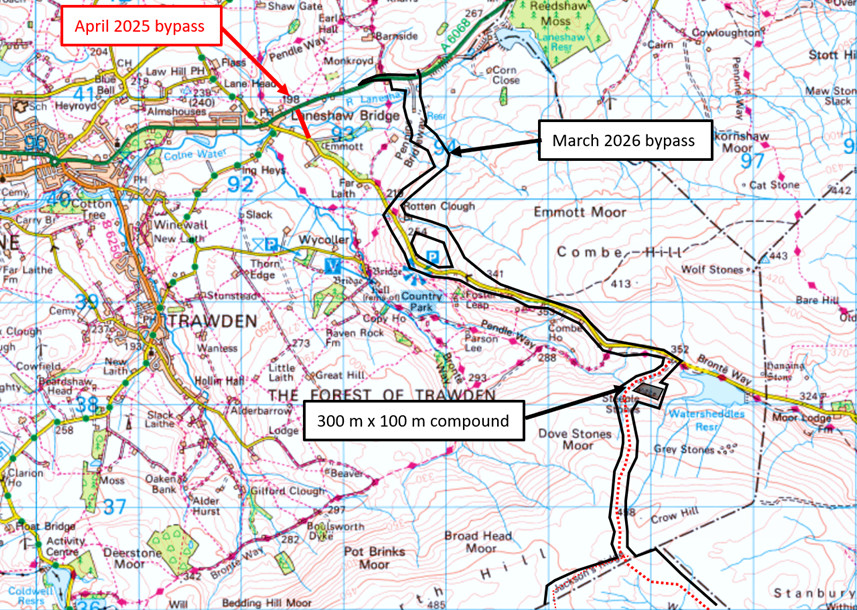
The access mystery, which has perplexed CWF Ltd since the beginning, now has a sort of solution, and the electricity bill-payers will want to know what further demands Christopher ‘440 Kelvin-Volts’ Wilson is making on their money.
In Laneshaw Bridge the tight housing either side of School Lane south of the weak bridge and on the swept path to the north makes it impossible to turn an 80-metre turbine blade. At the Non-statutory Consultation, a short bypass was proposed (shown in red on the map above) and as Donald Mackay put it when I asked him, “Some minor realignments” to the Lancashire Moor Road beyond. I asked, “A million quid?” and he said, “You get a lot of roadworks for a million quid.” I was closer to the truth than he was at that point, both in the hazards of his moorland track up Crow Hill (which he has now straightened but which is still the riskiest thing in the proposal) and in what would be needed for the Laneshaw Bridge bypass, which will be more like £2 million quid.
The disastrous Logika Scoping Report of September 2025 was still unsure about where the stone was coming from; the implied model was to do the civil engineering from the east at Cock Hill on the A6033 and then deliver the turbines from the west through Colne. It was clear to us that this was not going to work if most of the imported stone had to be granite brought by sea to Ellesmere Port, not sphagnum-killing limestone from the Dales, because the granite deliveries could not get up out of Hebden Bridge. It was clear that all the stone as well as the turbine components would have to come through Laneshaw Bridge.
When delivering turbine blades, it can be enough to dump some gravel on a verge to get a trailer wheel round a corner; in a 10-turbine wind farm, that gravel ramp might only support one wheel of 30 trailers. As we observed, these “minor realignments” to allow the passage of the 80-metre blades would not be enough to turn the Lancashire Moor Road into a two-way delivery route for tens of thousands of stone deliveries. We end up with the major Laneshaw Bridge bypass and another two million quid on our civil engineering bill. It might have been a public benefit to re-engineer the existing road, but the cost of doing that to highway standards is far greater, and this is our money in the end.
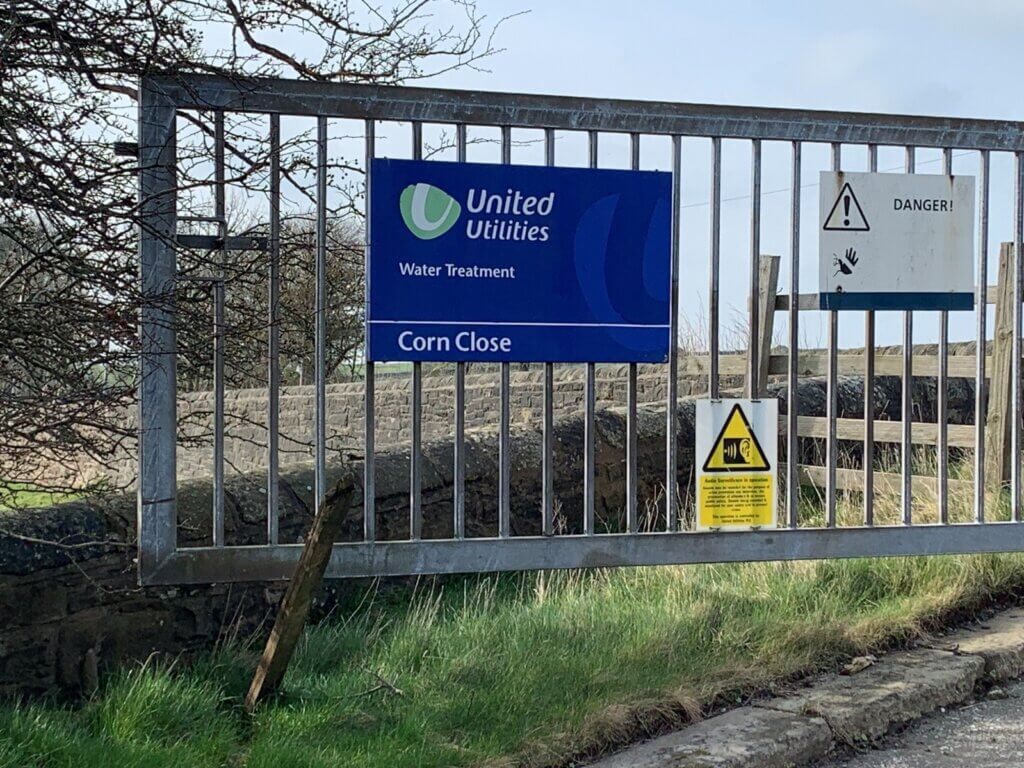
The bypass would leave the A6068 parallel to a concrete track track serving the United Utilities Corn Close water treatment works. UU have the Lancashire side of the watershed; at the other end of the bypass is Watersheddles Reservoir, owned by Yorkshire Water.
The A6068 is a racetrack, and the cars were passing at over 70 mph when the dog and I crossed at the blind corner. The bypass entrance must have lorry controlled traffic lights, or a collision between a speeding car and a slow turning aggregate lorry would be inevitable.
The concrete track is graced with a rusting 666g canister of Cream Deluxe, enough nitrous oxide to make 120 litres of Chantilly. These are much cheaper per serving than the familiar 8g silver canisters, and are stocked in vape shops like the one that recently destroyed a glorious building by Glasgow Central Station. At Corn Close the dairy abusers wolf down their profiteroles while thinking, “This would be a great place for some fly tipping”. UU should keep their gate locked.
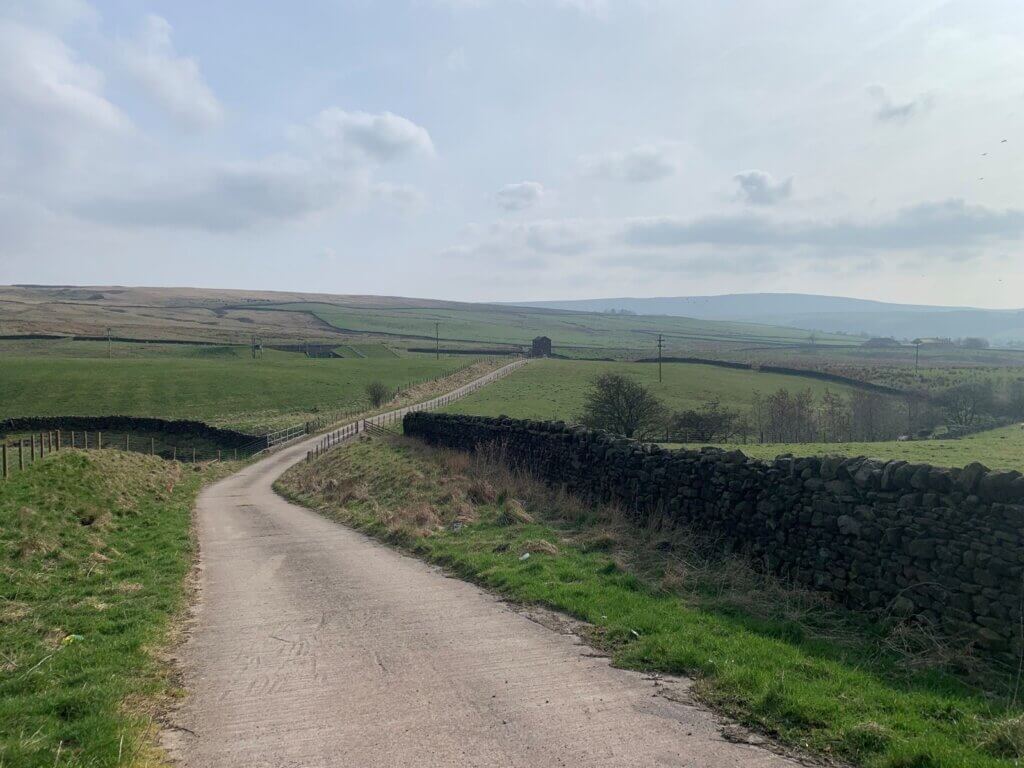
The UU track is only 3-metres wide and not strong enough for the wind farm abnormal loads (5 m width required) which would include two 100-tonne transformers for the 66kV/275 kV substation at distant Sutcliffe Plantation. The bridge is too narrow. Because of the reservoir, the bypass must go right of the works and therefore start right of the dry stone wall. The UU infrastructure and the CEP proposal are not compatible and can have little overlap. Although a wide splay will be needed to turn the blades off the A6068, 99% of the traffic will be orthodox 20-tonne loads of stone delivered in the working day, and the empty returns. The turbine component deliveries, 34 convoys, would be made at night, with the roads closed in sequence from Boundary Mill in Colne to the Watersheddles site entrance.
On well-sited wind farms there is far less local disruption during construction because almost all the stone is won on-site from borrow pits. The weakness, porosity and susceptibility to frost of West Yorkshire gritstone when crushed to aggregate means that on-site stone can only be used as bulk fill in the deep subbase of roads, and not at all in concrete. The six borrow pits that are proposed (swimming-pool blue in the first map) are mainly to create voids to dump the excavated peat and other spoil. The bulk fill extracted from the CEP borrow pits is equivalent to the cheap waste from the quarrying of the high-quality building stone that defines Brontë Country. The PEIR should include a full account of the stone deliveries.
The people of Laneshaw Bridge, on whom the imposition would be a grim, know that the Planning Inspectorate put a low weight on local concerns (one councillor said “low means zero”). The key arguments against Calderdale Energy Park are international: it is wholly within a Special Area of Conservation (peat), a Special Protection Area (curlews and lapwings at record densities) and the outstanding universal value of the Brontë Moors (defined by the same boundary as the SAC and SPA). This is unprecedented. The national argument is that the poor site choice means the electricity would be expensive and dirty: the bill-payers must finance the unprecedented destruction while the atmosphere takes a front-loaded carbon hit.
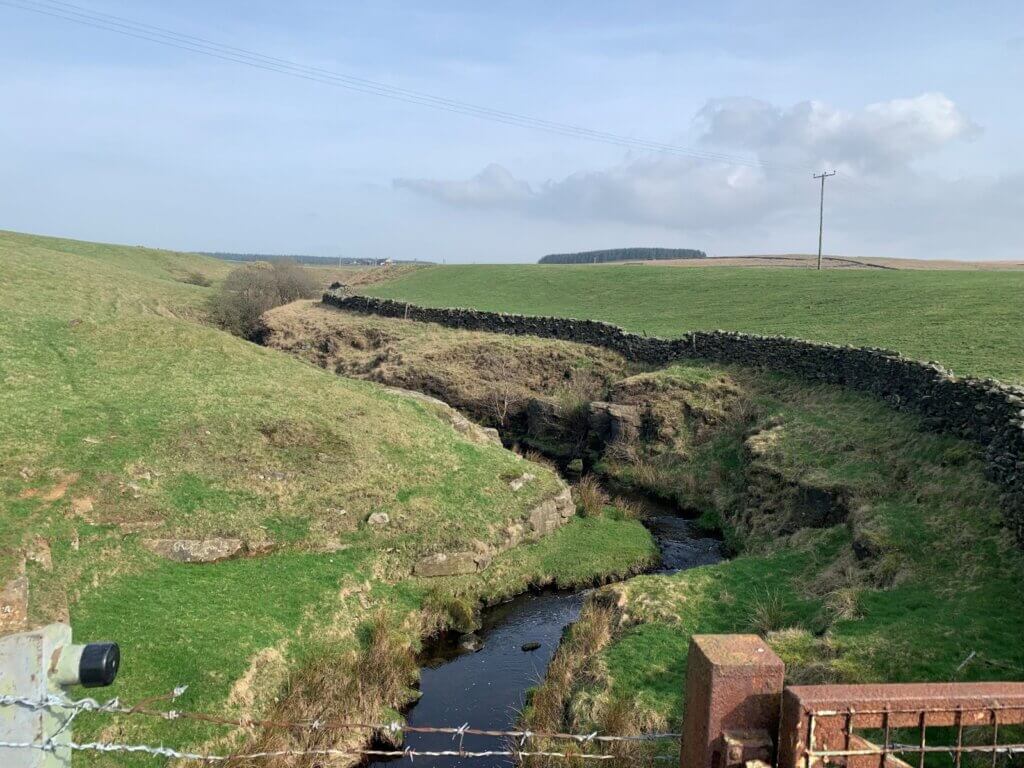
At the river, CWF Ltd will try to persuade the Environment Agency, and indeed United Utilities, that a box culvert and aggregate embankment is an adequate crossing, and this discussion will be had at every watercourse in the proposal. The EA hierarchy is led by clear span bridges with enough clearance for climate change induced flooding. Bridges should have no parapets so that flood water can pass over. Box culverts accelerate water flow, erode the stream bed and can be blocked.
The rest of the route is surveyed from the other end where my public-interest trespassing could be more discreet. The ground is not difficult like a peat bog, and as the route is just outside the South Peninnes SAC, cheaper limestone might be permitted by Natural England if United Utilities accept thousands of tonnes of mobile bicarbonate ions in their soft water catchment.
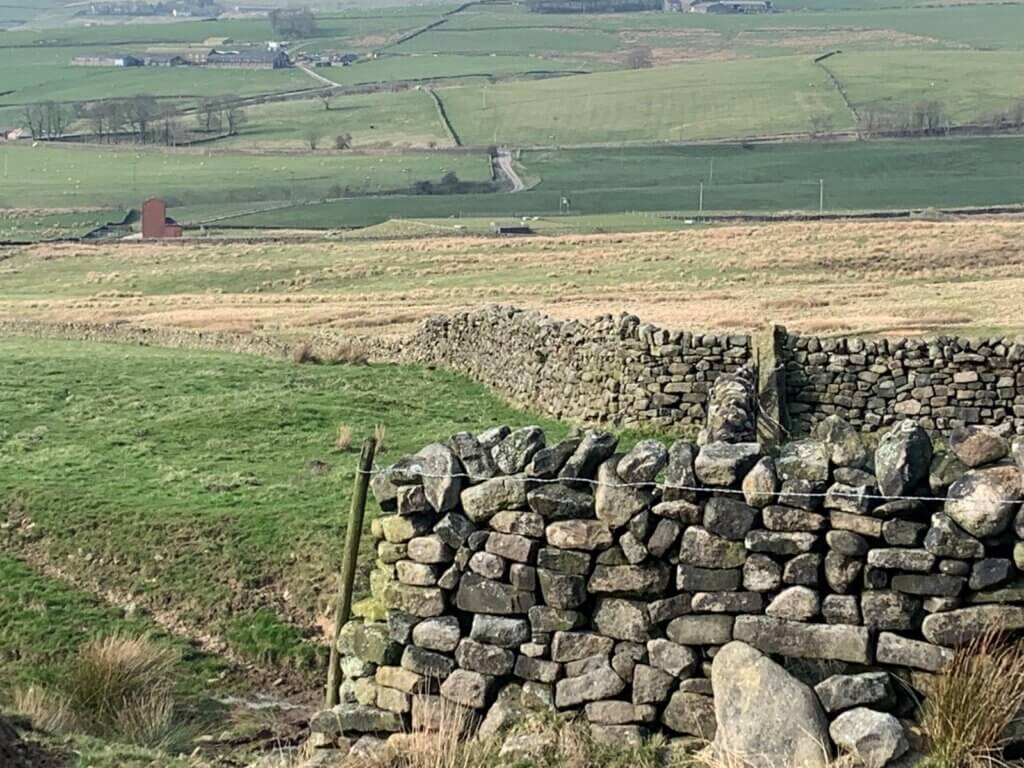
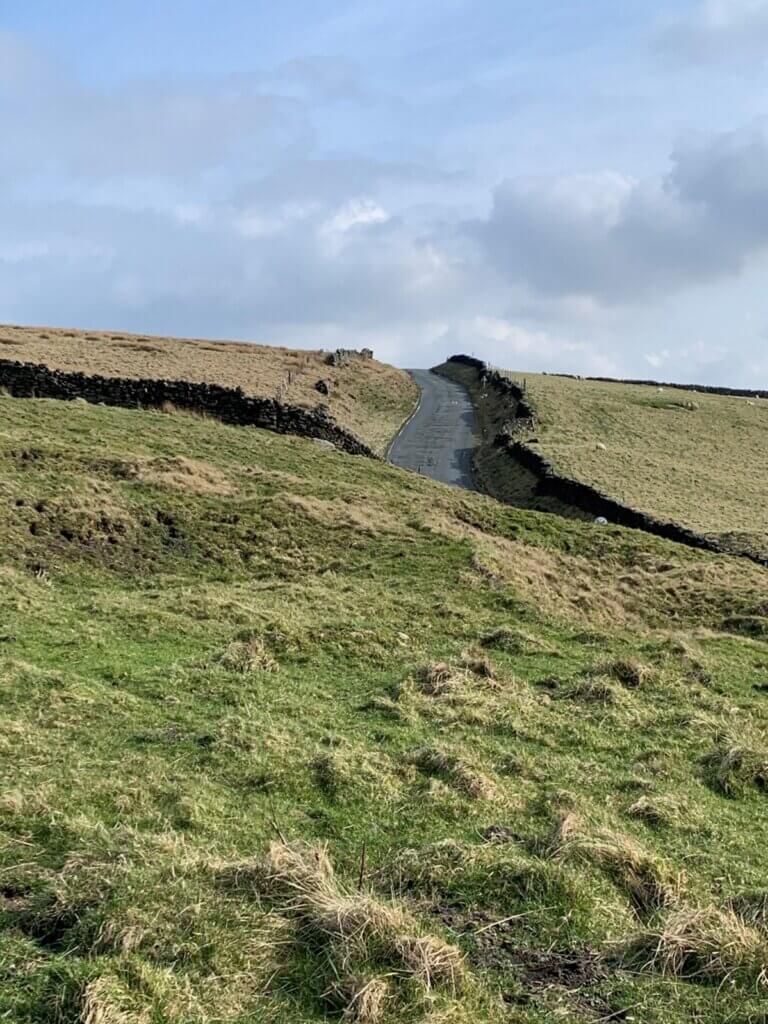
Now the bypass contours across the grazing (behind the camera) until it meets the public road at the bridge over Ratten Clough.
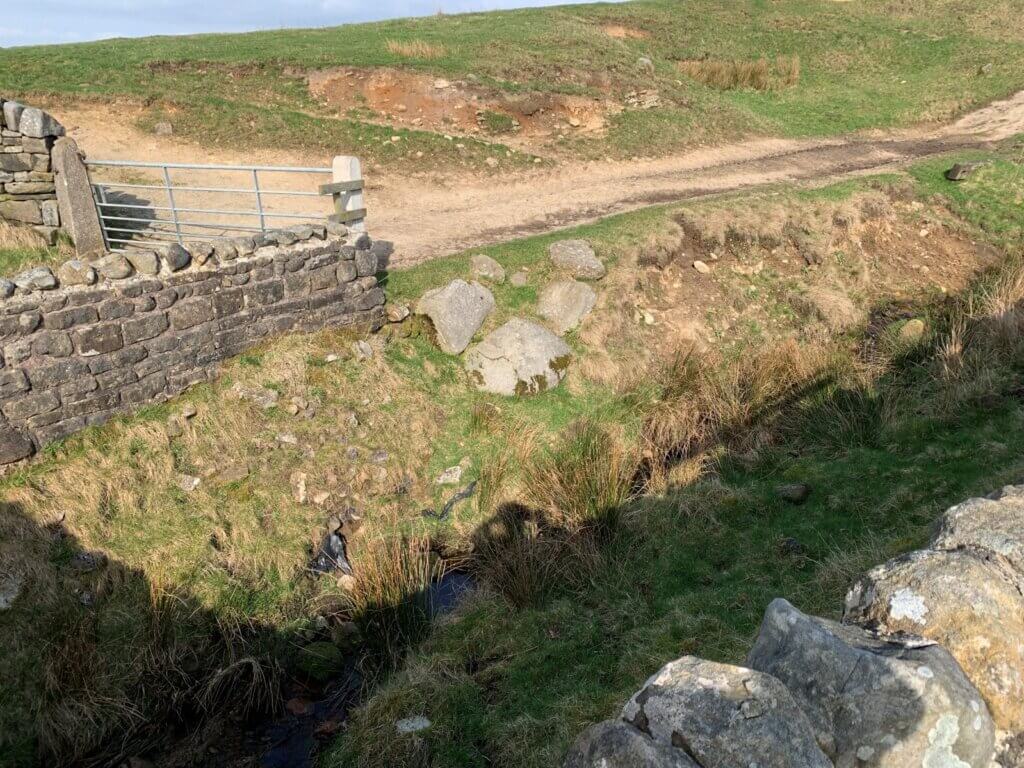
The alignments seem to require a new bridge here, rather than use of possibly adequate public one, because the bypass immediately goes up the side of Rattan Clough at a 13% gradient. Another sudden change of direction to avoid the SSSI moorland brings the road across Herders Common to another awkward alignment with the public road near the entrance to Foster’s Leap.
A proposal that is so destructive of red-listed bird assemblages will hardly concern itself with the many lapwings that are nesting on the bypass route. Christopher Wilson may think that Calderdale Energy Park is a jolly good way of using them up.
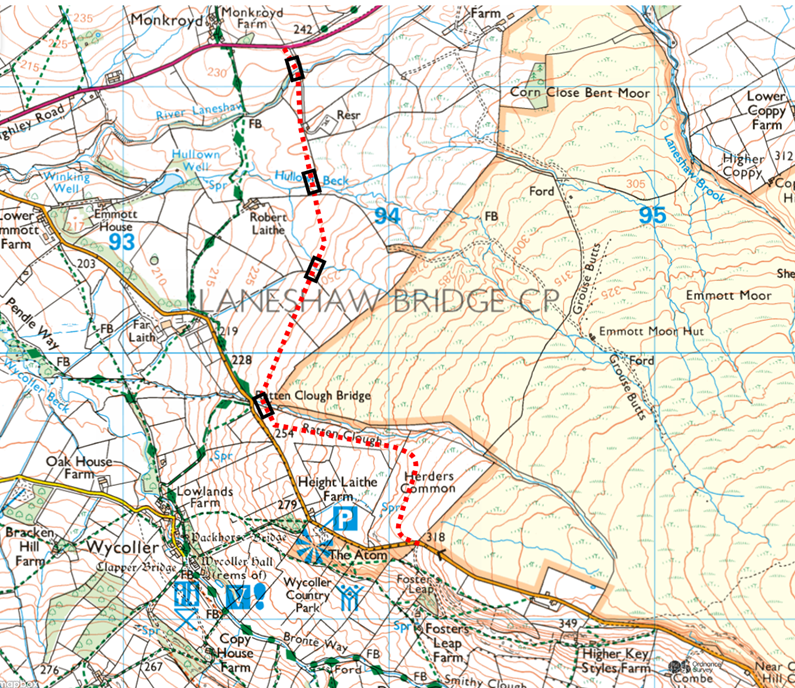
There are pinch points to come, some with houses very close to the road, but nothing that the bill-payer’s money can’t solve.
All this is an extra £2 million, small beer in some ways compared to the cost of the 18.4 km buried cable from Sutcliffe Plantation, mapped here, drilled below the gorgeous peat on the Wadsworth Plateau, along the Brontë skyline and then trenched somehow across Thornton Moor to Bradford West. I cannot square the cost of this unusual engineering with the rest of the budget. Every new wind farm will pay about the same for its turbines, but CEP pays a lot more for its complex civil engineering and hugely more for its buried cable, so it will need a very high strike price for its peat-stained electricity. A company wanting good vibes might pay a premium price to take the electricity, but not to be associated with the destruction of curlews and world famous cultural heritage. The government also won’t want to force the bill-payers to subsidise the destruction by accepting an inflated strike price, because that brings Net Zero into disrepute. There are ways out of this engineering bind, but not at 240 MW by buried cable to Bradford West. At 130 MW, carried off overhead on wooden poles to Rochdale, the destruction of the SPA, SAC and outstanding universal value of the Brontë Moors becomes even more disproportionate but at least they might be able to sell the dirty electricity to companies that don’t mind the ignominy, Cream Deluxe, for example. The local Labour MPs, Josh Fenton-Glynn, Jonathan Hinder and Oliver Ryan, can come out of their shells and save their seats: Calderdale Energy Park is a great big dud. For Robbie Moore in Keighley & Ilkley it is the gift that keeps on giving.
Let’s get the great big dud up onto the moor!
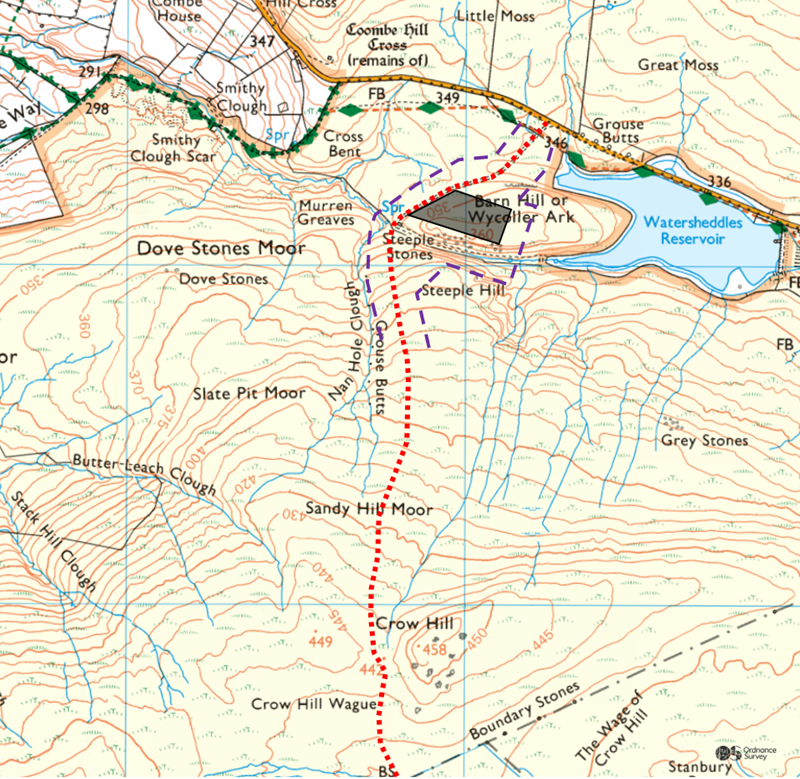
Readers will remember how Donald Mackay first drew this access track. The map below is primary evidence of the carelessness with which CWF Ltd conducted the unlawful Non-statutory Consultation. The unlawful conduct of the NSC and the incompetence of the Scoping Report paint a clear picture of corner cutting that will be presented to the Planning Inspectorate. It would have been easier and cheaper for Christopher ‘440 Kelvin-Volts’ Wilson to have done all this properly, and that would also have saved him months in his race to get this in front of Ed Miliband. This is not “newts”; this is an inexperienced start-up flailing on an unsuitable site.
The revised track goes from flat, through the trapezium, into 150 metres of 17% gradient. There is a lot to do to make that work and it must all be explained in the PEIR, with peat depths and a full peat management plan, or the whole proposal is dead. CWF Ltd cannot stand a fourth set of incompentent documents (CWF website September 2023-October 2024; CEP launch documents April 2025; Logika Scoping Report September 2025 have all been shredded, with admissions of uselessness and error made by the consultants).
John Page observed the sideways traverse on the convex slope was a peat slide waiting to happen in a place where the biggest one ever recorded in Britain was witnessed in 1824, by Emily Brontë when she was six. We mapped Mackay’s track on a contoured map, measured the peat depth on the traverse across Sandy Hill Moor on the first legal day, and wrote a detailed Scoping Opinion (p 386) that’s on the Planning Inspectorate website.
Our argument was incontrovertible; the only way the access track might be made less dangerous is to go straight up, and now that’s what Donald Mackay is proposing, despite the sustained steepness at the start. All the peat must be stripped off, creating a two km canyon through an SAC that is filled with aggregate, none of which can be quarried onsite, because we are not onsite yet. The remaining peat either side will drain into this aggregate-filled French drain and also put sideways pressure on the track. This stripped peat and other spoil from benching the subgrade has to be stored in the black trapezium and then dumped in a borrow pit higher up. Below the peat is a layer of yellow boulder clay, spread like butter by the glacier over the bedrock gritstone. Boulder clay is competent ground for road building and a geotextile will be laid on it, to get some grip on the loose stone. This is not a place for weak gritstone aggregates, and granite will be used all the way down to the geogrid. Where the relatively permeable aggregates meet the impermeable boulder clay will be a water-lubricated shear zone, the same shear zone that caused the 1824 Crow Hill bog burst. Because the 17% stretch is beyond the safe gradient limits of even an ordinary aggregate track to a single turbine, engineering measures to stop the aggregate sliding down hill under repeated massive loads are needed. This should include a a benched subgrade cut into the clay and bedrock to make a staircase, and also (further up) pinning of the adjacent peat to the bedrock. Specialist locomotion would be used to get the components up the 17% slope from the standing start. With the double ditches and sloped batters to grade the aggregate canyon into the surrounding ground, the disturbed width will be about 11 metres, creating about 40000 cubic metres of peat waste once decompressed. It is essential to get water off such a long steep track and into the dirty-side ditch as soon as possible, or a single rainstorm will destroy the surface, so there will be many expensive diagonal bars made of reinforced concrete to kick the rain off. The new drainage line is aimed at the peat pile in the trapezium.
This is the most vulnerable track in the proposal, and yet everything must come over it. Were it a single-turbine delivery track, the turbine would be deleted. CWF Ltd’s problem is that they have made this track existential to their proposal even though there was an alternative. It will cost £2 million to get over Crow Hill from the Peat House, after which the track can float for a bit.
Donald Mackay’s previous track used bends to reduce the gradients, but he hadn’t measured the peat depth. When I buried my three-metre probe almost to the hilt at the end of his traverse on the first legal day (1 August 2025) after the Non-statutory Consultation had closed, I knew his track design was faulty. This is not a normal wind farm entrance track, and the only excuse is force majeure again. “You have to let us come straight up here because we have no other route to site.” That is not strictly true. There is a peat-free alternative, mapped at the Non-statutory Consultation that closed on 10 June 2025 and abandoned without comment in the incompetent Scoping Report published on 3 September 2025. The consequences for Halifax were evidently assessed as so bad that the peat slide risk on Crow Hill and now the destructive Laneshaw Bridge bypass were thought preferable. Collets of Halifax, the world-leading wind farm delivery firm, one of the most innovative companies in the UK, were well-placed to advise, if they did, especially as they had done the nightmare raised blades deliveries through Hawick, just 33 sixty-metre blades, not the 102 eighty-metre blades which would come through Halifax.
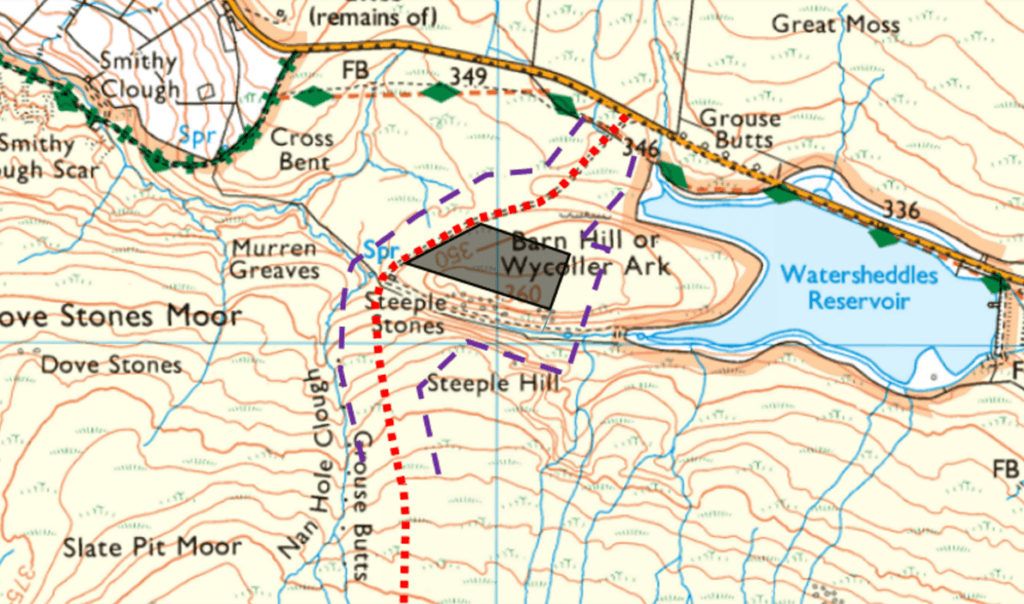
The black trapezium, like a clot in the purple corridor bulge at the Bannister “Peat House” (the clue is in the name) maybe the main entrance compound. One of its first purposes will be to store the peat stripped off the track above until a final dumping place can be found in the borrow pits. The track is too steep at 8% plus to dump the peat alongside (pending disposal) as might be done elsewhere. The trapezium is only just big enough to receive the 30000 cubic metres stripped off the access track, if the maximum storage depth of 2 metres is used. Once the peat is picked up again and dumped in the borrow pits above, the trapezium can become a compound. The idea that the complex internal structure of the peat can survive “dig it-dump it, leave it to dry, dig it-dump it” is absurd. Left to itself, peat is a carbon sink and the basis of a rare and irreplaceable habitat. This huge pile of peat slurry is dangerous and expensive industrial waste, not an environmental resource.
They will claim the trapezium drains into Lancashire. Yorkshire Water who own the adjacent Watersheddles Reservoir will insist on stringent hydrological separation of the compound from the reservoir, because there is a lot of insulation oil travelling up in the turbine transformers and a lot of silt from the granite aggregate used to surface the compound, and first of all a lot of oily water, poisoned by heavy metals from the Industrial Revolution, seeping out of the peat dump. This filthy liquid is what lubricates my flimsy aluminium avalanche pole three metres down. It is not normal to store industrial waste so close to a reservoir. As with everything else, CWF Ltd will claim some kind of force majeure: “We have to put the industrial waste right next to Watersheddles Reservoir because there is nowhere else for it to go.”
“We have to build this destructive bypass or we can’t get the turbines onto site.”
“We have to strip off this peat because the slope is so steep and unsafe.”
“We have to destroy these red-listed bird assemblages because our wind farm is in an SPA so obviously there are lots of rare birds in our way.”
“We have to open these borrow pits on an SAC even though they can only supply weak bulk fill because we have to dump the peat slurry somewhere.”
It’s all fake force majeure with Calderdale Energy Park and all consequent on a terrible site choice and a failure to examine the alternatives that the planning system ostensibly demands. As Donald ‘Transparent’ Mackay, with the refreshing truth-telling that is his most potent asset, told me at Trawden, “Looking at alternatives is never how these stories go. We have a single landowner of a huge plot and we apply for planning to build a wind farm on his land.”
He may have signed off a hasty design for the S-bends of the moorland track up to CEP, but Donald Mackay is the only obviously competent person in the skeleton crew that constitute the management of CWF Ltd. Whatever Christopher ‘440 Kelvin-Volts’ Wilson is paying to keep him aboard the wreck is not enough, and it is a waste of his abilities to be chained to this great big dud. Donald ‘Transparent’ Mackay’s “I will say this in front of the children” frankness should be central to the national discussion of on-shore wind on protected peatlands. If we demand expensive dirty electricity generated on peat then it will not be unicorns and rainbows. It will be immediately destructive of nature.
++++++++++++++++++++++++++++++++++++++++++++++++
This is the 55th in a series of guest blogs originally based on the 65 wind turbines which Richard Bannister planned to have erected on Walshaw Moor.
The developers canned their original 65 wind turbines, quite possibly in response to the public humiliation of having their so-called ‘plan’ publicly shown to be damaging, irrational and probably unlawful. They came back with a plan for 42 wind turbines and the amazing Nick MacKinnon and friends ridiculed that so-called plan. Now the developers have brought forward a 34-turbine revision – the series continues.
To see all the blogs – click here.
[registration_form]
Thank you for a great explanation as to is happening and what may happen. I live in Colne close to Laneshawbridge.
I hope we can stop this madness! I will email our MP. He should be bothered!
Thank you for the proposed and moreover the detailed destruction of our country side
We pander to net zero call from government London based forgetting the impact on local and visiting people.
Myself having traveled this area all my life as a resident from the Keighley its one of the best country road routes across the moors its stunning views of peat moors and the history behind it ,the cost of such a plan surely out ways the gain.
Its now becoming evident that the cost of producing electricity in this manner isn’t cost effective and not wanted by the majority of tax paying people.