The two most important recent reports on the operation of the SSSI mechanism in the UK have been published by Wild Justice, which is a bit odd when you think about what that means about the rest of the wildlife conservation movement.
The first, A Site for Sore SSSIs – click here, demonstrated that English SSSIs were not being monitored to assess whether they were meeting their targets to conserve wildlife and that some of these sites had not been assessed for over a decade.
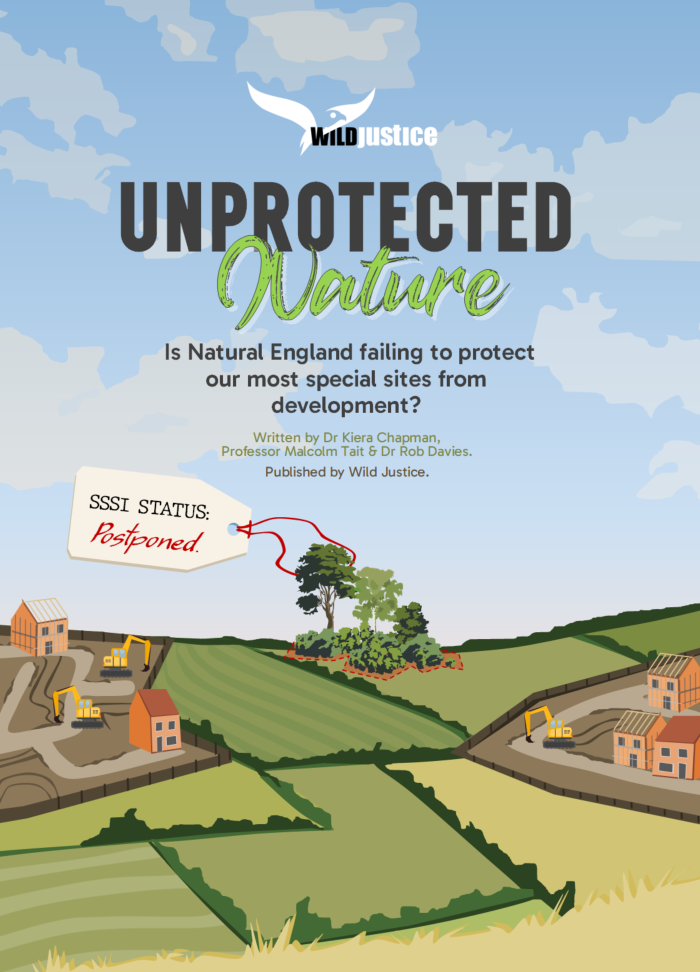
The most recent, Unprotected Nature – click here (produced by the star partnership of Kiera Chapman and Malcom Tait (who produced another Wild Justice report, Lost Nature) this time with Rob Davies) details the failure of Natural England to continue to designate sites that qualify as SSSIs. The pipeline for new SSSIs has practically been turned off. It’s as though statutory site protection has ceased to exist and no-one, except Wild Justice and their collaborators, has noticed.
I wonder what is happening outside of England in the other three UK nations. I’m a fan of devolution as a principle but it does have practical difficulties too. Who is doing what Wild Justice has done for England for Northern Ireland, Wales and Scotland? Are things any better elsewhere? I wonder, but sitting in rural Northamptonshire I can’t really know.
Natural England’s boards over the years are partly to blame for these failures. Site protection, through designation (although ownership is an alternative) is a fundamental part of the work of a statutory agency. NE had its budget dramatically cut in 2010 and it has been harried by right-wing Conservative MPs ever since so it would have taken bravery and a true grip of what the job of a statutory agency is to stand up to government but the bottom line is that site protection is almost the very last thing that should disappear from the work of an organisation such as NE. Since Labour arrived two years ago the political climate has been for sweeping aside anything that might affect the profits of house builders – the Labour government has been too dim to see that the house building industry will not deliver cheap housing however much so-called environmental red-tape is cleared from their path. This won’t have made a very timid Natural England rush to open that pipeline of wildlife-rich sites that need protection.
It’s easy to make up a story for why things are so bad in England but it would be really interesting, and perhaps very useful, to see an analysis of these issues in Wales and Scotland (less so in Northern Ireland). Are SSSIs monitored? If not, why not? Are SSSIs in good condition? If not, why not? And are suitable sites for designation as new SSSIs still being advanced? If not why not? Is this a particularly English problem, caused by England’s recent political shambles or isn’t it?
,
[registration_form]
Hi Mark
I don’t know the in’s and outs of SSSIs.
But I do know that many have fallen beyond the purpose they were designated for – and what’s further annoying, I’ve been frequently told that radical changes to improve them for wildlife cannot be made because they are SSSIs.
We all know Natural England is not fit for purpose. Responsibility for that rests firmly with the last Conservative Government – and Labour has yet to be in a financial position to improve things.
But at least you would think that every project NE is able to get involved with will improve the site for wildlife.
But it doesn’t.
A good example of that is a nature reserve near me called Houghton Washland.
Owned by the Environment Agency – managed by RSPB Old Moor (Dearne Valley) and NE.
Since RSPB / NE management we have lost all our breeding lapwings (2018 – 24pr) and snipe (2018 – 6pr). These organisations have been frequently asked about the lack of on site management but have refused to debate the matter.
The paradox is this – because NE exists the general consensus is that our natural environment is being well cared for.
But look closer – and you find that it isn’t.