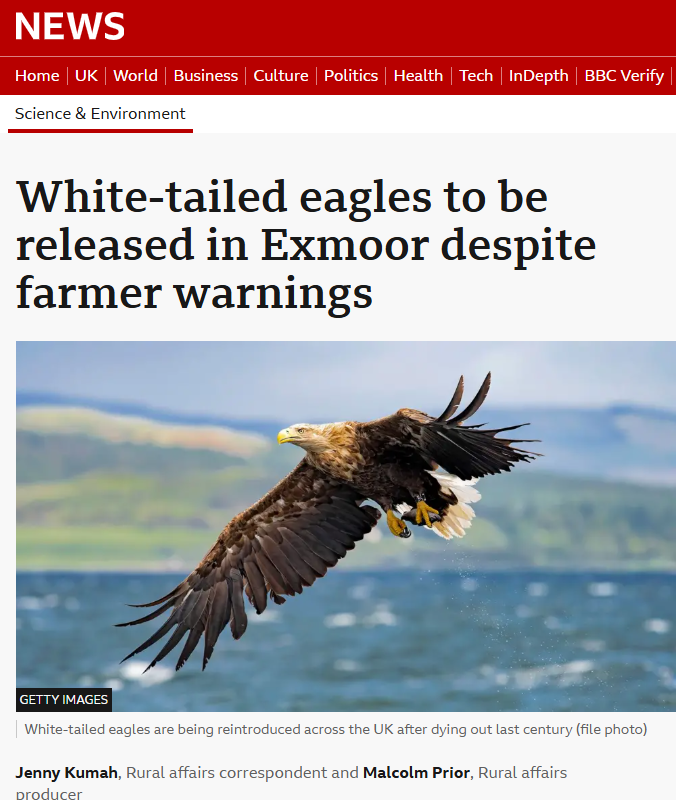
Exmoor is an upland area of almost no value in terms of food production – that’s why the recently produced England Land Use Framework – click here – had it shaded as an area for above average land use change. Exmoor is also a National Park. If we can’t put hook-beaked biodiversity back in a place like Exmoor then we’re going to be a bit stuck.
The most vociferous local opposition to this plan from Forestry England and supported by Natural England wasn’t very vociferous at all as far as I can see. The intemperate words all come from Scotland and the NFUS.
The Isle of Wight White-tailed Eagle reintroduction which is going pretty well faced similar opposition from local farmers. I’m not aware of any serious issues of losses of live lambs to eagles, and if there were any then I’m sure we would all have heard about them.
It’s entirely possible that dead or sickly lambs might be taken but that will partly be a sheep husbandry issue and partly an impact that should be set against biodiversity gain and increased tourism revenues.
The measure of a good public policy is not that nobody at all is disadvantaged even by a little bit, it is whether the public benefit overall is positive. Conservationists do not have to argue that eagles never take lambs to support this project, merely that the lamb losses are no big deal compared with the wider benefits.
I wonder where these eagles will end up; feeding in Bridgwater Bay in winter, nesting along the Somerset and Devon coast or maybe nesting on Lundy?
[registration_form]
This is very good news. Some might end up nesting on the Avalon Marshes.
Slowly, ever so slowly, we are getting our fauna back.
Those objecting to this are the “usual suspects” who as usual shout loudly about the threat to sheep farming due to lamb losses, the risk to pets and at least one fool the risk to children. All bound to grab headlines but frankly all without a shred of real evidence. WTEs are huge, imposing creatures but not the fierce predator that might engender preferring carrion and klepto-parasitism to hunting. Yes they kill some of their own prey, fish, birds ( up to the size of geese-one hopes they get a taste for Canadas and Egyptians) and mammals. Taking live lambs is, yes a possibility but rare and in an English context NONE have been taken since the IOW releases anywhere in England. Given that England, and these birds have wandered widely, is home to millions of breeding ewes that ought to be taken as a very very very low risk.
I welcome this prospect that has a far more likely and easier prospect of success than golden Eagles into the North of England with not only the voices of the sheep industry ( NFU etc, again with no real risks) but that whole area of grouse moors and so called “sport shooting” with its seemingly inexhaustible supply of wildlife crime and wildlife criminals with their well known intolerance of hook beaks that might just eat grouse.