
These seven south-facing solar panels were installed in early July 2025 so we’ve had them, and the battery they fill when our electricity production is greater than our immediate need, for just over a year.
Overnight, when there is no solar generation, we use whatever electricity is stored in our battery and then switch to the grid. During the day, there will be solar generation (lots in summer, little in winter) and the battery gets a top up.
As of yesterday morning, our solar panels had produced three quarters (75.8%) of the electricity we used in the year (right hand column, consumption, below). We are paying Ecotricity for the 24%, some of it at the day rate and some of it at the night rate.
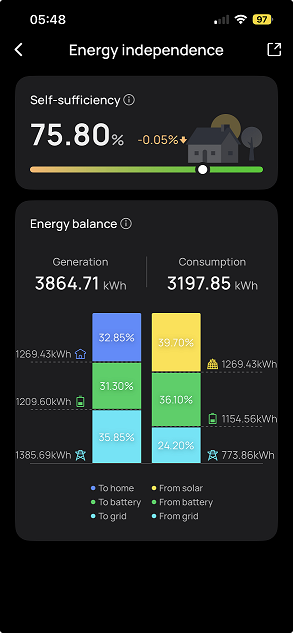
More than a third (35.85%) of our domestic generation (left hand column, generation, above) was exported to the grid because our battery was full and we get paid by Ecotricity for that at (now) 16p/kWh. Our home’s carbon footprint is reducing and we are contributing green energy to the grid.
But what of the money? It’s not completely straightforward to do the comparison, or to work out how much one is saving in real time. Why not? Electricity prices change, so with what do you compare? It’s not just what you pay that changes, it’s how much you get paid for export too; Ecotricity’s 16p/kWh came in recently. And, one’s behaviour changes too – we have deliberately shifted, modestly, towards using more electricity (because it is cheap and green) and less gas which results in gas savings which are difficult to estimate. Also, we now gladly ‘allow’ visitors to recharge their electric cars from our battery – a small cost to us and a much bigger saving to them. And rather prosaically, one’s electricity bills come monthly (but, of course, were not synchronised to the day that the solar panels began to work) and our payments for export are paid quarterly and there was a delay in getting an export contract because Ecotricity were rejigging their rates when our panels went live.
However, I estimate that we have saved around £800 off our bills in the last year (and I haven’t done the adjustments for gas or car-charging largesse, nor really have I built in the price increases). Today, we are paying more per unit of electricity we take from the grid than a year ago (so it’s good that we can limit their number) and we are getting more per unit we export to the grid than when we started. That feels like the future too although who knows?
The cost of getting panels installed was about £9,000 and so I could calculate how much interest I am losing from that sum to set against the savings. However, the £9,000 figure includes (as explained in a previous blog) the cost of removing old solar heating panels and the cost of scaffolding that was used to give access to workmen doing other things to the roof. I think an attributable cost of £7,000 sounds about right which would be 9 years, roughly, payback time – longer than the five years that is mentioned when one signs up. However, that is using the first year as a measure and we end that year, I repeat, being paid more for export and paying more for grid electricity. You might think, things can only get better because both export payments and import prices will continue to rise. What will they be in five years time?
We are very likely to get an electric car (and that will not be cheap to buy, and we’d need a charging point) but will open up more day-on-day savings.
All of this is predicated on the panels continuing to work.
The economics are a bit complicated but we didn’t decide solely on economic grounds. We’ve gone greener by having solar panels and that is worth an investment of our cash, just like it is worth an investment of the nation’s cash to deliver reduced carbon emissions.
[registration_form]
Interesting to see more real world results.
Are you just charging the battery to full then exporting? A friend has gone for more complex automation, and will top off the battery from super-cheap overnight electricity so he can re-export in the morning when demand surges. Their imports are higher than they might be, but bills lower. If the pricing market is working properly, that suggests that, oddly, they’re being greener by importing more – effectively being paid to help the grid smooth supply and demand 🙂
Martin – thank you. Yes, I haven’t figured that out yet but I know it’s a possibility. I need a lesson on driving the app!!
You mention cost of panels but not battery (unless this is included in the £9000/£7000. How would this affect the payback time? I ask because I bought panels and (more recently) battery and wonder whether I’ll live long enough to see financial benefits myself (or my children benefit from my estate)!
Peter – battery included in that price.