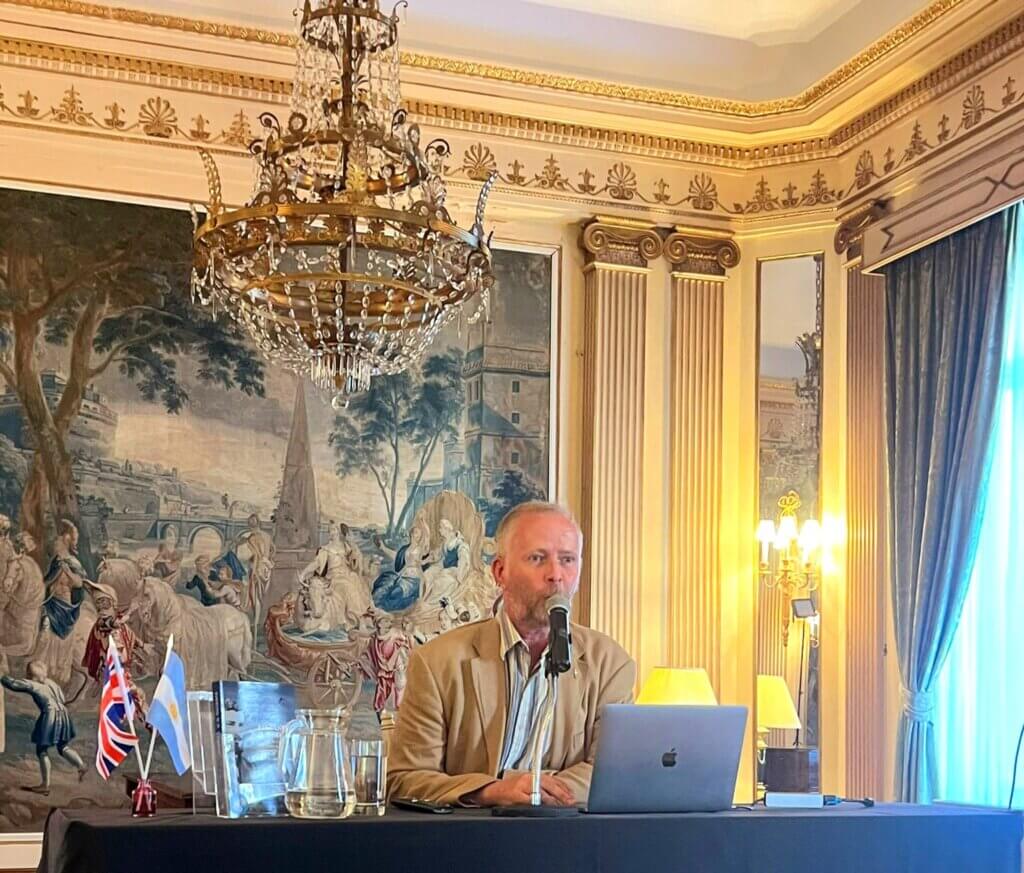
Conor Mark Jameson worked in conservation all of his career and now lives and writes in west Norfolk. He is also the author of Silent Spring Revisited (reviewed here), Looking for the Goshawk (reviewed here), and Shrewdunnit (a collection of his feature articles, (reviewed here)).
Conor’s biography Finding W. H. Hudson – The Writer Who Came to Britain to Save the Birds (reviewed here, is published by Pelagic.

A century has passed since the unveiling of a monument and sanctuary in honour of campaigning naturalist W. H. Hudson, in Hyde Park. Conor Mark Jameson has pieced together Hudson’s final campaigning summer.
‘I really didn’t expect to ever come back to London when I went away in November,’ W. H. Hudson wrote when he arrived in the city once more at the start of summer 1922. He hadn’t expected to survive another winter in Cornwall. He was approaching his 81st birthday, and his health was failing.
He got to London as soon as he could, like a late spring migrant bird on the tail of the warmer weather. But he wasn’t there in time to attend the reception hosted by the RSPB on 9th June at the Zoological Gardens in Regent’s Park. It was for Dr T. Gilbert Pearson, President of the US National Association of Audubon Societies. The campaigns to curtail the global plumage trade had made clear that conservation needed to be joined-up internationally. Pearson had given an address in the lecture hall after tea in the newly opened pavilion, but Hudson had been busy in Cornwall that day, donating his clothes to charity as he prepared to leave his late-life winter quarters for the last time.
Of course, Hudson would have been an honoured presence at the Regent’s Park event. It is likely that he had no wish to participate, even if he could have got there, due to a combination of failing health, his usual reticence of formal occasions, and a sense from him that his work in this line was done. It was now for others to take forward the fight for nature.
Pearson had crossed the Atlantic with a packed schedule ahead of him. Besides the Regent’s Park reception, he visited several European countries and then chaired the historic gathering of international bird conservation organisations on 20th June. It was hosted by Reginald McKenna, a former Minister of Finance, to discuss the formation of an International Committee for the Protection of Wild Birds. It launched what we know today as BirdLife International.
While Hudson took a back seat, his close male friends were well represented. Viscount Edward Grey of Fallodon was there, as well as H. J. Massingham, who visited Hudson a week later and no doubt told him all about it. William L. Sclater, son of Hudson’s old Zoological Society of London collaborator (on Argentine Ornithology, 1888) Dr Philip Sclater, was also present. There too was Earl Sydney Buxton, Dr Percy Lowe, Frank E. Lemon, Honorary Secretary of the RSPB (husband of Etta, who in a fairer world would have been invited); Jean Delacour, President of the Ligue pour la Protection des Oiseaux (LPO, now BirdLife in France); and P.G. Van Tienhoven and Dr A. Burdet of the Netherlands.
Their declaration of principles stated: ‘…by united action, we should be able to accomplish more than organisations working individually in combating dangers to bird-life.’
Hudson died two months later, on August 18th, at his home in west London. He had been on his feet to the end, frantically busy, making final arrangements to leave almost everything to the RSPB in his will, and for two more books to be completed after his death. A day before he died, he lunched with Helen Thomas, widow of poet Edward, killed in 1917 on the Western Front, to discuss how he could help her and her three children. They also talked about the destruction of crested tit and snow bunting nests in the Highlands that she had witnessed while on a recent visit there.
Hudson had lived just long enough to see the Plumage Act become law, from April 2022, more than three decades on from the first meetings of his beloved ‘Bird Society’ in Manchester and Notting Hill. But was it – and the devil in its detail – the law that the wild bird protectors wanted? There were certainly compromises, to overcome those who would continue to block it. Not all imported plumage was banned, and a list of exempt species was appended and would be subject to continued review and wrangling.
The existence of permitted plumage would – as expected – present problems for customs officials with limited ornithological training. And with no ban on ownership or sale of plumage – because such a ban was thought to be unworkable and unenforceable – unscrupulous dealers could continue to claim that their bird wares pre-dated the new law. There were many further seizures of plumage – including nearly 140,000 grebe skins in 1924, as these ‘furs’ continued to be promoted by the fashion industry. But there were few prosecutions – they averaged just one per year up to 1936.
The campaign effort on plumage law did not stop in 1922. Seven more bills to ban ownership and sale were introduced in Parliament between 1922 and 1940. All of them failed. On a happier note but amid much less publicity there was another victory for the environment and wild birds in 1922 when the Oil in Navigable Waters Act was passed, effective from 1923. There would now be fines for ships discharging oil within three miles of the coast.
Slowly but surely, the global trade in bits of birds for costume adornment died out. Hudson’s great friend Robert Cunninghame Graham would report in 1926 that egret feathers had no value in a city where they once were traded. One thing’s for sure: fashionable people don’t as a rule wear dead kittiwakes on their heads anymore.
After 1919 there were four attempts in the next eight years to introduce a Wild Birds Protection Bill. The first three failed owing to a lack of parliamentary time, and the fourth as too many amendments were tabled. The Wild Birds Protection Act was finally converted into law in 1954, another 32 years after the Plumage Act, and the death of Hudson. It was also the year that long-serving RSPB president Winifred Cavendish-Bentinck, Duchess of Portland, passed away. Tireless leader Etta Lemon had died the previous year, aged 92, having worked for the society until the age of 79 – she would have stayed on for longer if she’d had her way. Both had given more than 60 years’ devoted service to the cause.
Whether we realise it or not they laid the foundations for the work we continue today. We can take inspiration from the example they set, against what must have seemed at times overwhelming odds.