 Conor Mark Jameson worked in conservation all of his career and now lives and writes in west Norfolk. He is also the author of Silent Spring Revisited (reviewed here), Looking for the Goshawk (reviewed here), and Shrewdunnit (a collection of his feature articles, (reviewed here)).
Conor’s biography Finding W. H. Hudson – The Writer Who Came to Britain to Save the Birds (reviewed here, is published by Pelagic.
Conor Mark Jameson reflects on an important anniversary for conservation campaigning.
If anything demonstrates the scale of William Henry Hudson’s achievements and renown by the end of his life it is surely this: the British head of government attending the official opening of a large chunk of the English capital’s principal royal park, dedicated to the memory of a humble writer-naturalist-campaigner from the Argentine.
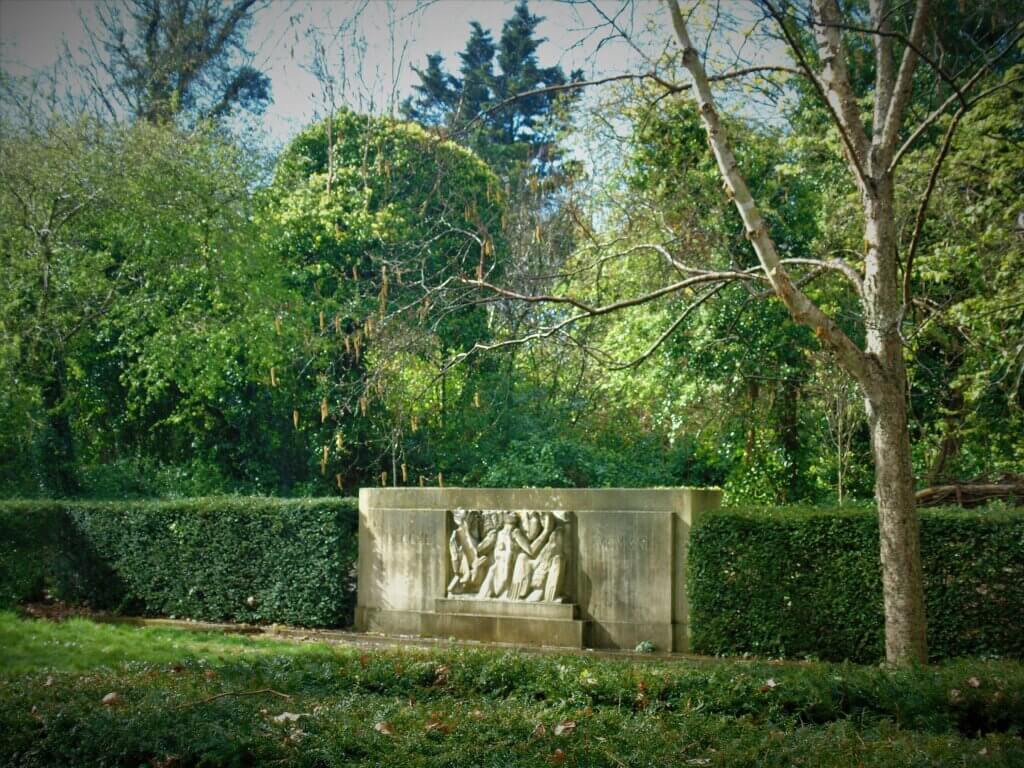
It was Tuesday 19th May 1925. The birds were singing on a bright spring morning. Conservative Prime Minister Stanley Baldwin had been introduced by master of ceremonies Robert ‘Don Roberto’ Cunninghame Graham (the first socialist MP) and stood poised and ready to pull the cord, to unveil a monument: a sculpted slab of Portland stone the length of a motor bus, centrepiece of this newly created sanctuary. Baldwin’s mother had passed away just a few days earlier, her funeral yet to take place, but he was never going to miss this occasion, nor delegate the honours to a member of his cabinet – Chancellor Winston Churchill, for example.
Baldwin later wrote a memoir, On England, in which he published the script of the speech he gave on that spring morning. In the chapter covering ‘Literature and the Arts’ Hudson is in distinguished company: the other three essays are on The Classics, William Shakespeare, and Lord Byron.
‘There was one thing which bored Hudson,’ Baldwin told the large crowd, ‘And that was politics. He showed impartiality in his admiration, but could tolerate only two [politicians]. Grey, and Lord Banbury…’ Viscount Edward Grey had been an early champion and later a close personal friend of Hudson. Lord Banbury had been helpful in securing bird protection laws.
When he spoke, Baldwin had a pointed comment to make on the modern media, with their new-found preoccupation with pictures: ‘Mr Cunninghame Graham has spoken of St Francis feeding the birds. Today St Francis would be snapshotted, birds and all, to form an exclusive picture the next morning.’ We might imagine the rueful nods from the audience.
And there was a comment on the uniqueness of this bird sanctuary, at this time: ‘We are beginning to feel the need for something of this kind,’ the Prime Minister told the crowd, portentously, before issuing a clarion call for future conservation. ‘Something should be done to preserve our birds and our wild flowers.’ And finally: ‘This day we are helping to draw people’s attention to bird life… I rejoice to be allowed to unveil this memorial!’
Despite this lasting tribute to his contribution, Hudson is largely forgotten in Britain today, and park-users who pause to look may wonder that such an impressive monument in London’s principal royal park has been given to an apparently obscure figure.
Hudson was the only man in the room in 1889 when a group of determined women gathered in a Notting Hill drawing room to found what we know today as the Royal Society for the Protection of Birds. He dedicated the last 33 years of his life to the cause and left virtually all of his estate to it. As a long-serving employee of the organisation I became intrigued by these forgotten founders, who had created the organisation that had given me a career. The more I could glean about Hudson (and, through him, his female colleagues) the more fascinated I became and baffled that the extraordinary rags to riches tale of this economic migrant from the Pampas of South America should be so poorly understood.
I soon moved from reading most of Hudson’s 24-volume collected works to reading early biographies, and then to immersing myself in his surviving letters, many of them preserved by his female colleagues, and most of which ended up in American archives. He found belated popularity among American readers, and was even adapted for the big screen by Hollywood. I followed his trail across the Atlantic to the humble estancia in which he was born, near Buenos Aires. There, I found his legacy still honoured, his books about his early life adventures there still treasured.
I visited the Hyde Park shrine again recently, my own small homage on the centenary. Happily, the Anglo-Argentine Society have taken the opportunity to celebrate and fundraise for good causes around the lingering Latin American interest in this remarkable figure, with his dual heritage, and his contribution to literature and conservation. My main interest has been in his (and his colleagues’) dogged and ultimately successful campaigning against the almost overwhelming might of the establishment and their vested interests in things like the multi-million dollar global trade in wild bird plumage, caged birds, and birds as trophies, alive or – more usually – dead. Importation of plumage to Britain was mostly banned from spring 1922. Hudson lived just long enough to witness it.
What Hudson and his colleagues achieved did not come without pain for many often very powerful and influential people, including those naturalists who were not quite ready to give up their expensively filled trophy cabinets. Perhaps that is a factor in his fall from the spotlight. Another might be the conservative backlash against the Epstein sculpture, its avant garde style and its depiction of partial nudity that led to calls for its removal by the Daily Mail, and some MPs in Parliament. It was vandalised by fascists, who daubed their acronym across it.
Although held in high regard by many illustrious figures – John Galsworthy to the fore among the Edwardian literati with whom Hudson found himself lunching in Soho – ‘Old Huddy’ always pushed back on fame. I ask myself what he would have made of this monument to his contribution, masterminded by Don Roberto, Viscount Grey, the Ranee of Sarawak, Galsworthy and others – and the controversies around it, and I am sure he would have said, in his soft, candid, modest and understated tone: ‘Could they not just have given the money to the bloody birds?’.
We face huge challenges today, but can take inspiration from those who went before us, and in many ways who made us possible, and whose persistence paid off in the end.
Part 2 – tomorrow
[registration_form]
Wonderful to hear the story of W H Hudson – and 100 year anniversary today since the unveiling of the beautiful Memorial in Hyde Park. Hudson clearly inspired many people and leaving virtually all his estate to the Royal Society for the Protection of Birds is a powerful message about his love of birds and their place in our precious world. Thank you Conor for keeping the memory of Hudson and his work alive.
Thank you Angela. I have a strong sense of indebtedness to Hudson and his colleagues. Shoulders of giants, and all that! Warm wishes to you.
Thank you again Connor . There will never be too many stories about Hudson. And yours are refreshingly significant.
Gracias, Anna! It has been a real pleasure to make links with colleagues in South America, through this project. Finding him so warmly remembered in Argentina was a life highlight – he has introduced me to a lot of very interesting and admirable people, past and present. Warm wishes to you.
Thank you Conor for keeping Hudson’s memory alive, I was always intrigued by the portrait of him which watched over The House Mtg room at RSPB HQ.
Hi Jo – thanks for posting. The painting was donated to the RSPB by fans of Hudson, who had it commissioned (based on a photo) after his death, then donated it to the organisation. It hung at HQ in London before coming to the Lodge, when the RSPB moved in the early 1960s. I am sure the clothes he is wearing are borrowed from the photographer, as Hudson cycled 20+ miles to have the photo taken. It’s a shame there is no team photo of Hudson and his co-founders, in a Notting Hill drawing room! Warm wishes to you.
Conor Mark Jameson,
I have been a huge fan of Hudson for past 40 years, have most of his books – including one first edition.
“Finding W.H. Hudson” has been a revelation, just finished it. It must have taken a lot of hard work – not unlike Hudson himself.
Congrats!
George Harding.