The Blackcap and the Mistletoe – a garden experiment pays off.
Nick Brown worked for the Wildlife Trust for many years but since retiring has continued his voluntary work helping to run projects on Swifts and urban Peregrines. Nick was also involved in the initial stages of setting up Hen Harrier Days, the first being in Derbyshire.
The chance of seeing a Blackcap in winter is much increased if you have a garden in a town or city where the temperatures in winter are a degree or two higher and also, of course, if you feed your birds.
Living in a semi-rural situation in Derbyshire since the late 1980s, we would see returning Blackcaps in our garden in spring feeding on ivy berries. And again towards the end of August each year, Blackcaps were drawn in by some early honeysuckle berries but especially by the thousands of tiny berries growing on a large elderberry bush which fortuitously had sprung up in full view from the kitchen window.
At its peak, I calculated that this bush held some 50-60,000 berries.
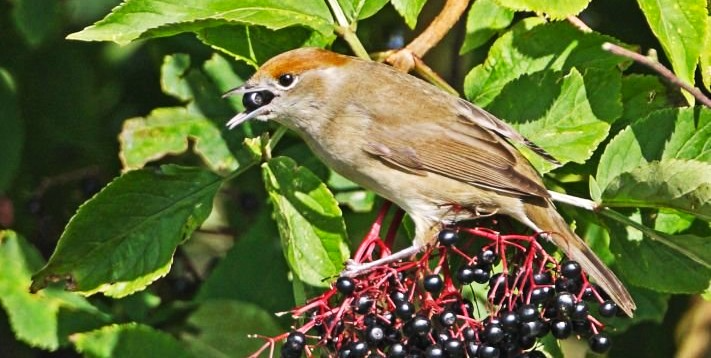
Furtive though they are when taking berries of any type, sometimes as many as four Blackcaps could be seen feeding together in that elderberry bush, though none would take more than three or four berries before flying into cover.
While stocks lasted, the ‘berry-fest’ would last for six or seven weeks into early October, It would also draw the occasional Lesser and Common Whitethroat and Garden Warbler as well as many traditional garden birds from Blue Tits and Blackbirds to Woodpigeons and even a Nuthatch.
The Blue Tits were ‘seed predators’. Clutching each berry in their feet, they’d peck away the flesh and then eat the seed inside. By contrast, I once watched a Woodpigeon gobble down some 200 berries in the space of ten minutes – ‘fast food’ for sure!
But how might it be possible to attract a wintering Blackcap given that we live where temperatures in winter are lower than in those urban gardens to which most gravitate?
Knowing that Blackcaps, along with Mistle Thrushes, are effectively the only species able to deal with those super-sticky mistletoe berries, it occurred to me to import a big bunch of berried mistletoe each winter and hang it up in view of the kitchen window hoping that one or other species might find it.
Mistletoe is a relatively rare plant in Derbyshire with most found growing on back garden apple trees where someone had set seeds from their festive sprigs. Fortunately, I was knew a suburban garden a few miles away where an apple tree was laden with big bunches of mistletoe and where the house owner was only too happy for me to cut one or more off.
For the first few years, the berries remained un-eaten but in early January 2003, a female Blackcap suddenly appeared. She ignored the bird feeders and instead focused her attentions on the mistletoe berries and also on halved apples which I attached to a bird table nearby, commuting between these two food sources.
This bird stayed in the garden until mid-March that year and as the winter progressed, I had to beg several more bunches from my mistletoe provider as each bunch was stripped clean.
Mistle Thrushes eat the whole white berry and at some time later, the sticky seeds are excreted, very occasionally adhering to a branch, often near the tops of tall trees where these thrushes often perch.
A Mistle Thrush appeared once in the garden but only took a few berries that had fallen to the ground below.
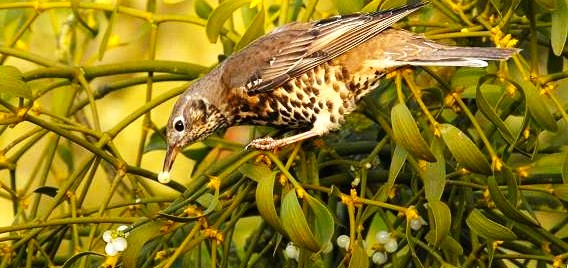
By contrast, Blackcaps have a very different way of tackling the berries as demonstrated by our garden female. She would pluck one off, carry it to a nearby bush and rub it against a twig, deftly separating the outer pulp, which she ate, from the sticky green seed inside which usually remained glued to the twig.
It was a delight to watch her feeding in this way virtually daily for six or seven weeks and without even having to go outside.
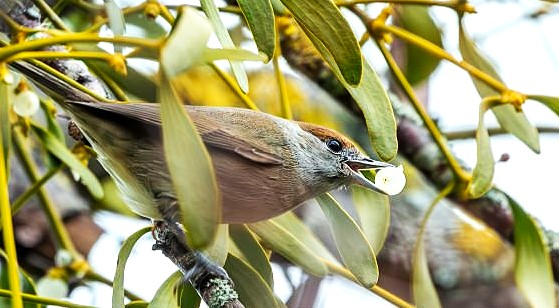
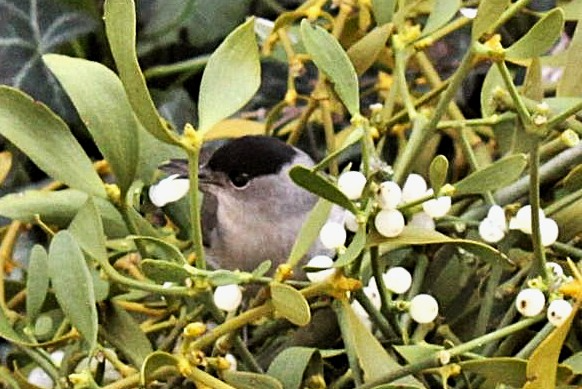
Unlike most wintering Blackcaps, she was never seen to take either seeds or fat from the feeders close by, defying the literature which says they feed on fat, seeds and peanuts as well as on any apples put out for them.
Some four years later I noticed a small bright green growth on a large Cotoneaster bush a few metres from where I had hung the mistletoe. It was clearly a tiny mistletoe plant which, over the ensuing years, gradually grew into a large bunch.
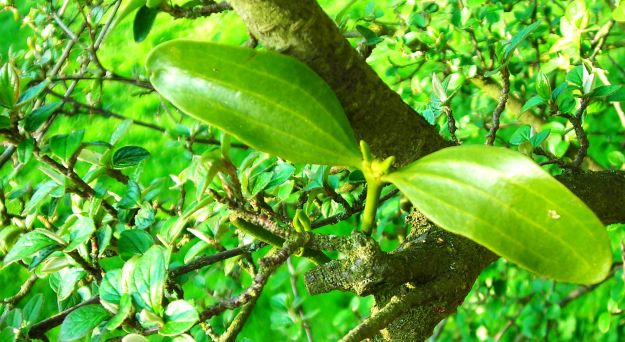
For its first ten years it bore no berries and I wrongly assumed it was a male – the tiny male and female ‘flowers’ are very similar:
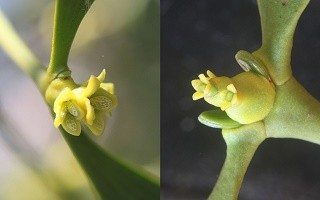
But then, one winter, a few berries appeared, proving the bunch to be female.
Now this plant is half a metre in diameter and this autumn has about a hundred berries. I assume the flowers were fertilised by pollen from male mistletoes which I had ‘set’ on a neighbour’s old apple tree nearby.
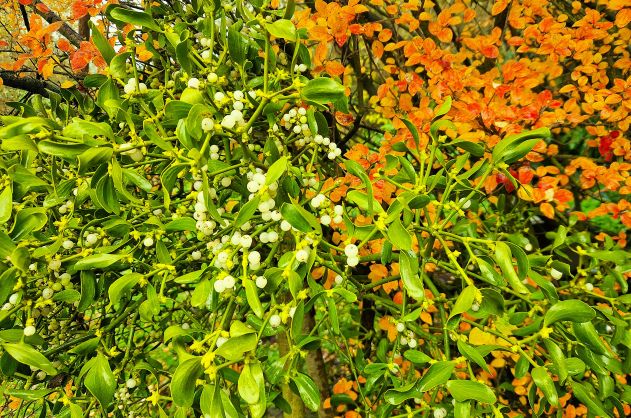
How good would it be if another Blackcap was to appear this winter and start feeding on those home-grown berries to complete this fascinating cycle?
We’ll be watching and waiting in hope.
>>>>>>>>>>>>>>>
Find out more about the intriguing natural history, its mythology and also how to grow it: https://mistletoe.org.uk/mp/ and Mistletoe Matters .
And discover more about wintering Blackcaps here: Garden Blackcap Studies | BTO and here: blackcaps_bto_news_341.pdf .
That’s a lovely story.
I live in a Somerset village with several mature and post-mature apple orchards. Most of the trees have multiple mistletoe plants and wintering blackcaps are common. There are a few apple trees with so much mistletoe that it seems the blackcaps may be able to sustain themselves over the winter without ever leaving the tree. The larger trees (ash and poplar) which bound the orchards often have upwards of twenty mistletoe plants but these seem to be commandeered by mistle thrushes.
I don’t know if the summer breeding blackcaps are from the same population as the wintering birds but I do know that having blackcaps year-round is a joy.
And just as an update, a female blackcap turned up on 11th January and began eating the halved apples I had installed just above the bunch in an attempt to attract any blackcap that happened to be passing through the garden.
After eating the apple for awhile, she finally dropped down into the bunch, picked off a berry and moved a metre away where she brushed it against a branch, separating the pith, which she ate, from the seed which remained glued to the branch.
It was great to see the whole cycle completed, a new bird taking advantage of the mistletoe another blackcap had set more than 20 years ago!
Nick
Thanks for that Alick.
By comparison with the Somerset and the West Midland/Welsh Border counties, mistletoe is a rare plant up here in Derbyshire, especially growing ‘in the wild’ as opposed to having been set on back garden apple trees.
It seems our UK summer breeding blackcaps all migrate south, mainly down to the Med, whereas the wintering birds emanate from Europe, travelling west (or even north) from various parts of Europe where they nest to spend the winter with us in the UK.
The BTO’s work on the diet of wintering blackcaps focuses on fat and seed feeders (and apples) but doesn’t even mention mistletoe berries, presumably because none of its ‘garden birdwatchers’ have mistletoe visible from their houses?
Nor can I find reference to anyone studying post-harvest orchards to see the extent to which blackcaps and/or mistle thrushes are taking mistletoe berries in winter, let alone spending the whole period living exclusively on a ‘white berry’ diet.
Hello Nick, what a lovely surprise to find you writing in Mark Avery’s guest blog. This is Sue Hetherington from Buckinghamshire. I don’t have any input about blackcaps and mistletoe but I have news about urban peregrines in Bucks which may be of interest. Counting Milton Keynes as Bucks (which it is, as “historic Bucks”) we now have 5 urban pairs in the county – Aylesbury, Milton Keynes (in the MK Dons football stadium of all places!) High Wycombe, Marlow and Olney. High Wycombe is bitter sweet – you may recall my brother John lived there and his dream would be to have nesting peregrines in his home town. I told him that was a pipe dream, you might as well hope for nesting unicorns – but I was wrong, they are there. Oh how I wish John could have seen them. Hope all is well with you!